
Laundry Storage Ideas: How to Organise a Cluttered Laundry

A laundry can have plenty of cupboards and still feel cluttered. Detergent sits on the bench, baskets end up on the floor, and the ironing board gets shifted from one spot to another.
I’ve seen the same thing in my own renovations. Adding more cabinetry does not automatically improve laundry organisation if everything inside it has no proper place. Some of the most useful laundry storage ideas start with working out what you actually need to store, then making the space you already have work harder.
In this guide, I’ll show you how to group laundry and cleaning products, decide what needs to stay within easy reach, and deal with baskets, linen and bulky cleaning gear. We’ll also look at keeping your benchtop usable and working out whether you need more storage at all.
The best place to start is with what is already taking up space in your laundry.
Start by Working Out What Actually Belongs in Your Laundry
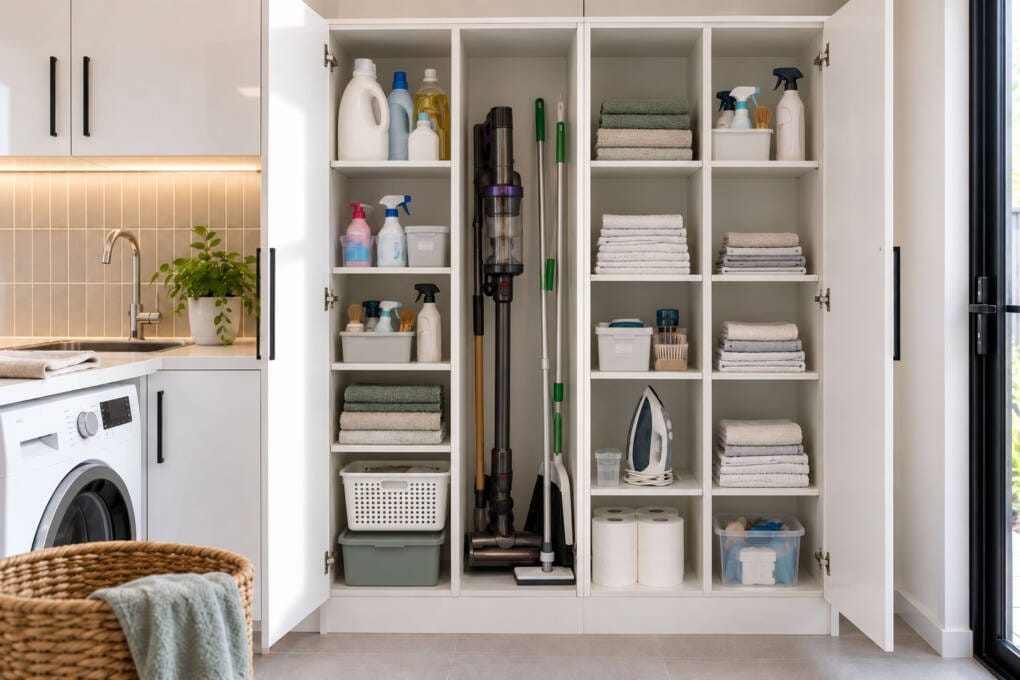
Before you add another cupboard or buy more organisers, work out what actually needs to live in the laundry.
I’ve found this is where a lot of clutter starts. The room slowly becomes a catch-all for anything without a proper home, so full cupboards do not always mean you need more storage.
Start by taking stock of what you actually use in the room. Most laundries need space for a few clear groups:
- laundry detergents and stain removers
- towels and linen
- ironing equipment
- brooms, mops and other cleaning gear
- baskets for dirty and clean washing
- bulk supplies and seasonal items
Anything outside those groups deserves a second look. If it belongs elsewhere in the house, moving it can free up useful space without changing the cabinetry at all.
This is a simple but important part of laundry organisation ideas. If you want to declutter your laundry room properly, you need to know what the room is being asked to store before you decide where everything should go.
Once you have that list, the next step is working out which items need to stay close at hand and which can be stored further away.
Laundry Storage Ideas That Work by Task and Frequency of Use
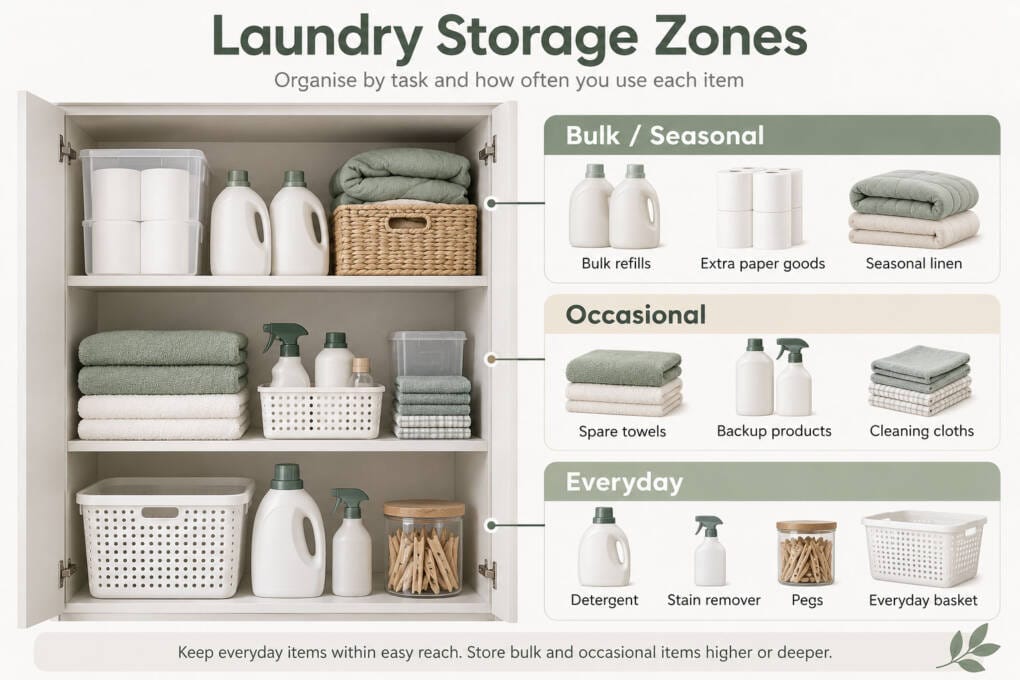
The most practical laundry storage ideas start with two questions: what is the item used for, and how often do you need it?
If something is used every day, it should be easy to reach. If it is only used occasionally, it can sit higher up or deeper inside a cupboard. That simple rule makes laundry organisation much easier to maintain.
How Do You Organise a Laundry Room?
- Remove items that do not belong in the laundry.
- Group what remains by task.
- Keep everyday items within easy reach.
- Store bulk and occasional items higher or deeper.
- Give baskets and bulky equipment a dedicated home.
- Keep the benchtop clear for sorting and folding.
Everyday-Use Storage
Everyday products should be the easiest things to access. That usually includes your regular detergent, stain remover and the basket you use most often.
Avoid hiding frequently used items behind bulk supplies or stacking them at the back of a deep cupboard. If you have to move three things to reach one bottle, the storage system will quickly become frustrating.
Occasional and Bulk Storage
Backup detergent, spare towels and seasonal items can sit in less convenient spaces because you do not need them as often.
This is where higher shelves or deeper storage can work well. The aim is to keep prime storage zones for the things you reach for most.
Once you organise your laundry room by task and frequency, it becomes much easier to see where each category should live.
Give Detergents and Cleaning Products a Safe, Easy-to-Reach Home
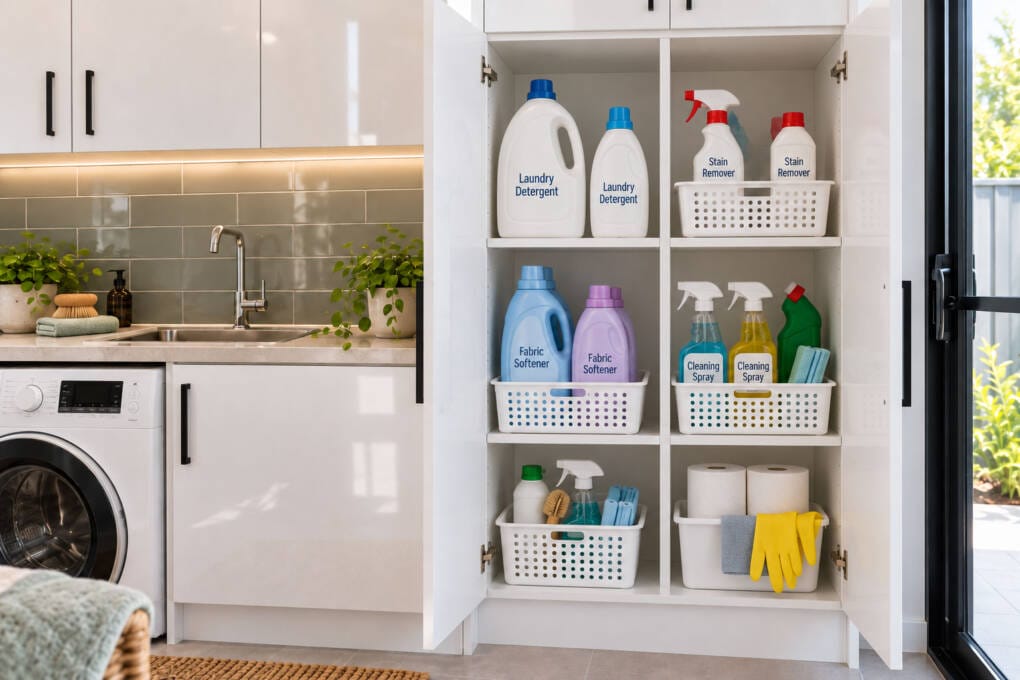
Detergents and household cleaning products are some of the easiest things to lose control of in a laundry. A good storage setup keeps the products you use most within easy reach without leaving bottles scattered across the benchtop.
For better laundry cupboard organisation, I like to group products by what they actually do. Keep everyday washing detergent and stain removers together. If you use fabric softener, give that a place in the same zone. Household cleaning products can sit together in a separate group so you are not searching through unrelated bottles each time you need something.
For safe storage, the HealthyWA household chemical storage guidance recommends keeping household chemicals in their original containers, with lids tightly sealed, and in a secure location away from children. It also advises against putting chemicals in unlabelled containers or containers normally used for food or drink.
That is why I would organise the containers rather than decant the products themselves. A basket or defined cupboard zone can keep similar bottles together while leaving the original labels visible.
This also makes organising laundry cupboards much easier over time. You can quickly see what you already have, what is running low and whether a leaking or damaged container needs attention.
Once your bottles and cleaning products have a proper home, the next big source of laundry clutter is usually the larger stuff: baskets, linen and bulk supplies.
Create Proper Storage for Baskets, Linen and Bulk Supplies
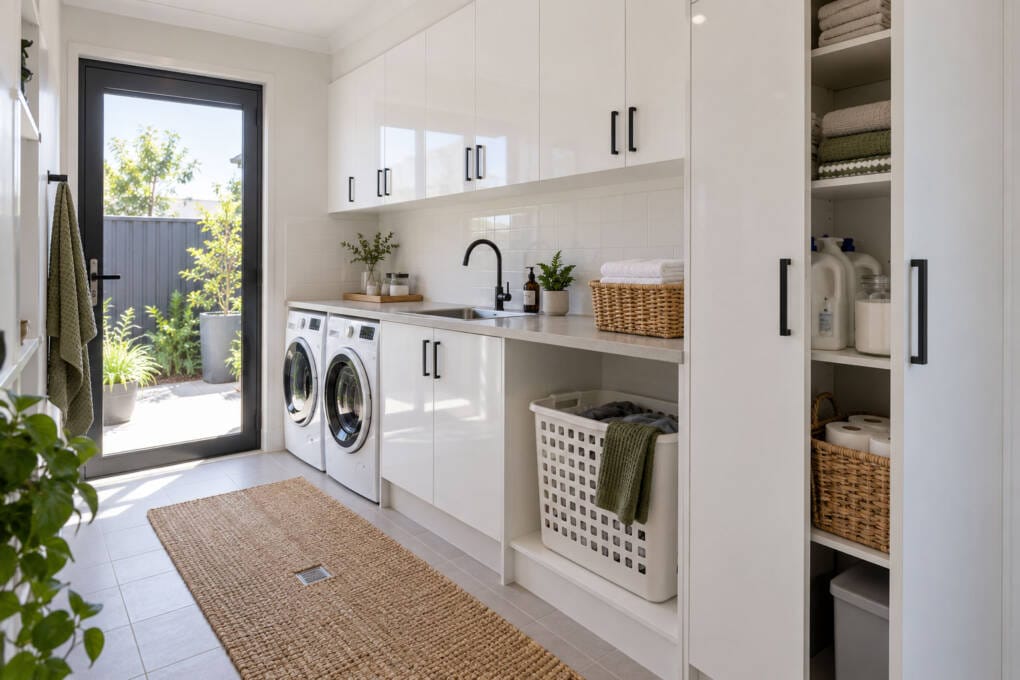
Baskets, towels and spare supplies take up more room than bottles, so they need a different storage approach.
One of the simplest laundry cupboard storage ideas is to give each group a defined home instead of letting everything compete for the same shelf or floor space.
Give Laundry Baskets a Defined Home
Laundry baskets usually create clutter because they move around the room. One might hold dirty washing, another clean clothes waiting to be folded, and a third can end up wherever there is room.
Give each basket a clear job and a regular place to sit. The right setup depends on how your household sorts washing, but the main goal is to stop baskets becoming permanent floor clutter.
Separate Everyday Linen from Bulk and Seasonal Items
If you store towels or linen in the laundry, keep the items you use regularly within easy reach. Spare towels, bulky linen and seasonal items can go higher up or further back because you do not need them every day.
Good laundry cabinet storage ideas are less about fitting more in and more about keeping the right things accessible.
Keep Bulk Refills Together
Store spare detergent and other refill products together so you can quickly see what you already have. Keeping bulk supplies in one zone also helps stop everyday cupboards filling up with backup stock.
Once baskets, linen and bulk supplies have their own places, the next challenge is usually the awkward gear that does not fit neatly on a shelf.
Find a Dedicated Home for Bulky Cleaning and Ironing Gear
Some laundry clutter is easy to organise into baskets or shelves. Bulky cleaning gear is different. An ironing board, broom, mop or vacuum can still make the room feel untidy even when every bottle and towel has a proper place.
I’ve found these awkward items often reveal whether a laundry has a genuine storage gap. Once the smaller products are sorted, it becomes obvious which larger items still have nowhere practical to go.
Start by grouping bulky cleaning and ironing gear together. Keep the iron with the ironing board rather than storing them in separate parts of the room. Brooms and mops also work better with a dedicated spot instead of leaning against a wall or being moved every time you need access to something behind them.
The same applies to a stick vacuum or similar cleaning equipment. The goal is not to squeeze everything into the nearest cupboard. It is to give each bulky item a home that is easy enough to use that you will actually put it back.
If your existing cabinetry cannot accommodate these items, our guide to types of laundry cabinets explains the main cabinet configurations and what each suits. Alternatively, if long-handled cleaning equipment is the main problem, our guide to broom cupboard planning goes into that storage decision in more detail.
Once the bulky gear is sorted, you can start using higher storage for the things you do not need every day.
Use Vertical Storage for the Things You Do Not Need Every Day

Vertical storage works best when you use it for the things you do not need constantly. Some of the most practical laundry storage ideas simply move lower-priority items out of the easiest-to-reach spaces.
Spare towels, backup detergent, seasonal items and rarely used laundry accessories are all good candidates for higher storage. These items still need a home, but they do not need to compete with everyday products for the most convenient shelf or cupboard space.
The same rule works in reverse. I would not put your regular detergent, stain remover or anything heavy and awkward in a spot that is difficult to reach. Everyday storage should be easy to access without stretching, shifting other items or climbing up to get to it.
Think of vertical storage as a way to create a simple order of priority. Keep the things you use most often in the easiest positions, then move occasional and seasonal items higher up.
If you are deciding where overhead cupboards or tall cabinetry should physically sit, our guide to laundry cupboard ideas and layouts covers that side of the planning in more detail.
Once the storage height matches how often you use each item, the next decision is whether those items should stay visible or be kept behind closed doors.
Decide What Should Stay Visible and What Should Be Behind Doors
Good laundry organisation is partly about deciding what you actually need to see. Some items are easier to use when they stay visible, while others just make the room feel cluttered.
The goal is not to hide everything. It is to match the storage style to how often you use the item.
Open Storage for Genuine Frequent Use
Open shelving works well for frequently used items that are easy to keep tidy. Baskets, folded towels or a few everyday supplies can suit open storage because you can grab them quickly.
The downside is that open shelving puts everything on display. If too much ends up there, it starts to look messy even when the items are technically organised.
Closed Cupboards for Bulk and Visual Clutter
Closed cupboards are better for backup products, bulky supplies and anything you do not need to see every day.
If you are trying to organise a laundry cupboard, keep similar items together rather than filling every shelf with a mix of unrelated products. That makes it much easier to find what you need without pulling half the cupboard apart.
Drawers and Deep Cupboards Need Internal Grouping
Drawers can work well for smaller everyday items because you can see what is inside more easily.
Deep cupboards need a little more thought. Loose bottles and baskets can disappear behind each other, so grouping similar items together helps stop the back of the cupboard becoming forgotten storage.
Once you decide what should stay visible and what should stay behind doors, it becomes much easier to keep the benchtop clear as well.
Keep Your Laundry Benchtop Clear Enough to Work
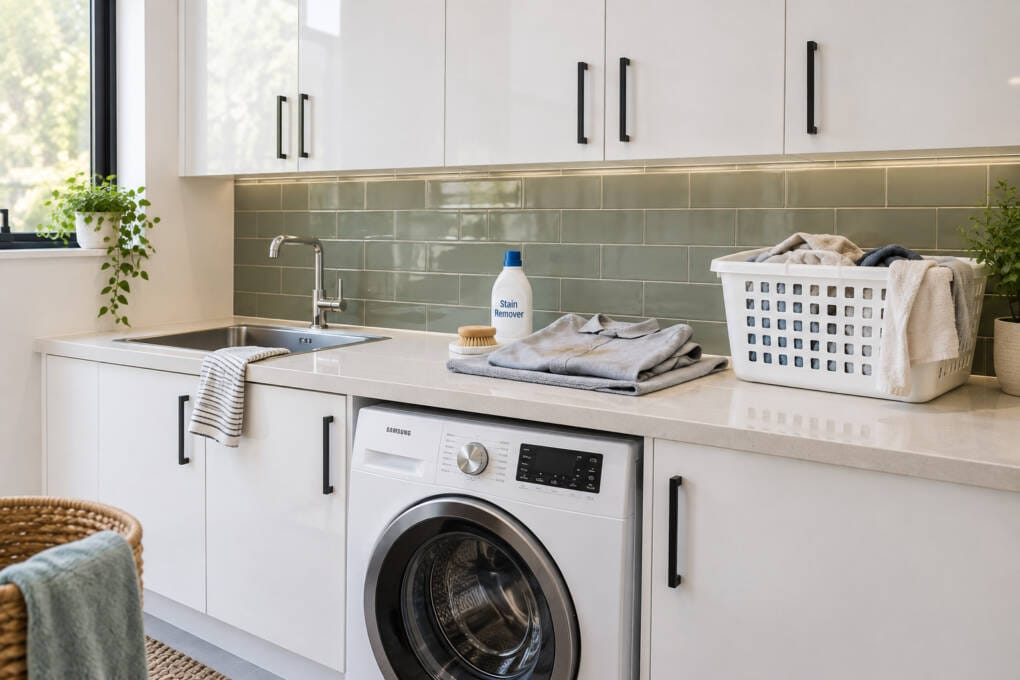
A laundry benchtop should be useful working space, not permanent storage.
It needs room for sorting washing, treating stains, folding clothes and handling the odd laundry job without first clearing everything out of the way. Once bottles, baskets and random household items start living there full-time, that working space disappears.
If the same items keep ending up on the bench, there is usually a reason. They either have no proper home, their assigned storage is too hard to access, or the cupboard they belong in is already overfilled.
That is why a clear benchtop is a good test of your laundry organisation. Instead of repeatedly tidying the surface, fix the storage problem that keeps putting those items back there.
I like to think of the benchtop as a short-term work zone. Items can sit there while you sort, fold or treat stains, but they should have somewhere else to go once the task is finished.
If your benchtop keeps becoming overflow storage even after the rest of the laundry is organised, that is usually the point where you need to work out whether the room needs more storage at all.
Frequently Asked Questions About Laundry Storage and Organisation
Once these everyday storage questions are sorted, the final step is deciding whether your laundry actually needs more cabinetry or simply a better storage system.
Do You Need More Storage or a Better Storage System?
Good laundry storage ideas should help you work out whether you actually need more cabinetry or whether the space you already have just needs better organisation.
Start with the basics. Remove what does not belong, group similar items together, keep everyday products within easy reach and give baskets and bulky cleaning gear a proper home. Then keep the benchtop clear enough to use.
I’ve found this approach useful in my own renovation planning. Sometimes, once everything is sorted properly, the existing cupboards are more than adequate. Other times, one well-chosen extra cabinet solves the problem far better than filling every available wall with storage.
That is the point of good laundry organisation. If everything fits once it has a proper place, your storage system was the issue. If essential items still have nowhere practical to go, you have identified a real storage gap.
If that is where you end up, you can compare our laundry cabinets online or visit our Guildford showroom to see our pre-assembled cabinetry in person.
