
Bathroom Renovations Perth: Your Complete 2026 Guide
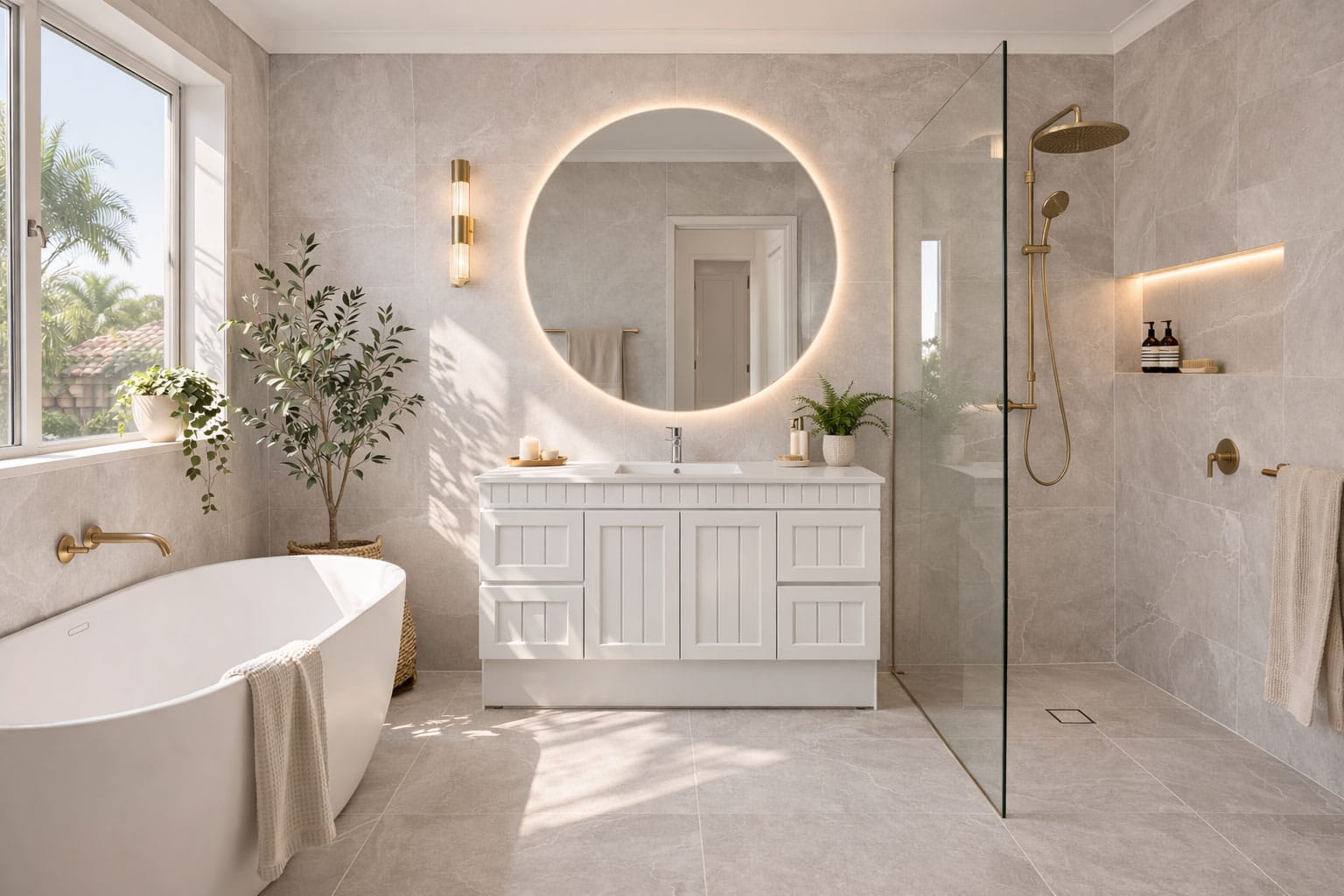
Planning a bathroom renovation in Perth in 2026 looks a little different to what it did even two or three years ago. Costs have shifted, the trades landscape has tightened, and what Perth homeowners want from their bathrooms has changed significantly. Perth bathroom renovations are no longer just about replacing tired tiles and dated fixtures. People are thinking harder about materials, layout, and long-term value.
I’ve been involved in bathroom renovations, both personally and through the store, for a long time. What I see more often than anything else is homeowners who are enthusiastic but underprepared. They underestimate costs, overlook critical steps like waterproofing, or make material choices before locking in a layout. It causes entirely avoidable headaches.
This bathroom renovation guide covers everything you need to know before you start, from early planning and WA permit requirements to materials suited to Perth’s conditions, current design trends, and the mistakes that blow out timelines and budgets. Whether you’re planning a full renovation or trying to figure out where to start, this is the starting point.
Setting Your Bathroom Renovation Budget
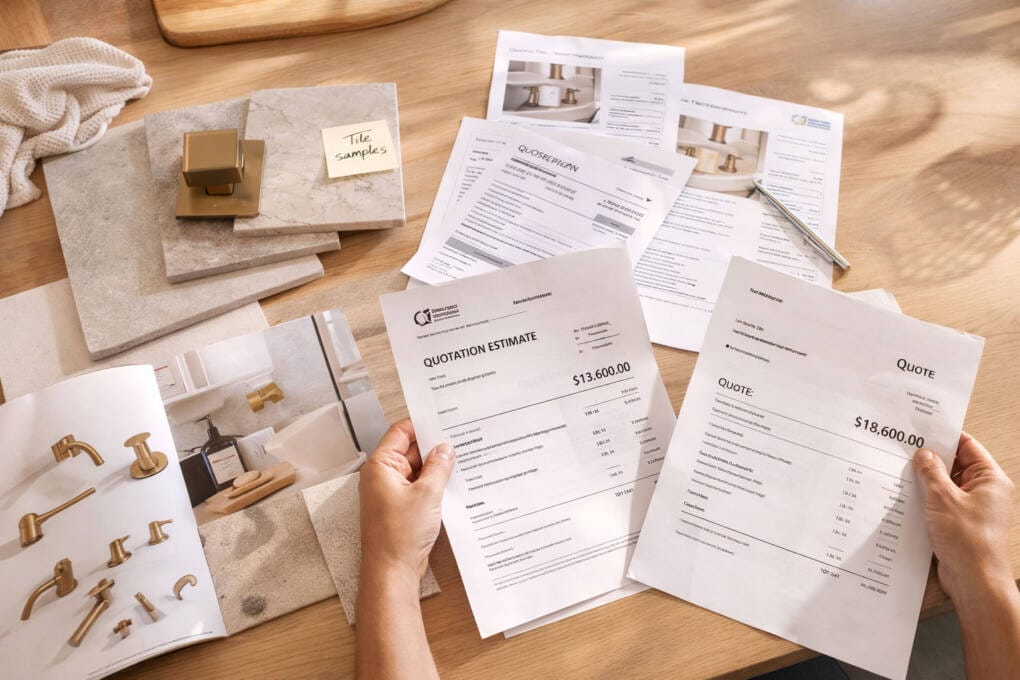
Bathroom renovation costs in Perth vary with the room size, scope, product choices and whether you change the existing layout. Published benchmarks also differ, with hipages reporting a Perth average of about $15,667 and the HIA reporting a WA average of around $26,000. Use these figures as broad planning guides rather than fixed quotes.
Moving plumbing is usually one of the fastest ways to increase the budget. Price your fixtures and trades separately, allow a contingency and compare the scope included in each quote. For current price ranges by fixture and trade, see our bathroom renovation cost breakdown for Perth.
Do You Need a Permit for a Bathroom Renovation in Perth?
The short answer is: it depends on what you’re doing. For most straightforward bathroom renovations in Perth, you won’t need council approval. Replacing like-for-like fixtures — a new toilet where the old one sat, a new vanity in the same position, retiling, generally doesn’t trigger a building permit requirement. The moment you start moving walls, relocating plumbing, or making structural changes, that changes.
Here’s what you need to know specifically for WA.
Plumbing and Electrical Licencing
All plumbing work in Western Australia must be carried out by a licensed plumber registered with Building and Energy (DMIRS). This applies regardless of the size of the job, there’s no DIY exemption for plumbing in WA. The same applies to electrical work. A licensed electrician is required for any new circuits, power points, lighting, or exhaust fans. Always ask for your tradie’s licence number before signing anything, and verify it on the DMIRS register.
Registered Builder and Home Indemnity Insurance
If your bathroom renovation cost comes in above $20,000, WA law requires the work to be carried out by a registered builder. Home indemnity insurance also becomes compulsory at this threshold, with minimum cover of $100,000 and a validity period of six years from project completion. If you’re project managing your own renovation and engaging trades directly, this is worth understanding before you start getting quotes. The structure of your contracts may need to reflect it.
Water Corporation Plumbing Permits
If your renovation involves any modifications to drainage, such as relocating a floor waste, shifting a toilet, or changing waste pipe runs, your plumber may need to obtain a plumbing permit from the Water Corporation before work begins. This isn’t something to sort out mid-renovation. Confirm with your plumber at the quoting stage whether a permit is required and make sure it’s included in their scope of works.
When a Building Permit Is Required
A bathroom renovation permit in Perth is required when work involves structural changes such as removing or relocating walls, changing window or door openings, or any work that affects the building’s structure. If you’re unsure whether your planned renovation crosses that line, the City of Perth building permits page is a good starting point, though your local council may have slightly different requirements depending on where in Perth you’re located. When in doubt, ask your builder or contact your local council directly before work begins. Council approval for a bathroom renovation in WA is far easier to obtain before you start than to deal with after the fact.
Planning Your Bathroom Renovation
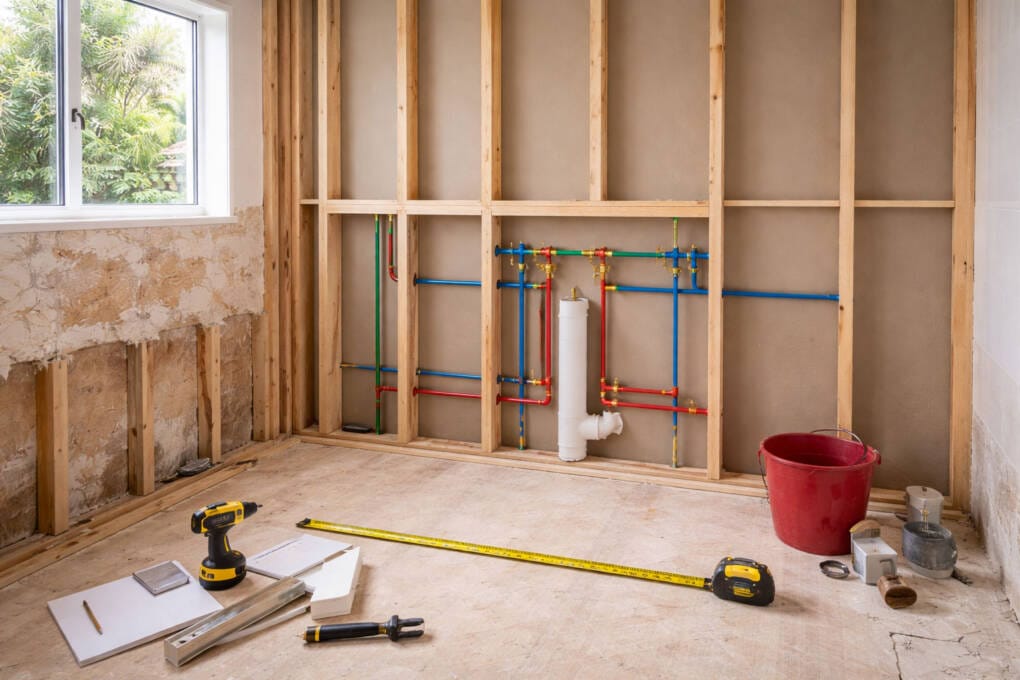
Planning a bathroom renovation properly is what separates a smooth project from a stressful one. Most of the problems I see, budget blowouts, delays, fixtures that don’t fit, trades waiting on each other, come down to decisions that weren’t made early enough. Get the planning right, and everything else follows.
Bathroom renovation planning in Perth has some specific considerations that don’t apply everywhere else in Australia. Trades availability is tighter than on the East Coast, many older Perth homes have asbestos to deal with, and Perth’s hard water affects fixture selection. All of that needs to factor into your planning before you start getting quotes.
Start With Your Layout
Your layout is the single decision that flows through every other part of the project. The position of your toilet, shower, and vanity is largely dictated by where your existing plumbing rough-ins are. Keeping fixtures in the same location is the most effective cost control available to you. It’s not just about the plumber’s hourly rate. Relocating a drain on a concrete slab means cutting the slab, repositioning the waste pipe, and re-screeding before anyone can even think about waterproofing or tiling. It adds time, cost, and complexity to every trade that follows.
I’ve seen two bathrooms of identical size come in at completely different prices simply because one homeowner wanted to shift the toilet 600mm to the left. That one decision added over $3,000 to the job once the plumber factored in cutting the slab, relocating the drain and re-screeding. It wasn’t worth it.
That said, sometimes a layout change is genuinely worth it. If your current layout is awkward or the bathroom simply doesn’t function well, the long-term benefit can outweigh the upfront cost. Just go in with a clear understanding of what it will add to your budget.
Measure Accurately
Before you order a single fixture, measure your bathroom properly. Not just the floor area. Measure wall-to-wall at fixture height, account for wall thicknesses if you’re moving anything, and check door swing clearances. Minimum clearances around toilets, vanities, and shower entries are set by the National Construction Code. Confirm these with your plumber or building surveyor before ordering anything.
I’ve seen homeowners fall in love with a freestanding bath only to discover it doesn’t leave enough clearance around the tap wall once it’s in position. Measure twice, order once.
Plan Storage Before You Plan Style
Storage is the thing most people underplan. Recessed shower niches, vanity drawers, and towel storage all need to be resolved before waterproofing begins, not after. A niche in a shower wall needs to be framed and waterproofed as part of the wet area, so settle the shower niche size and placement height at the same time you settle the layout. You can’t add one after the tiles are down without tearing them out again.
Think through where everything will live: toiletries, towels, toilet paper, and cleaning products. A bathroom that looks beautiful but has nowhere to put anything will frustrate you every single day.
Consider Ventilation and Natural Light
Perth’s climate is generally kind to bathrooms. Long dry summers mean moisture clears quickly if ventilation is adequate. But a poorly ventilated bathroom in Perth still grows mould. An exhaust fan sized correctly for your bathroom’s volume is non-negotiable. If you can incorporate a window or skylight into the design, do it. Natural light makes any bathroom feel larger and reduces reliance on artificial lighting during the day.
If you’re adding or relocating an exhaust fan, that’s an electrical rough-in that needs to be planned before tiling begins.
Understand the Order of Trades
One of the most common mistakes in bathroom renovation planning is not understanding why the sequence of trades matters. A bathroom renovation checklist is about more than choosing tiles and tapware. It’s about understanding the scope of works as a sequence. The order goes: demolition, plumbing rough-in, electrical rough-in, waterproofing, screeding, tiling, fixture installation, and fit-off. Each trade depends on the one before it being complete and signed off. If your electrician can’t get on-site because waterproofing hasn’t been inspected, your whole timeline slips.
For more details on what to consider before you begin, read 10 Things You Need to Know Before Embarking on a Bathroom Renovation. If you’re managing the renovation yourself, How to Coordinate a Bathroom Renovation covers the logistics in detail. And if you’re going the DIY route, A DIY Guide to Planning a Bathroom Renovation is a good place to start.
Small Bathroom Renovations in Perth
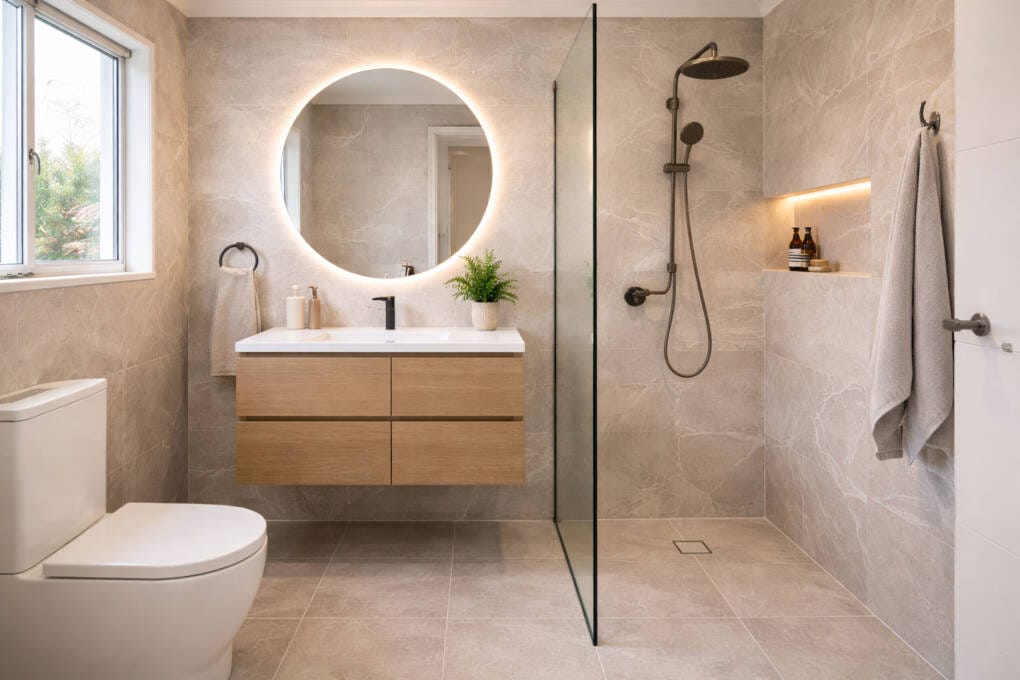
Perth homes vary significantly in bathroom size. A generous master ensuite in a newer Baldivis or Ellenbrook home is a very different project from a standard 2x3m bathroom in a 1980s Dianella brick-and-tile. Small bathroom renovations in Perth come with real constraints, but with the right decisions, they can deliver results that punch well above their size.
One thing I always make clear to customers: a small bathroom doesn’t automatically mean a small renovation bill. Fixed trade costs, such as the plumber’s call-out, the waterproofer’s minimum charge, and the tiler’s setup time, don’t reduce because your bathroom is smaller. Compact bathroom renovation ideas need to be smart from the start, not just aesthetically but financially.
Layout Decisions for Small Bathrooms
In a compact space, every layout decision has a visual and functional consequence. The biggest call is usually a shower versus a bath/shower combo. A walk-in shower without a bath opens up the floor plan significantly and suits most Perth households well, particularly as a second or ensuite bathroom. If a bath is important to you but space is tight, a shower-bath combo is the practical solution rather than a compromise.
Wall-hung vanities are one of the most effective space-saving moves in a small bathroom renovation. Lifting the vanity off the floor exposes more of the floor surface, which makes the room feel larger instantly. Pair that with recessed storage niches in the shower rather than freestanding shelving, and you keep the visual space clean without sacrificing storage.
Ensuite Renovations in Perth
An ensuite renovation in Perth is typically a more focused scope than a main bathroom. The floor area is usually smaller and the room is often designed around one or two users. However, the same core trades are still required, so a compact ensuite needs just as much planning as a larger bathroom.
The focus in an ensuite renovation should be quality over size. A well-specified shower, a considered vanity, and tapware that suits Perth’s hard water conditions will serve you far better than squeezing in features the space can’t comfortably accommodate.
Powder Room Renovations
A powder room renovation is the most limited in scope but can be one of the most impactful. No shower, no bath. The vanity, toilet, tapware, and mirror do all the work. Because the scope is tight, there’s room to invest in better quality fixtures without blowing the budget. A well-chosen basin, a quality mixer, and a considered mirror can make a powder room feel genuinely impressive for a relatively modest spend.
For inspiration and practical advice, see Small Bathroom Renovations Perth and Smart Tips for Small Bathroom Renovations.
Waterproofing — The Most Important Part of Any Perth Bathroom Renovation
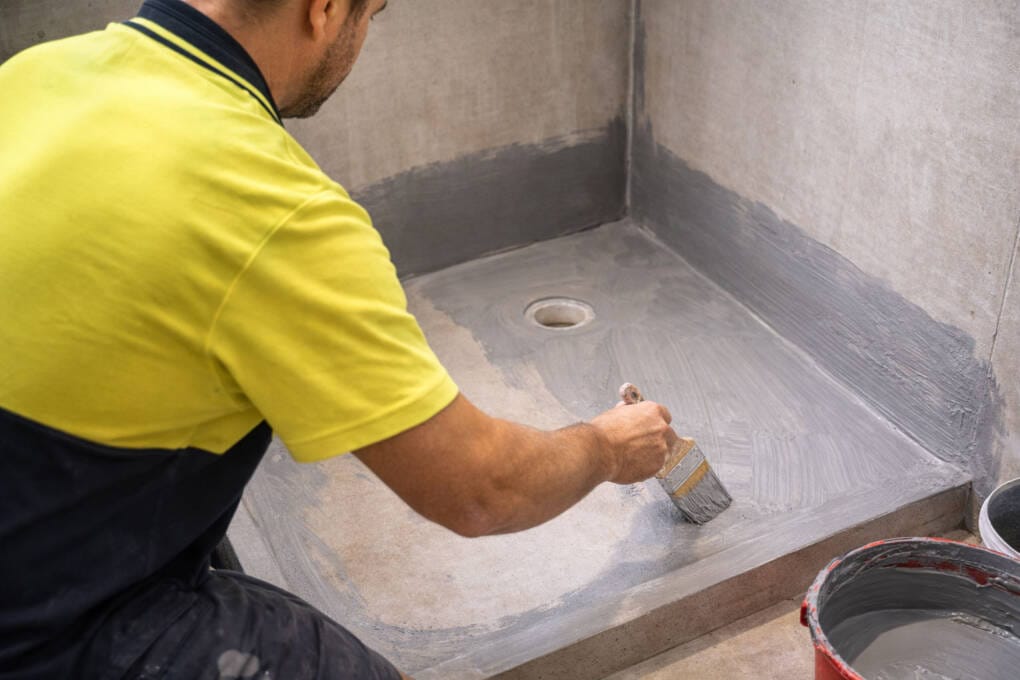
If there is one part of your bathroom renovation where you cannot afford to cut corners, it is waterproofing. I have seen beautiful bathrooms that looked perfect on completion start showing water damage within two years because the waterproofing was done poorly or, in some cases, not done properly at all. Rectifying a waterproofing failure means pulling out tiles, membranes, and sometimes structural materials. The repair bill is always far higher than what was saved by rushing or skimping on this phase.
Bathroom waterproofing in Perth is not optional, and it is not a DIY job. It is a licensed trade in Western Australia, which means only a licensed waterproofer can carry out and certify this work.
What AS 3740 Requires
All domestic wet area waterproofing in Australia must comply with AS 3740, the Australian Standard for waterproofing of domestic wet areas. For your Perth bathroom renovation, wet area waterproofing requirements under AS 3740 include:
- The entire floor of the shower recess
- Shower walls to a minimum of 150mm above the shower floor
- Shower walls to 1800mm where the showerhead is attached
- All junctions between the bath, walls, and floors
- Around all penetrations, including floor wastes, pipes, and fixings
Each of these areas requires a correctly applied waterproofing membrane with adequate curing time before tiling begins. Rushing this phase is where most waterproofing failures start.
Get a Compliance Certificate
Always request a waterproofing compliance certificate from your contractor on completion of this phase. This is your written confirmation that the work meets AS 3740 requirements. It protects you if issues arise later and is something any reputable waterproofer will provide without hesitation. If a contractor is reluctant to provide one, that tells you something important.
Floor Wastes and Floor Grading
This is an area that trips up a lot of Perth renovators. In Perth’s predominantly Class 1 freestanding homes, a floor waste outside the shower recess is not mandatory under the National Construction Code. Most Perth bathrooms on a concrete slab are Class 1 buildings, so there is no legal requirement to install one beyond the shower area.
However, where a floor waste is installed, the floor must be graded toward it at a minimum fall of 1:80 and a maximum of 1:50. This grading needs to be coordinated between your plumber and tiler before screeding begins. It cannot be corrected after the screed is laid. If your renovation includes a floor waste, make sure both trades are aware of this requirement before anyone pours anything.
Choosing the Right Materials for a Perth Bathroom
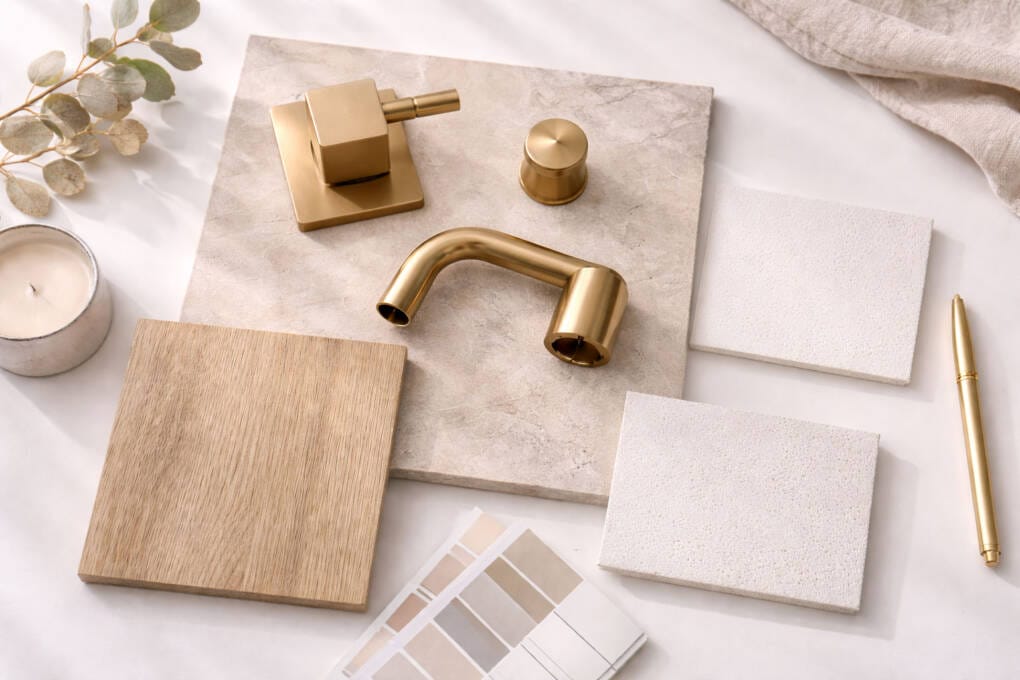
Choosing bathroom renovation materials is where most people spend the bulk of their planning time, and rightly so. But in Perth, material selection goes beyond aesthetics. Hard water, strong UV exposure, and bathroom humidity all affect how materials perform over time. What looks great in a showroom needs to hold up to real Perth conditions for the next 15 to 20 years.
Tiles
The key decision for most renovators is porcelain versus natural stone. Porcelain is denser and less porous, making it significantly more resistant to Perth’s hard water. Scale buildup on polished porcelain wipes off easily. On unsealed travertine or marble, mineral deposits work into the surface and are much harder to remove.
Natural stone suits Perth’s resort-style aesthetic well but requires regular sealing to maintain moisture and stain resistance. If you’re committed to natural stone, factor ongoing maintenance into your decision before committing.
Large-format porcelain tiles are the dominant choice in Perth bathrooms in 2026. Fewer grout lines mean easier cleaning and a more contemporary look. For floor tiles, slip rating is non-negotiable. Specify P4 or P5 for shower floors and wet areas generally.
For more guidance, see Choosing the Right Bathroom Tiles and Creative Bathroom Tile Ideas.
Wall Panels
Waterproof wall panels are a growing alternative to tiles in Perth bathroom renovations. They install faster, eliminate grout maintenance entirely, and handle Perth’s bathroom humidity well. In some situations, they can go directly over existing tiles, reducing demolition costs and speeding up the renovation. They won’t suit every style or budget, but for a practical, low-maintenance finish, they’re worth serious consideration once you’ve weighed up how wet wall panels compare with tiles on cost, maintenance and design. Browse our wet wall panels range to see the colours and finishes available.
Vanities and Basins
Your vanity is the most dominant fixture in most bathrooms. Wall-hung vanities lift off the floor, making the room feel larger and simplifying cleaning. They suit smaller bathrooms and ensuites well. Freestanding vanities offer more storage and suit larger bathrooms where floor space isn’t at a premium.
Construction quality matters more than most people realise. Standard MDF carcasses absorb moisture over time in a heavily used bathroom. A waterproof vanity is worth the premium in Perth’s humid conditions.
For basins, the three main styles are above-counter, undermount, and integrated. Above-counter makes the strongest design statement. Undermount gives a clean bench surface but needs a solid stone or engineered top. Integrated is the most streamlined and easiest to clean. Double vanities are now standard in Perth master ensuites.
Baths
A freestanding bath is the aspirational centrepiece of many Perth bathroom renovations. Before committing, confirm adequate clearance on all sides and that your floor structure can handle the weight when filled. Acrylic is lighter and more affordable. Stone resin retains heat better and feels more premium but is considerably heavier. For a shower-bath combo in a smaller bathroom, a well-chosen acrylic unit delivers the functionality without the weight or cost penalty. For inspiration on building a bathroom around a freestanding bath, see our luxury bathroom renovation guide.
Tapware
Tapware is where Perth’s hard water has the most visible impact. Scale builds up quickly on polished chrome around spouts and showerheads. Brushed finishes, including brushed nickel, brushed gold, and brushed gunmetal, are far more forgiving between cleans.
Specify ceramic disc cartridges rather than rubber washer fittings. Ceramic discs handle Perth’s mineral-rich water significantly better and will outlast rubber washers by years. A WELS 3-star or higher rated showerhead and mixer reduces water consumption without any noticeable pressure drop.
Finish trends for 2026: brushed gold and brushed gunmetal are gaining ground on matte black across Perth bathrooms. Browse our full tapware range online.
Shower Screens
Frameless screens are the premium option and the easiest to keep clean. No frame channels means nowhere for soap scum and mould to accumulate. Semi-frameless offers a middle ground, and our range of shower screens covers both styles. Framed screens are the most economical and still perform well.
Stock screens suit standard openings and cost significantly less than custom. Unless your layout genuinely requires a non-standard solution, stock is the smarter choice. See our guide to stock vs custom shower screens to work out which suits your renovation.
Toilets
The main choice is between a standard close-coupled suite and a wall-hung toilet with an in-wall cistern. Close-coupled suites are simpler to install, easier to service, and more affordable. Wall-hung toilets look cleaner and simplify floor cleaning, but the in-wall cistern must be built into the wall cavity before tiling begins. This is a planning phase decision, not a fit-off decision.
Rough-in measurement is critical. Confirm the distance from the wall to the centre of the waste pipe with your plumber before ordering any toilet suite.
Bathroom Accessories
Accessories are the part of the budget most people underestimate. Towel rails, toilet roll holders, robe hooks, soap dispensers, and shower niches can collectively add $1,500 to $4,000 or more depending on specification. Coordinate all finishes with your tapware before ordering anything.
Several accessories require electrical rough-ins planned before tiling. Heated towel rails, LED mirrors with demister pads, and bidet toilet seats all need dedicated power outlets behind walls or tiles. None can be retrofitted without significant remedial work. Recessed shower niches need to be framed and waterproofed before tiling begins. Lock in position, size, and quantity during the planning phase.
For the full bathroom products range, browse our bathroom section and bathroom tiles, including grout and adhesive.
2026 Bathroom Design Trends in Perth
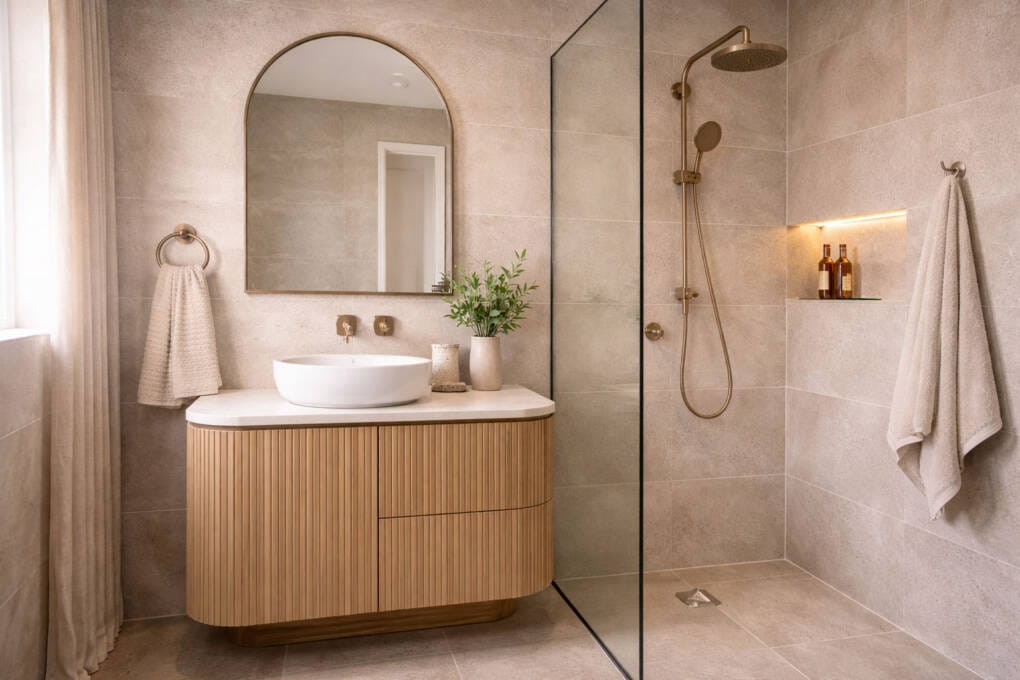
Bathroom design trends in Perth for 2026 are moving clearly in one direction: warmer, more personal, and more considered. The clinical all-white bathroom that dominated Perth renovations through the 2010s is firmly out. Modern bathroom designs in Perth are drawing on the city’s coastal lifestyle and generous spaces, and the results are genuinely impressive.
The most significant shift is away from cold greys and stark whites toward warm neutrals. Sand, greige, soft olive, and terracotta are showing up across Perth renovations from Cottesloe to the northern suburbs. These tones suit Perth’s natural light well. They glow rather than glare, which makes a real difference in a bathroom with a west-facing window on a summer afternoon. Matte and leathered surface finishes are replacing high gloss across tiles, tapware, and cabinetry. Practically speaking, matte finishes show fewer water marks and fingerprints, which matters in a bathroom that gets daily use.
Natural materials are also making a strong showing. Timber vanity accents, stone-look tiles, and textured wall finishes are adding warmth and a resort-style feel that suits Perth’s indoor-outdoor lifestyle well. Perth bathroom renovation ideas in 2026 are less about creating a showroom and more about creating a space that feels like a genuine retreat.
In terms of specific features trending right now:
- Curved and organic shapes are replacing hard rectangular lines, including rounded vanities, arched mirrors, and pill-shaped niches
- Brushed gold and bronze hardware are gaining ground on matte black, pairing better with the earthy palettes trending alongside them
- Underfloor heating and sensor lighting are the smart technology additions worth considering — invisible when done well, and genuinely useful every day
- Double vanities are now the standard expectation in Perth master ensuite renovations
That said, trends should always come second to practicality. A bathroom renovation is a 15 to 20 year investment. Choose a design that suits how you actually live and how your home is oriented, not what’s popular this season. Warm neutrals and natural materials are a strong choice right now partly because they’re trend-adjacent but also genuinely timeless.
For deeper inspiration on bathroom styles and finishes, see Bathroom Design Trends You’ll Want to Follow, Bathroom Tile Trends You’ll Want to Follow, and Popular Bathroom Design Styles to Consider for Your Renovation.
The Bathroom Renovation Process — Step by Step
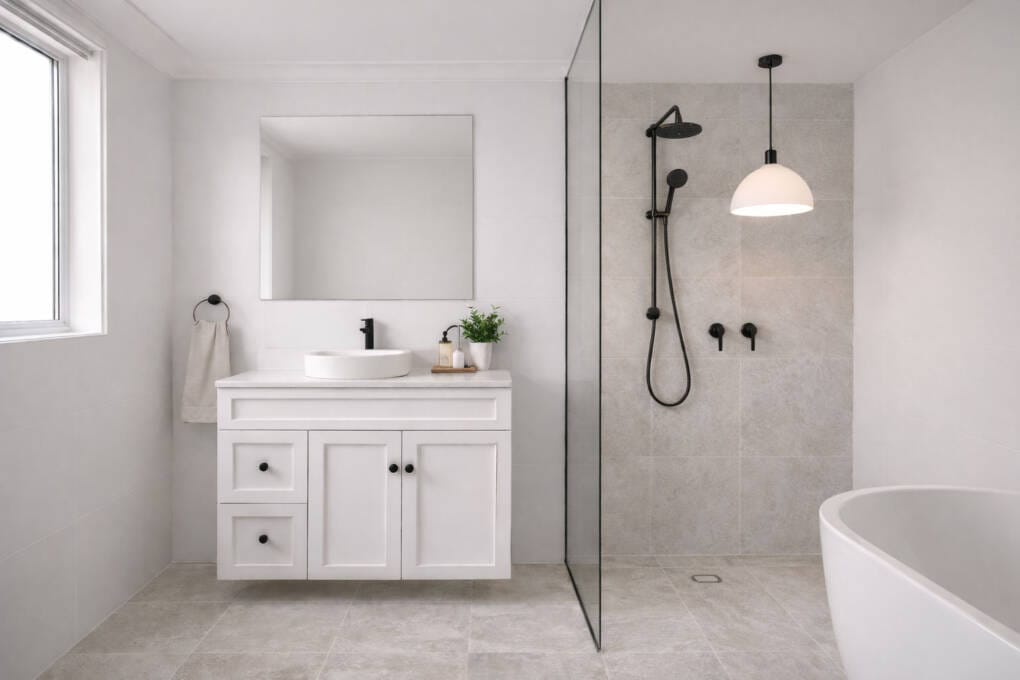
Understanding the bathroom renovation process before you start is just as important as choosing your tiles and fixtures. Each stage depends on the one before it being complete. Skip ahead or overlap trades and you create problems that cost more to fix than the time you saved.
How long does a bathroom renovation take in Perth? For a standard renovation, expect three to six weeks from demolition to handover. That excludes lead times for vanities, custom shower screens, and any special-order items, which can add several weeks before work even begins. Book your trades before you finalise your selections, not after. Perth’s plumber pool is smaller than Sydney or Melbourne, and strong new-build demand across the northern and southern corridors means good tradies book out weeks in advance.
Here is the bathroom renovation process in order.
Stage 1: Planning and Selections
Every fixture, tile, fitting, and finish needs to be selected and either on order or confirmed available before demolition begins. Waiting on a vanity that’s out of stock while your bathroom sits gutted is an expensive and avoidable situation. Confirm lead times on everything before you start.
Stage 2: Demolition
Demolition is one of the few stages Perth homeowners can legally do themselves, and it can save meaningful labour cost. Strip out the old tiles, fixtures, vanity, and fittings. If your home was built before 1990, stop before you touch any wall sheeting or floor adhesive and have an asbestos inspection carried out first. This is non-negotiable. See our guide on how to demolish your bathroom the DIY way for more detail.
Stage 3: Plumbing and Electrical Rough-In
Once the bathroom is stripped back to the framing, your plumber and electrician complete their rough-in work. This means repositioning any waste pipes or supply lines if required, running new electrical circuits, and positioning conduit for exhaust fans, heated towel rails, LED mirrors, and any other powered accessories. Everything that will end up behind walls or under floors gets done now.
Stage 4: Waterproofing
Waterproofing follows rough-in and must be completed and inspected before any screeding or tiling begins. As covered in the waterproofing section, this is the most consequential phase of the entire renovation. Allow adequate curing time for the membrane before the next trade comes in. Do not rush this stage.
Stage 5: Screeding and Floor Preparation
If your floor requires a screed to establish correct falls toward the floor waste or shower drain, it happens after waterproofing is complete and cured. In Perth, most bathrooms are slab-on-ground construction, which simplifies drainage runs considerably compared to suspended floors. Your tiler and plumber need to agree on floor falls before screeding begins.
Stage 6: Tiling
Wall and floor tiling is typically the longest single trade stage in the bathroom renovation process. Allow two to four days for a standard bathroom depending on tile size, layout complexity, and the number of cuts required. Feature tiles, mosaic inserts, and complex patterns all add time. Once tiling is complete, grout needs to cure before anything is installed on top of or adjacent to tiled surfaces.
Stage 7: Fixture Installation and Fit-Off
With tiling complete, your plumber and electrician return for fit-off. The toilet, vanity, basin, bath, tapware, shower screen, exhaust fan, lighting, towel rails, and accessories all go in during this stage. This is also when your shower screen installer comes in. Having all fixtures on site before this stage begins keeps the process moving.
Stage 8: Finishing
The final stage covers siliconing all junctions, installing mirrors and accessories, touch-up painting where required, and a thorough clean. A good contractor will walk through the completed bathroom with you before signing off. Check everything against your original selections and scope of works before making final payment.
For a more detailed breakdown of each stage, see 16 Easy Steps to Successful Bathroom Renovations.
Perth-Specific Considerations You Can’t Ignore
A bathroom renovation in Perth is not the same as a bathroom renovation in Melbourne or Brisbane. Local conditions, housing stock, and the trades landscape all create considerations that don’t apply elsewhere in Australia. If you’re planning a bathroom renovation, these are the Perth-specific factors you need to understand before you start.
Hard Water
Perth’s water is classified as hard to very hard, with hardness levels ranging from 121 to 180+ mg/L depending on your suburb. If you’ve noticed white crusty buildup around your taps, showerhead, or on your shower screen, that’s scale from mineral deposits in the water supply. It’s a cosmetic nuisance but also a functional one. Scale builds up inside tapware cartridges and showerhead outlets, reducing flow over time. It shortens the lifespan of hot water systems and damages rubber washer fittings faster than most people realise.
For a Perth hard water bathroom, fixture selection matters. Specify tapware with ceramic disc cartridges rather than rubber washer fittings. Brushed finishes, including brushed nickel, brushed gold, and brushed gunmetal, show scale deposits far less than polished chrome. If scale is already a visible problem in your current bathroom, it’s worth getting a quote on a water softener system before your renovation begins rather than after.
Asbestos in Pre-1990 Homes
Many Perth homes built before 1990 contain asbestos-containing materials in bathrooms. Wall sheeting, floor tile adhesives, and some vinyl floor tiles from this era are common sources. Asbestos bathroom renovation work in Perth requires this to be identified and safely managed before a single tile is touched.
If your home was built before 1990, an asbestos inspection by a licensed assessor is the first step before any demolition work begins. If asbestos is identified, removal must be carried out by a licensed asbestos removalist. This is not optional and it is not something to work around. Add a 10 to 15% contingency to your renovation budget if your home falls into this category. The cost of asbestos removal varies depending on the extent of affected materials, but it is always preferable to find it before demolition rather than mid-renovation.
For WA-specific asbestos information and licensed removalist requirements, see WorkSafe WA.
Trades Availability and Seasonal Timing
Perth’s trades market is tighter than most Perth homeowners realise. The plumber pool here is smaller than in Sydney or Melbourne, and sustained demand from new residential construction across the northern and southern growth corridors means experienced tradies book out well in advance. The same applies to good tilers and waterproofers.
Book your trades six to ten weeks ahead of your planned start date. Don’t assume availability because a tradie answers your call.
Autumn, running from March through May, is the best time to renovate a bathroom in Perth. The summer new-build rush eases off, tradie availability improves, and the cooler weather makes for better working conditions inside the home. If you have flexibility on timing, aim for this window.
Licensing and Insurance Requirements
In Western Australia:
- All plumbing work requires a DMIRS-licensed plumber
- All electrical work requires a licensed electrician
- Any renovation with a contract value above $20,000 requires a registered builder
- Home indemnity insurance is compulsory at the same threshold
Always ask for licence numbers before signing any contract. Verify them on the DMIRS online licence search before work begins. A legitimate tradie will have no hesitation providing this information.
DIY Bathroom Renovation vs Hiring a Professional
One of the first decisions Perth homeowners face is how much of the renovation to take on themselves. It’s a genuine question worth thinking through carefully, because the answer affects your budget, your timeline, and your stress levels significantly.
The short version: there are things you can legally do yourself in WA, and things you cannot. Understanding where that line sits is the starting point.
What You Can Do Yourself
In Western Australia, homeowners can legally carry out demolition, painting, and general labouring work without a licence. Tiling is also something handy homeowners can tackle, provided it doesn’t involve structural work. Some fixture installation falls within reach too, including fitting a freestanding vanity once plumbing connections are in place.
If you’re considering removing your existing vanity yourself before trades arrive, see our guide on how to remove a vanity. And if you’re planning to install a freestanding vanity at fit-off stage, how to install a freestanding bathroom vanity walks you through the process.
Doing these tasks yourself can save meaningful money on a DIY bathroom renovation in Perth. Labour costs across demolition, tiling, and basic installation can represent a significant portion of a mid-range renovation budget.
What Requires Licensed Trades
Regardless of how capable you are, some work in WA requires a licensed tradie. All plumbing must be carried out by a DMIRS-licensed plumber. All electrical work requires a licensed electrician. Waterproofing sign-off must come from a licensed waterproofer. There are no exceptions and no workarounds.
Attempting to carry out this work unlicensed creates liability issues, voids insurance, and can result in failed inspections that cost far more to rectify than the original work would have. It’s not worth the risk.
Project Managing Your Own Renovation
Hiring individual trades and managing the renovation yourself is where significant savings are possible. You effectively take on the role a builder or renovation company would otherwise fill, coordinating each trade, managing the schedule, and making sure materials are on site when needed.
The savings are real. A bathroom renovation contractor in Perth typically adds a margin on top of trade costs to manage the project. Cut that out and you keep it yourself.
But the hidden costs of self-managing are also real. Delays between trades when one stage runs over or a tradie can’t attend as scheduled add up quickly. Ordering errors on fixtures or tiles can hold up an entire stage while replacements are sourced. Getting the sequencing wrong, such as booking a tiler before waterproofing is inspected, creates problems that cost money to unpick.
I’ve seen homeowners take on project management confidently and execute it well. I’ve also seen it go the other way, where delays and mistakes meant the renovation took three months instead of six weeks and cost more than hiring a bathroom renovation contractor in Perth would have from the start. The difference usually comes down to preparation and how well the homeowner understood the sequence of trades before they started.
If you’re considering self-managing your bathroom reno, go back to the planning and process sections of this guide and be honest with yourself about whether you have the time and headspace to coordinate it properly.
Common Bathroom Renovation Mistakes to Avoid
I’ve seen the same bathroom renovation mistakes come up again and again with Perth homeowners. Most of them are entirely avoidable if you know what to look for before you start.
- Moving plumbing unnecessarily: This is the most expensive mistake you can make. Even shifting a drain 500mm adds significant cost once you factor in cutting the slab, repositioning the waste pipe, and re-screeding before waterproofing can begin. Design around your existing plumbing wherever possible.
- Skimping on waterproofing: The most consequential mistake in any bathroom renovation. A waterproofing failure doesn’t show up immediately. It shows up two or three years later when water has been slowly working into wall framing or subfloor. By then, the damage is significant and the rectification cost dwarfs whatever was saved.
- Not planning power outlets before tiling: Heated towel rails, LED mirrors, and bidet toilet seats all need dedicated power outlets roughed in before walls are tiled. Once tiles are down, adding a power point means cutting into tiled walls. Decide on every powered accessory during the planning phase and tell your electrician before rough-in begins.
- Choosing fixtures before confirming rough-in measurements: Toilet rough-in distance, shower mixer height, and bath tap position all need to match your plumbing rough-in precisely. Confirm measurements with your plumber before ordering anything that connects to plumbing.
- Underestimating the timeline: A standard Perth bathroom renovation takes three to six weeks from demolition to handover. If you only have one bathroom in your home, have a solid plan for where you’ll shower and use the facilities during the renovation. Don’t assume it will be done quickly.
- Making style decisions before functional ones: Homeowners fall in love with a tile or a finish before the layout is confirmed, then discover the aesthetic choices don’t work with the functional requirements of the space. Lock in your layout and fixture positions first, then choose your finishes around that framework.
- Not checking for asbestos in older homes: In Perth homes built before 1990, asbestos in bathroom wall sheeting, floor tile adhesives, and vinyl tiles is a real risk. I’ve seen projects delayed and budgets blown because this step was skipped. Always have an inspection carried out before demolition begins.
For more on avoiding costly errors, see Bathroom Renovation Mistakes to Avoid: Lessons From Someone Who’s Made Them.
Budget Decisions to Make Early
A budget bathroom renovation in Perth doesn’t mean a cheap-looking one. It means making smart decisions early to control costs without compromising results. Here are the ones that make the most difference.
- Keep plumbing where it is: This is the single most effective cost control available to you. Every time you relocate a drain or water point, costs climb quickly. Design your renovation around your existing rough-ins wherever the layout allows.
- Choose stock products where they suit the space: Standard vanity sizes and stock shower screens cost less than custom-made equivalents and suit many Perth bathrooms. Use a custom product where the layout genuinely requires it.
- Don’t cut corners on waterproofing: Every other saving on this list is worth pursuing. This one isn’t. A failed waterproofing job costs far more to fix than the original work would have cost to do properly. It’s the one area where saving money now creates a genuinely expensive problem later.
For more detail, see How to Save Money on Bathroom Renovations and Ross’s Top Tips for Renovating Your Bathroom on a Budget.
Shopping for Bathroom Products at Ross’s Discount Home Centre
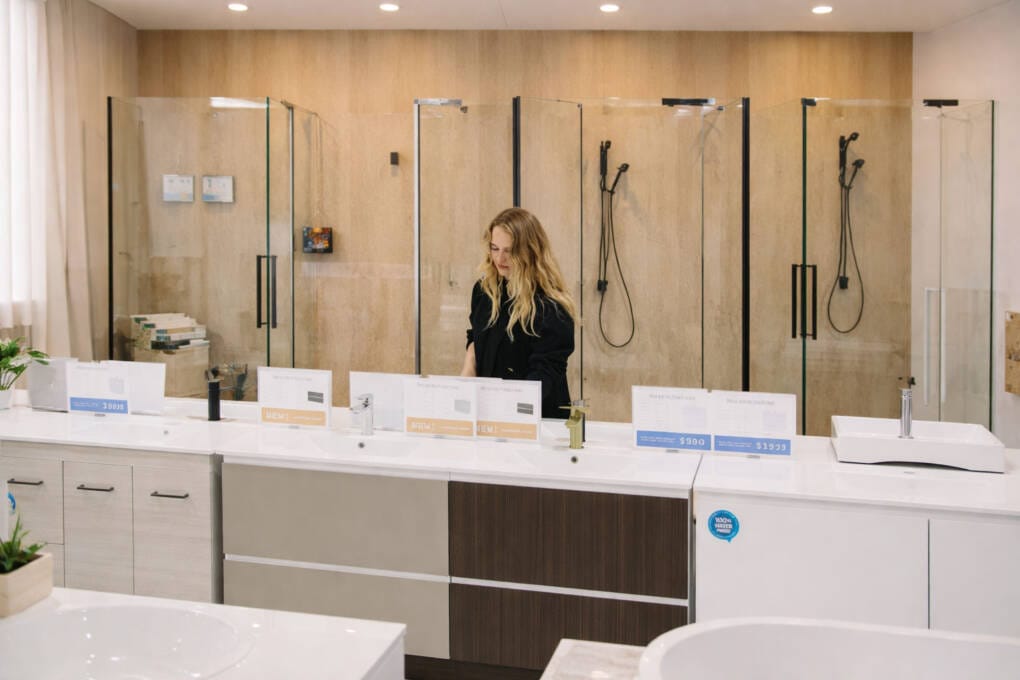
Finding the right bathroom products in Perth for your renovation is easier when you can see everything in one place. That’s what we’ve built at Ross’s. Our warehouse showroom stocks everything you need to complete a bathroom renovation from start to finish, and our displays are set up so you can see how products actually look together rather than making decisions from a small sample card.
We stock a wide range of vanities, baths, toilets, and shower screens across multiple price points. Our tapware range covers everything from practical everyday mixers through to premium brushed gold and brushed gunmetal finishes that suit the warmer palettes trending in Perth bathrooms right now. For wall and floor coverings, our bathroom tiles range includes large-format porcelain, natural stone looks, and feature tiles, along with all the grout and adhesive you need to complete the job. We also stock wet wall panels for homeowners who want a tile alternative that installs faster and requires no grout maintenance.
I always recommend coming in before you finalise your selections. It’s one thing to look at products online and another entirely to stand in front of a display and see how a vanity finish reads next to a tile sample under real light. Perth homeowners who come into the store almost always leave with better decisions than those who order entirely online. That’s not a criticism of online shopping — it’s just the reality of choosing bathroom finishes. Colour, texture, and scale are hard to judge from a screen.
If you’re not sure where to start when choosing a bathroom store in Perth, see our guide on how to choose the right bathroom store for your renovation.
Whether you prefer to browse online or come in and see everything in person, we’re here to help you get your renovation right.
Final Thoughts
A well-planned bathroom renovation in Perth is one of the better investments you can make in your home. It improves how you start and end every day, adds genuine value to your property, and when done right, it lasts 15 to 20 years without needing to be touched again.
The keyword is “planned”. Every section of this guide comes back to the same principle: decisions made early, in the right order, with a clear understanding of what follows. Get that right, and the renovation almost runs itself. Get it wrong, and you spend the whole project fixing problems that didn’t need to exist.
Not everyone is ready for a full renovation, and that’s fine. Sometimes a few targeted updates make more sense than a complete overhaul. If you’re not sure whether your bathroom needs a full renovation or just some attention, 5 Signs of a Neglected Bathroom is a good place to start.
If you have questions about products, pricing, or where to begin, come and see us at Ross’s. We’ve been helping Perth homeowners renovate their bathrooms for over 50 years. That experience is there for you to use.
