
Pivot vs Hinged Shower Door: Which One Suits Your Bathroom?
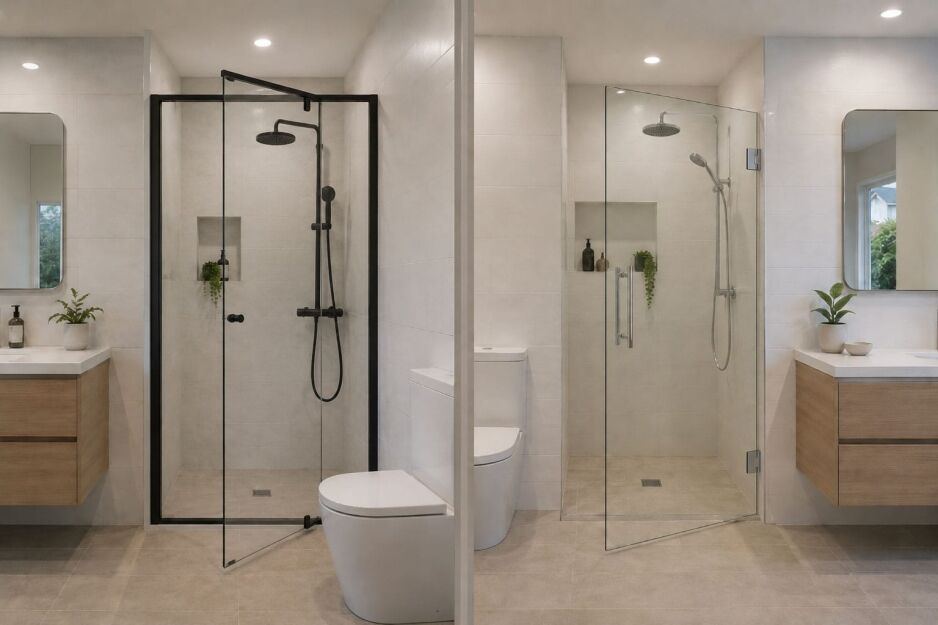
A pivot and a side-hinged shower door can look very similar in product photos. The difference becomes obvious once you see how each door moves within a finished bathroom. Your pivot vs hinged shower door decision should start with the opening arc, not appearance alone.
Customers often come into our Guildford showroom using “pivot” and “hinged” to describe the same door. I show them where each door rotates and how that movement could interact with a vanity, toilet or towel rail. That simple check often changes which option they prefer.
The right choice depends on the exact model, your shower recess and the position of nearby bathroom fixtures. You also need to compare the pivot position, opening direction, clear entry, seals, installation requirements and price. If you are comparing shower screens in Perth, this guide will help you decide whether a pivot or conventional side-hinged door will work properly before you order.
What Is the Difference Between a Pivot and Hinged Shower Door?

A pivot shower door rotates on top-and-bottom pivot fittings, which may be inset from the glass edge. A side-hinged shower door swings from hinges fixed along one vertical edge. The pivot position changes how much glass moves inside and outside the shower, while side hinges create an edge-based swing.
A pivot door still uses a hinge mechanism, but the support points and movement differ from a conventional hinged shower door. The top and bottom fittings create a pivot axis. That axis may sit close to the edge or further into the door panel, depending on the product.
An inset pivot divides the moving glass between the inside and outside of the shower. This can reduce how far the door projects into the bathroom, but the inward-moving section still needs room inside the enclosure.
A side-hinged shower door uses side-mounted hinges along one vertical edge. The full door swings from that fixed edge, so the opening arc is usually easier to picture.
Some products are described as reversible. This usually means the installer can configure the door for left-hand or right-hand opening. It does not automatically mean the door opens both inward and outward.
For a reliable comparison, check the exact product diagram. The pivot position, permitted opening direction and swing dimensions can vary between models.
Pivot vs Hinged Shower Doors at a Glance
The main differences between hinged vs pivot shower doors come down to where the door rotates, how much clearance it needs and the entry it creates. Neither mechanism is automatically better. The right choice depends on the exact screen design and the available space around your shower.
| Factor | Pivot Shower Door | Side-Hinged Shower Door |
| Support position | Uses pivot fittings at the top and bottom of the door | Uses hinges fixed along one vertical edge |
| Door movement | An inset pivot may move part of the glass inside and part outside the shower | The full door swings from the hinged edge |
| Opening direction | Depends on the product, with some models opening in both directions | Depends on the product, although many open outwards |
| Clearance | Depends on the pivot position, door width and fittings inside the shower | Depends on the full opening arc and nearby fixtures |
| Clear entry | Depends on how far the pivot is inset and how much glass remains across the opening | Can create a broad entry where the door can open fully |
| Hardware appearance | Pivot fittings may look less prominent | Side hinges remain visible along the door edge |
| Cleaning | Pivot fittings, seals and profiles all need regular cleaning | Side hinges, seals and profiles all need regular cleaning |
| Water control | Relies on magnetic seals, bottom seals and the overall enclosure design | Relies on magnetic seals, bottom seals and the overall enclosure design |
| Installation | Requires accurate top-and-bottom alignment | Requires suitable hinge support and accurate door alignment |
| Best fit | Bathrooms where the pivot movement solves a measured clearance issue | Bathrooms with clear swing space and a suitable hinge support point |
Neither option wins every part of the comparison. A pivot door may reduce the amount of glass moving into the room, while a side-hinged door may provide a wider clear entry. The actual result depends on the model, the opening direction and the position of nearby fixtures.
Which Door Needs Less Opening Space?
Both pivot and side-hinged shower doors swing, so both need a workable opening arc. The difference is how much of the glass moves outside the shower and how much space the door needs inside the enclosure.
An inset pivot can reduce the outward projection because part of the panel moves into the shower. This may help where a vanity, toilet or towel rail limits the available floor space. However, the inward-moving section still needs to clear the shower mixer, rail, niche and the person using the shower.
A side-hinged door swings from one vertical edge. The full panel usually moves across the bathroom floor, so it can need more uninterrupted space outside the shower. That does not make it unsuitable for a compact room. A narrower door or a better hinge position may still work well.
I would never choose between the two mechanisms from the product name alone. I would mark the proposed arc on the floor with painter’s tape or use a piece of cardboard cut to the door width. This makes clashes obvious before you order.
Check these measurements against the exact product diagram:
- door width
- internal swing
- external swing
- handle projection
- fixed-panel position
- distance to the vanity, toilet and towel rail
A pivot shower door for a small bathroom may solve a measured clearance problem, but it is not automatically the best option. The pivot shower door opening clearance depends on the pivot location and the space available on both sides of the glass.
Where neither door has a safe, practical swing, sliding shower screens remove the opening arc altogether. That is often the better choice for a narrow walkway or a shower positioned close to another fixture.
Which Door Gives You the Better Shower Entry?
Neither door type always provides the better shower entry. The usable space depends on the clear entry width after allowing for the pivot position, fixed panels, frame, handle and seals. The advertised screen width does not tell you how much room you will have to step through.
How a Pivot Door Affects the Entry
A pivot door rotates from fittings at the top and bottom. Where the pivot is inset, part of the glass may remain across the shower opening when the door is fully open.
This means a wide pivot shower door can still create a narrower clear entry. The result depends on the moving panel width, fixed panel dimensions and exact pivot position.
How a Side-Hinged Door Affects the Entry
A side-hinged shower door swings from one vertical edge. It can create a wide, unobstructed opening where the full door swings clear of the shower entrance.
The trade-off is that the door needs enough room outside the shower to open fully. A vanity, toilet or narrow walkway may prevent you from using the full available entry.
What Should You Check?
Before choosing either option, check:
- the manufacturer’s stated clear entry width
- the moving and fixed panel dimensions
- the pivot or hinge position
- the handle and seal projection
- the height of any hob or threshold
- whether the door can open fully without hitting another fixture
I always recommend using the stated opening measurement rather than estimating it from the overall screen size. Product diagrams often list the total width, door panel and clear entry separately because they are different measurements.
A pivot or hinged shower door should not be described as accessible based on the opening mechanism alone. Accessibility depends on the complete bathroom layout, including the clear entry, threshold, floor space and ease of operation.
Choose the door that gives your household a comfortable entry without creating another clearance problem elsewhere in the bathroom.
Which Shower Door Is Easier to Clean?
Neither pivot nor side-hinged shower doors are automatically easier to clean. The simpler screen is usually the one with fewer frame channels, accessible seals and hardware you can wipe without working around tight edges.
Cleaning a Pivot Shower Door
A pivot shower door has fittings at the top and bottom of the glass. Soap residue and mineral deposits can collect around these fittings, the vertical seals and the bottom seal.
The main advantage comes from the wider screen design, not the pivot mechanism itself. A frameless pivot door with minimal profiles may be easier to wipe than a heavily framed alternative.
Cleaning a Side-Hinged Shower Door
A hinged shower screen has hinge plates fixed along one side of the door. These plates create edges that need cleaning, particularly where they meet the glass and seals.
A frameless side-hinged door may still have fewer cleaning points than a semi-frameless pivot door. The opening mechanism alone does not decide which option needs less maintenance.
What Makes a Shower Door Easier to Maintain?
Look for:
- fewer aluminium channels and frame edges
- seals that are easy to reach and wipe
- accessible fittings without narrow gaps
- a bottom edge that does not trap residue
- glass with a suitable water-repellent coating
Ross’s Alpine shower screens use a hydrophobic coating that helps water run off the glass. This reduces the moisture left behind, but it does not replace regular cleaning.
I would compare the fittings, seals and frame design on the actual products before deciding. Follow the care instructions and avoid abrasive cleaners around coated glass, hardware and seals.
Does a Pivot or Hinged Shower Door Contain Water Better?
Neither a pivot nor side-hinged shower door automatically contains water better. The seals, door gaps, threshold, showerhead direction, floor falls and installation quality have more influence than the opening mechanism itself.
What Controls Water Around the Door?
Every moving shower door needs small gaps so it can open and close without rubbing against the surrounding glass or frame. The enclosure controls water by combining those gaps with the right sealing components.
The main parts to compare are:
- magnetic seals that hold the door closed
- vertical seals along exposed glass edges
- a bottom sweep or deflector seal
- frame channels that guide water back into the shower
- a threshold or shower base lip beneath the opening
A well-fitted enclosure uses these parts together. A missing, damaged or poorly aligned seal can allow water through on either door type.
Why Shower Layout Still Matters
The showerhead position can affect water control as much as the door itself. Water aimed directly at the opening may push past an otherwise sound magnetic or bottom seal.
Floor falls also need to direct water towards the waste rather than the doorway. Walls and floors that are out of square can affect door alignment, leaving inconsistent gaps between the glass and seals.
I would compare the supplied seals and installation diagram rather than assume a pivot shower screen will leak more or less than a side-hinged model. Check where the showerhead points, how the threshold is formed and whether the door closes evenly along every seal.
No swinging shower door should be sold as completely leak-free. Correct product selection and accurate installation give the enclosure its best chance of keeping water where it belongs.
Which Door Is Easier to Install?
Neither door is automatically easier to install. The complete screen design, finished opening and available wall support matter more than whether the door uses a pivot or side hinges.
Installing a Pivot Shower Door
A pivot door needs accurate alignment between the top and bottom fittings. The wall profiles must be plumb, and the installer must set the pivot position and clearances to match the product instructions.
Some models allow left-hand or right-hand installation. Ross’s Alpine Pivot Shower Door Silver has a reversible configuration and up to 100mm of adjustment for the finished opening. These features help accommodate different layouts, but they do not correct poor measurements or badly misaligned profiles.
Installing a Side-Hinged Shower Door
A side-hinged door needs a suitable support point for the hinges. The installer must check the door width, glass weight and hardware limits before fixing it to a wall or fixed panel.
The gaps around the door must also remain consistent. Poor hinge alignment can affect how the door closes against the magnetic and bottom seals.
What Both Installations Require
Finished shower openings are not always perfectly square. Measure the width at several points and check that the walls are plumb before ordering.
Shower screen glass must also meet Australian safety requirements. AS 1288:2021 covers glass selection and installation, while Grade A safety glass used for shower screens must comply with AS/NZS 2208. Ross’s Alpine pivot doors use 6mm AS/NZS 2208 toughened safety glass.
I recommend getting professional advice if you are unsure about the wall support, opening measurements or handling a large glass panel. Follow the supplied instructions for the exact model rather than choosing a door because its hardware appears simpler.
Pivot vs Hinged Shower Door Cost
The opening mechanism is only one part of a shower door’s price. A fair cost comparison must use products with similar glass, dimensions, panels and included hardware.
What Affects the Price?
The main cost factors include:
- a standalone door or complete enclosure
- frameless or semi-frameless construction
- glass thickness and overall dimensions
- fixed panels and return panels
- frame and hardware finish
- included handles, seals and support fittings
- product warranty
A door-only price should never be compared directly with a complete enclosure. Adding a fixed or return panel can make a much bigger difference than changing the hinge mechanism.
Current Ross’s Pivot Door Prices
At the time of writing, the Alpine Pivot Shower Door Silver costs $480 to $600 including GST. The Alpine Double Pivot Shower Door Silver costs $660 to $860 including GST. These are supply-only prices, with the final amount depending on the selected size and configuration.
We do not currently have a conventional side-hinged product that creates a genuine like-for-like comparison with these pivot doors. Quoting a glass door with separate hardware against a complete semi-frameless pivot model would give you the wrong impression about which mechanism costs more.
I have seen customers compare a door-only price with a complete door-and-return enclosure and assume the opening mechanism caused the difference. Once we match the glass, panels and included fittings, the enclosure configuration usually explains more of the price gap.
For a broader breakdown by screen type, size and frame design, see our guide to how much a shower screen costs. Always confirm the current product price and inclusions before ordering.
Which Door Suits Your Bathroom Layout?
The right choice depends on how the door moves within your actual bathroom. A pivot or hinged shower door can work well, but only where the opening arc, clear entry and nearby fixtures all suit the product.
Choose a pivot door when: The pivot position reduces a measured clash outside the shower, while the inward-moving section clears the mixer, rail and person using the enclosure. Check that the stated clear opening also suits everyone in the household.
Choose a side-hinged door when: The full door can swing clear without hitting a vanity, toilet or towel rail. The wall or fixed panel must also suit the hinge hardware and door weight.
Choose neither swinging option when: A narrow walkway or nearby fixture prevents either door from opening safely. In that case, a sliding screen removes the swing arc and usually makes better use of the available space.
A pivot door can suit a compact bathroom where an inset pivot reduces the outward projection. It may also work well beside a toilet if the door movement has been checked carefully. A side-hinged door often suits a standard alcove or corner enclosure where there is enough clear floor space for the full swing.
Where a vanity faces the shower, measure from the glass opening to the nearest cabinet edge and handle. Do the same beside a toilet or towel rail. Small projections can create a clash even where the floor plan looks workable.
Before buying, confirm:
- the finished opening measurements
- the internal and external swing
- the stated clear entry width
- the position of nearby fixtures
- the included seals, fixed panels and return panels
For a wider comparison that also covers sliding options, read our guide to sliding vs hinged vs pivot shower screens. The best mechanism is the one that works with the finished opening rather than forcing the bathroom layout to work around the door.
Frequently Asked Questions
These are the questions I hear most often from customers comparing pivot and side-hinged shower doors.
So, Should You Choose a Pivot or Hinged Shower Door?
A pivot door is the better choice where its measured movement solves a real clearance problem. A side-hinged door is the better choice where the full swing remains clear and the edge-mounted opening gives you the entry you need.
Before deciding, compare the exact product’s adjustment range, opening direction, swing diagram, clear entry width, seals and included panels. Do not rely on the product name alone. Two doors described in the same way can move very differently once installed.
A sliding door should also stay on the shortlist if both swinging options clash with a vanity, toilet, towel rail or narrow walkway.
For most homeowners, the best pivot vs hinged shower door choice comes down to measured movement rather than appearance. Mark the swing arc, check the product diagram and confirm the finished opening before ordering.
You can compare our shower doors online or bring your finished opening measurements into our Guildford showroom. We can help you compare the door movement, included panels and available adjustment before you choose.
