
Kitchen Splashback Ideas for 2026: The Hottest Trends
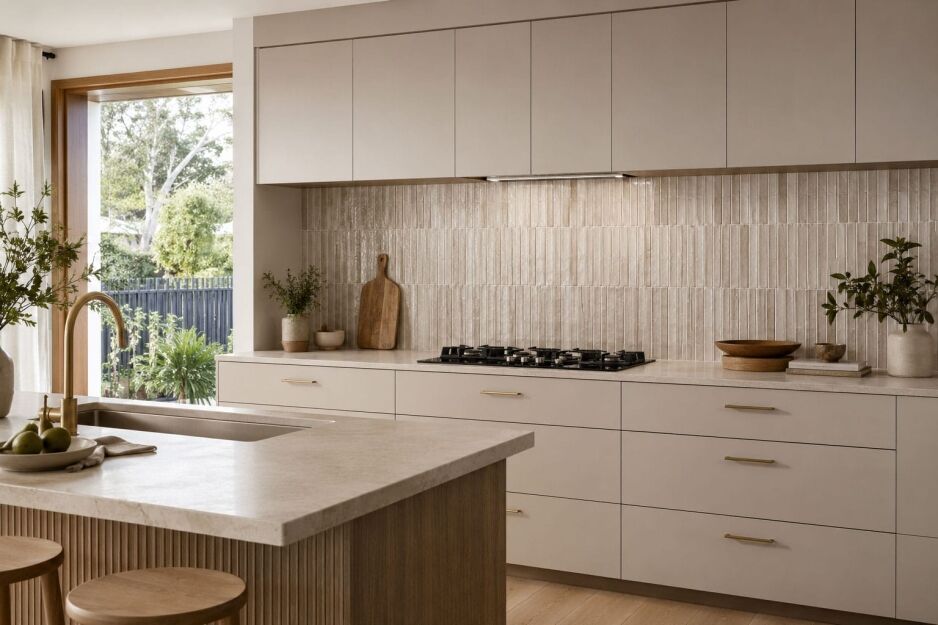
The 2026 kitchen splashback trends have a clear direction: texture and tactile depth over pattern and colour. If you’re planning a kitchen renovation this year, the splashback is doing more design work than it has in years, and the material and format choices have shifted significantly.
What are the best kitchen splashback ideas for 2026? The best kitchen splashback ideas for 2026 are led by zellige, handmade-look ceramic, and fluted tiles for tile-format applications, while sintered stone and porcelain slabs dominate full-height slab splashbacks. The warm neutral palette of 2026, with sage, terracotta, warm white, dusty blue, and mushroom, is replacing the cool greys and stark whites that defined the last decade. The 2023 Houzz Australia Kitchen Trends Study found that 56% of Australian kitchen renovations used tiles for splashbacks, and that preference for tile formats continues to shape kitchen splashback ideas in 2026.
The kitchen splashback ideas shared in this article reflect what I’m seeing move in 2026, material by material. For the full kitchen picture, our 2026 kitchen design trends article covers every room element.
Matching Benchtop and Splashback: The Full-Height Slab Trend

The full-height slab splashback is one of the strongest 2026 kitchen splashback trends, and the material conversation around it has changed completely. If you’re starting the project from scratch, our advice on choosing a kitchen splashback covers how to match the splashback to your benchtop before you settle on a material. The concept is simple: the benchtop material continues up the wall, no grout lines, no material break, one seamless surface from bench to overhead cabinets. In 2026, that run is climbing higher again, carrying past the overhead cabinets to the ceiling behind a feature rangehood or open shelving, where the unbroken surface has the most impact.
Engineered stone dominated this look for years, but products containing 1% or more crystalline silica are no longer available. Safe Work Australia’s engineered stone ban prohibits their manufacture, supply, processing, and installation from July 2024 — splashback panels included, not just benchtops. Imports were banned from January 2025, and WA’s transitional arrangement ended 31 December 2024. Compliant alternatives for a full slab look include sintered stone, porcelain slab, natural stone such as granite, marble, and quartzite, and crystalline-silica-free products like Silestone and Densified Stone, all covered in our kitchen splashback material comparison alongside indicative costs and gas cooktop requirements.
Stone benchtops are the most popular choice for a full slab splashback, and they suit Perth conditions well. Our Silestone range handles UV intensity and thermal cycling better than most alternatives, and in coastal suburbs like Fremantle, Cottesloe, and Scarborough, it holds up better against salt air than natural stone sealers. Honed and matte finishes are worth specifying over polished to reduce glare under our strong natural light. For a more budget-friendly DIY take on the matched look, our Densified Stone range offers prefabricated benchtops and splashbacks in two marble-inspired designs.
Zellige and Handmade-Look Ceramic: Texture Over Pattern
The shift driving 2026 kitchen splashback trends away from pattern and toward texture is most visible in zellige and handmade-look ceramic. These are surfaces that earn their place through dimension and tactile depth, not print or graphic detail.
Zellige is the 2026 heavyweight. Hand-shaped, kiln-fired Moroccan clay tile with deliberately uneven surfaces and glaze variation, no two tiles are identical. Light hits the surface differently across every square, which creates a shimmer effect that flat tiles simply can’t replicate. Handmade-look ceramic is zellige’s accessible sibling: visible glaze pooling, edge variation, organic surface. Both qualify as artisanal tiles in the truest sense. The 2026 colour direction for these formats across our splashback tiles and feature tiles ranges runs through warm white, sage, terracotta, dusty blue, and mushroom. Warm white and sage are moving fastest in the showroom right now, by a clear margin.
One practical note for Perth homes: seal the grout on zellige splashbacks. Hard-bore water and everyday cooking grime work into unsealed grout faster than most people expect.
Fluted Splashbacks: Depth and Shadow
Fluted and reeded tiles are one of the biggest 2026 kitchen splashback trends, offering surfaces that work through shadow depth and light interaction, not colour or pattern.
Two formats are worth knowing. Fluted ceramic tile delivers vertical grooves in a format that suits Perth’s hard-water environment well. Polished glass surfaces show mineral deposit buildup faster in areas with heavy bore water use, so fluted ceramic is the more practical choice for most Perth kitchens. Fluted glass splashbacks are the sleeker, more seamless option, and they work well in kitchens with town water where mineral buildup is less of a concern.
The application rule for both is the same: one feature element only. Behind the cooktop or a single bank of cabinetry. Wrapping fluted splashback tiles across the whole kitchen reads as overworked and will date faster than a restrained application. Both formats pair best with warm neutral cabinetry and brushed hardware.
Warm Neutral Colour Direction: What’s Replacing Cool White
Cool white and cool grey are splashback colours 2026 is moving away from fastest. The Dulux 2026 Colour Forecast confirms it across its three palettes, Ethereal, Elemental, and Evoke: warm whites, mushroom, greige, sage, terracotta, dusty blue, and clay are the direction. Dulux’s colour experts note that consumers are gravitating toward warm, comforting colours that offer a sense of stability, and that’s exactly what the warm neutral kitchen palette 2026 is delivering in splashback choices right now.
Cool white splashbacks have a particular problem in Perth kitchens. Our intense natural light makes them read harsher than they do in showroom photography, especially in north-facing kitchens that open onto alfresco areas. Warm neutrals carry that indoor-outdoor connection better and hold their appeal under the kind of light we get here year-round. Our kitchen wall tiles range covers the full warm neutral spread if you’re ready to make the shift.
Splashback Ideas for a White Kitchen
White kitchens are the most common starting point I see in Perth, and the splashback is what stops one feeling clinical. The trick is warmth and texture, not more white on white.
For a white kitchen, the strongest 2026 splashback ideas are a warm-white or off-white zellige for subtle movement, a vertical-stack subway in linen or warm white with tonal grout, or a large-format marble-look porcelain for a soft veined feature. If you want quiet contrast, a mushroom or greige tile reads as a considered choice against white cabinetry, while a single wall of sage or terracotta lifts the room without taking it bold. The best splashback tiles for a white kitchen are the ones that add depth, so steer clear of a flat, bright-white tile that just doubles up on the cabinets.
Subway Tiles: The 2026 Evolution
Subway tiles are not out, but the way they’re being installed has changed, and that change matters for anyone specifying a kitchen splashback in 2026.
The standard 3×6 horizontal layout with contrast grout is the application that reads dated now. The kitchen splashback trends of 2026 have moved to the vertical stack format, typically 4×12 tiles or longer, with tonal or colour-matched grout as the default. The vertical stack draws the eye upward, makes ceiling heights read taller, and feels deliberate rather than default. Tonal grout — matched to the tile colour rather than contrasted against it — is what makes the whole splashback read as one continuous surface.
If you love classic white subway tile, a vertical stack with warm-white tonal grout is the most current application right now. Off-white and linen colourways are gaining ground over stark white. Our subway tiles range covers both formats, and tile adhesives and grout have colour-matched grout options to finish the job properly.
Kit Kat Tiles: Small-Format Texture With Movement
Kit Kat tiles, sometimes called finger tiles, are one of the small-format options earning their place in 2026 kitchens on texture alone. They are slim, elongated rectangles, far narrower than a subway tile, and set together they create a fine ribbed surface that catches the light and gives a splashback depth and movement without any pattern or print.
This is the same shift driving the rest of 2026: dimension over decoration. Kit Kat reads as tactile and considered, whereas a flat gloss tile reads as plain. The format suits the warm neutral palette well, with sage, warm white, and clay all moving through the showroom, and a soft gloss finish lifts the surface without the dated edge of standard glossy subway tile. The trade-off is grout: more tiles mean more grout lines to keep clean, so I’d hold Kit Kat to a single feature run, behind the cooktop or one bank of cabinetry, rather than wrapping the whole kitchen. Our range of Kit Kat tiles covers the colours getting the most attention right now.
Large-Format Porcelain: Fewer Grout Lines, Cleaner Finish
For tiled kitchen splashback ideas that feel current without a slab budget, large-format porcelain is the place I’d start. It gives you the slab splashback look at tile prices, and it’s among the more practical 2026 options for busy Perth kitchens.
The 600x1200mm format is the sweet spot. It divides neatly into the standard 600mm splashback height, which means one tile from the bench to the overhead cabinet with a single horizontal grout line at most. Fewer grout lines, cleaner finish, more seamless visual — closer to the full slab look than anything else at the price point. Porcelain is also non-porous, requires no sealing, and handles Perth’s UV and heat load without complaint, making it easy to maintain behind a busy cooktop.
Our porcelain tiles include marble-look tiles and stone-look tiles in large-format sizes, so the seamless kitchen finish is achievable without the sintered stone price tag.
Patterned Tiles: A Supporting Role in 2026
Patterned tiles haven’t disappeared from creative kitchen splashback ideas — they’ve just moved into a more considered role. One feature splashback wall, one bold moment, and neutral everywhere else. That’s how I’d play it in 2026.
Encaustic-look tiles, heritage patterns, and geometric tile splashbacks all still work strongly in the right kitchen. Encaustic-look is worth calling out specifically as a more accessible alternative for anyone who wants the Moroccan artisanal feel of zellige without the zellige price. Pair any patterned tile against a neutral perimeter so the pattern leads without competing with everything else in the room. The rule is simple: if the rest of the kitchen is warm and calm, a bold patterned kitchen splashback reads as a deliberate design decision. If the kitchen is already busy, the pattern becomes noise.
Our patterned tile trends guide covers the full picture, and the encaustic tile designs and heritage tile range are worth browsing if you’re drawn to this direction.
Statement Splashbacks with Bold Tile Colours
Bold splashback tiles are still very much part of the 2026 story — the application has just shifted. The whole-kitchen bold colour moment is over. The 2026 version is one feature wall tile, one strong colour on a single splashback, with warm neutrals carrying every other surface in the room.
The splashback tile ideas for 2026 that are getting the most attention are deep sage, dusty blue, aubergine, clay, and terracotta. Emerald green has softened into sage. Stark navy has moved toward indigo. The Dulux Evoke palette captures this direction well, with Baked Clay, Deep Aqua, and Magic Melon being popular choices. Bold colour pairs best with warm brass or champagne hardware and matte or honed tile finishes, both of which help the splashback read as a statement in its own right. Going bold needn’t be expensive. A sage green splashback or terracotta tile in vertical stack subway format is an accessible, bold statement that doesn’t require expensive custom tile. If you’re thinking about colour across the kitchen and bathroom together, our bathroom design trends of 2026 article covers the same palette direction in a wet room context.
Glass Splashbacks: What to Know
Glass splashbacks remain a staple kitchen splashback trend of 2026 — grout-free, easy to wipe down, and available in custom colours, including the warm neutrals and soft earth tones defining this year’s palette.
However, the trade-offs are worth knowing. Glass shows fingerprints more readily than tiles, particularly in high-gloss finishes. Chips or cracks mean whole-panel replacement rather than swapping a single tile. Cost tends to be toward the higher end of splashback options. For a glass splashback kitchen you’ll need to source through a specialist glazier — it’s not a product we stock.
Frequently Asked Questions
So, Which Kitchen Splashback Idea Should You Choose?
The 2026 kitchen splashback trends tell a consistent story: texture and depth over pattern and colour, warm neutrals replacing cool whites, and compliant materials stepping in where engineered stone used to be specified.
The practical decisions that matter most before you buy are simple. Engineered stone is banned for new splashback installations in Australia. Tonal grout is the 2026 default, not contrast. If you’re using subway tile, the vertical stack format is the current application. Get those three right and most of the other choices, material, colour, format, are genuinely a matter of what suits your kitchen and your budget.
If you’re ready to look at options, our splashback tiles range is a good place to start, and our kitchen renovation guide covers the broader project if you’re planning a full refresh. Or come and see the tiles in person at 57 James Street, Guildford, where you can compare finishes side by side before you commit.
