
2026 Kitchen Design Trends You’ll Want to Follow
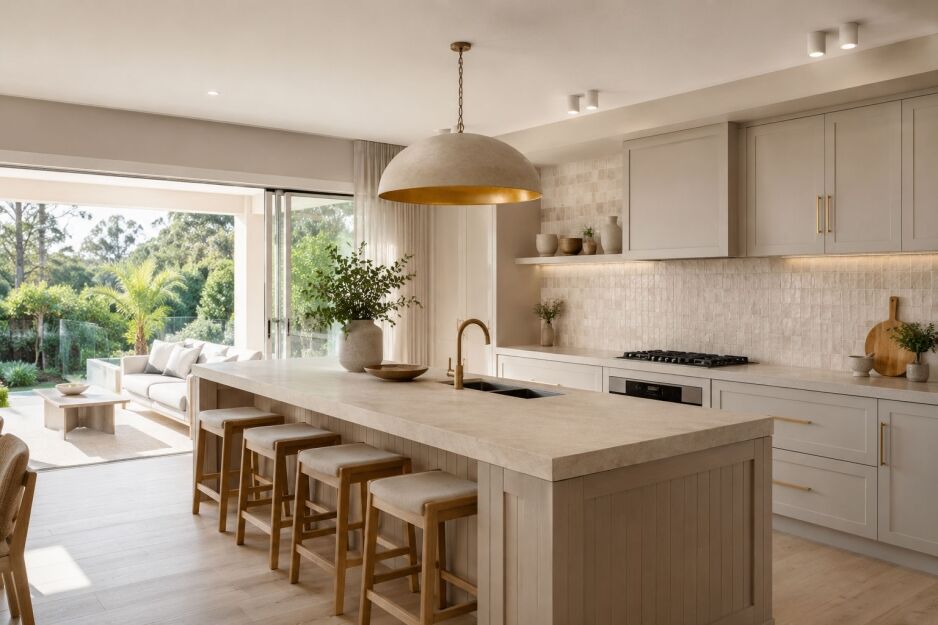
The 2026 kitchen is warmer, softer, and more considered than anything we’ve seen over the last decade, and the 2026 kitchen design trends shaping Perth renovations right now reflect a real shift in how homeowners want their kitchens to feel. If you’re planning a renovation or refresh this year, this is the year to step away from cold whites, sharp lines, and overly clinical finishes.
What are the 2026 kitchen design trends? The defining 2026 kitchen trends are warm earthy palettes replacing cool whites and greys, curved islands and soft profiles, slim shaker and fluted cabinetry, warm neutrals, natural materials like timber and stone, layered lighting, butler’s pantries and sculleries, and invisible technology integrated into seamless cabinetry.
I’ve spent years in our Guildford showroom helping Perth homeowners choose kitchens that look good now and still feel current ten years later. Below, I’ve grouped the key trends shaping kitchens in 2026 by colour, materials, layout, and detail. Some are bold shifts. Others are quiet refinements. All of them are worth knowing before you spec a new kitchen. If you’re ready to plan the full project, our 2026 Perth kitchen renovations guide walks through the practical side, including costs, timelines, and trades.
The New Neutrals: Warm Tones Replacing Cool Whites and Greys

The bright, clinical white kitchen is fading. In its place, the warm neutral kitchen has become the default direction for 2026, and it’s the clearest shift in Perth kitchens this year. The palette family is warm off-whites, mushroom, taupe, parchment, linen, oat, greige, soft chamois, and alabaster. The cool whites and stark greys that defined the last decade are the palettes designers are stepping away from fastest.
The shift is grounded in proper Australian research, not Pinterest hunch. The HIA 2026/27 Design Trends Report and the Dulux 2026 Colour Forecast both call out the same thing: a continued preference for warm, comforting colours that offer emotional reassurance and calm, in Dulux Colour and Communications Manager Andrea Lucena-Orr’s words. The Dulux Elemental palette is built around warm whites and neutrals like Blended Cream and Hog Bristle Quarter, then enriched with golden browns like Caramel Sundae and Coffee Dust.
The Perth angle matters here. Cool whites can read harsh under our intense natural light, especially in kitchens that open onto alfresco areas. Warm neutrals soften that glare and pair properly with Perth’s indoor-outdoor culture.
Get the palette right by working the whole room, not one element. Warmth comes from the benchtop, the splashback, the tapware, the hardware, and the flooring working together. A single warm-toned element on a cool-white background just looks like a mistake.
For renovators on a tighter budget, a plain-door gloss white cabinet still works beautifully as a clean canvas. The warmth comes from a warm-toned stone benchtop, a textured splashback, brushed brass or brushed gold tapware, and matching kitchen cabinet handles in the same finish family. I had a Perth couple in the showroom last year doing exactly this. White plain-door cabinets, a warm travertine-look stone benchtop, brushed gold tapware, and brushed gold handles right through. Their kitchen reads as a fully 2026 space without custom joinery costs anywhere in the project. For more on pulling a warm neutral scheme together, our kitchen cabinet colour ideas guide is worth a look.
Wood Grain and Natural Timber Cabinets


After a decade of painted finishes dominating Australian kitchens, 2026 is the year warm timber cabinetry returns to centre stage. The shift is one of the more talked-about moves across the Australian renovation industry this year, with mid-tone walnut leading the charge ahead of the lighter timbers that defined the late 2010s.
The tones doing the work in 2026 are white oak, mid-tone walnut, honey, and teak, with mid-tone walnut the standout. The appeal is the visible grain, the tactile depth, and the warmth that timber brings into a kitchen. Crucially, timber doesn’t fight the warm neutral palette covered earlier. It complements. A walnut island next to warm off-white perimeter cabinetry, or full walnut joinery against a parchment splashback, both read as one cohesive 2026 scheme rather than competing elements.
Perth’s natural light and indoor-outdoor culture suit warm timber tones particularly well. Walnut and oak come alive under the kind of light that pours through a north-facing kitchen here.
The honest budget reality. Solid timber cabinetry is a serious investment, and not every renovation budget stretches that far. Timber-look porcelain panels and timber-look laminate finishes are valid alternatives that get you close to the look at a fraction of the cost.
A practical middle path worth considering is layering timber warmth in through the floor rather than the cabinetry. Timber-look hybrid flooring brings the same grain, tone, and visible texture into the kitchen at a far lower price point, which lets the cabinet budget stretch further elsewhere.
Slim Shaker and the Hamptons Evolution
For over a decade, the Hamptons-style shaker kitchen has been one of the most-specified looks in Perth and across Australian renovations. In 2026, that style is evolving, not disappearing, and the way it’s evolving is worth watching this year.
Slim shaker cabinets are the refinement. The bold, architectural Hamptons shaker is giving way to a narrower profile where the door rails measure around 50mm rather than the 65mm or wider you’d see on traditional shaker. The result is a door that still carries the recessed-panel detail and the architectural shadow line, but reads as lighter, more contemporary, and more restrained. It’s shaker on a diet, essentially.
Slim shaker sits between the two ends of the cabinet spectrum. Slab is flat and modern. Traditional shaker is detailed and classic. Slim shaker, sometimes called micro shaker or refined shaker, takes the architectural detail of traditional shaker and quiets it down. That makes it a genuinely transitional kitchen door, comfortable in both contemporary and classic Australian homes.
The Australian angle matters here. Hamptons-Coastal has been more dominant across Perth and the eastern states than in many international markets, so the Hamptons evolution is a much bigger trend here than overseas. Slim shaker lets renovators who built or specified Hamptons in 2014 or 2018 keep the bones of the style without it dating. I see this most in Perth’s western suburbs, where Hamptons-Coastal still defines the streetscape and homeowners want a refresh that doesn’t abandon the language of the original house.
Hardware does the heavy lifting on a slim shaker kitchen. Brushed brass, brushed nickel, and knurled finishes pair particularly well with the narrower rails. The next section covers the brushed metal palette in detail.
Fluted and Reeded Detailing
In turns of surfaces, texture is replacing patterns in 2026, and fluted and reeded detailing is the clearest expression of that shift. These looks are defined by shadow and depth rather than colour or print, which is why the warm neutral palette we covered earlier.
The look is vertical grooves, evenly spaced, applied to cabinet doors, an island front, a rangehood surround, or glass cabinet inserts. Reeded glass on upper cabinet doors adds soft translucency that obscures contents without going fully opaque, which is part of the appeal.
Use it as feature detail, not whole-kitchen texture. The most successful applications are one area at a time, typically an island, a rangehood, or a single bank of feature joinery. Wrap every cabinet in fluted cabinetry and the kitchen reads as overworked and dates faster.
Fluting pairs particularly well with warm neutrals, brushed brass or champagne hardware, and honed natural stone. It struggles against high-contrast palettes and glossy finishes, where the shadow detail gets lost.
The budget reality. Custom fluted joinery is a significant cost. A fluted splashback delivers much of the same shadow play and textured detail at a fraction of the investment. Fluted ceramic and fluted glass splashbacks are part of the same trend family, and our splashback tiles range includes textured options that bring this look into the kitchen without custom joinery costs.
Curved Design Elements and Soft Profiles
Sharp geometry is giving way to softer forms, and curves are one of the most-cited moves across every Australian source worth following. The shift shows up in curved islands, rounded cabinetry corners, and bullnose benchtop edges replacing the hard right angles that defined the last decade.
The reasons are practical as much as aesthetic. A curved kitchen island works as a natural gathering point in a way a rectangular workstation doesn’t. There are no sharp corners to walk into or watch kids around. And the form reads as sculptural and furniture-like rather than utilitarian. Australian designers have flagged curved islands and rounded benchtops as a standout 2026 feature, and the trend has held up across every recent industry forecast.
Specific applications worth knowing: curved island ends, rounded benchtop profiles like bullnose and double bullnose, arched cabinetry detailing, and fluted curved islands that combine the texture trend covered earlier with the curve trend covered here.
The honest practicality. Curved islands need more floor space than rectangular equivalents. The curve eats walkway. They work beautifully in larger open-plan kitchens, but they don’t suit compact galleys or narrow inner-suburb kitchens where every linear millimetre counts. Most competitor articles present curves as universally suitable. They’re not.
Curves pair best with matte finishes, warm neutrals, timber accents, and brushed metal hardware. In my experience, they work hardest in Perth’s open-plan western-suburb homes and large family kitchens where the floor area can absorb the soft-edged geometry without compromising flow.
Two-Tone and Layered Cabinet Combinations
Two-tone cabinetry is one of the strongest cabinet trends carrying through into 2026, but the application has shifted. The 2026 version is not about high contrast. Navy and white, black and timber, deep green and oak. Those bold pairings that defined 2022 and 2023 are giving way to tonal layering, where both finishes share the same warmth family and the contrast is gentle rather than declarative.
Specific 2026 pairings worth knowing: warm linen uppers with mushroom lowers, a sage island against greige perimeter cabinetry, or a timber base paired with painted upper cabinetry in a warm off-white. The shift is toward layered cabinetry that reads as one cohesive scheme rather than two competing colours.
Application that works. Keep hardware consistent across both tones, same finish and same design, to unify the kitchen visually. The two classic approaches still hold: lighter on top, darker on bottom, or use the island as the single colour moment with the perimeter staying in a quieter tone. Timber as one of the two tones is a particularly strong 2026 pairing and ties back to the natural timber trend covered earlier.
In Perth specifically, lighter perimeter cabinets help bounce our strong natural light through the room, while a darker or coloured island anchors the space without making the whole kitchen feel heavy.
One honest budget note. Two-tone joinery is almost always more expensive than single-finish, partly because of additional supplier coordination and partly because two finishes mean two sign-off cycles. Worth knowing before you specify.
Brushed Metal Tapware: Gold, Nickel, and Beyond
Brushed metals are now the dominant tapware finish family in 2026. Brushed gold continues to lead the family, but brushed nickel is the finish gaining ground fastest.
Our tapware expert Greg von Einem, National Marketing Manager of Linkware Australia, explains it this way: “Brushed Gold continues to dominate as a key finish, offering a timeless and luxurious appeal. Designers love incorporating it to create unique and stylish spaces that reflect personal tastes.”
The full 2026 brushed metal family worth knowing: brushed gold tapware, brushed nickel tapware, gunmetal tapware, and matt black. Matt black has shifted away from pure black toward warmer charcoal and graphite tones. Brushed nickel reads softer than matt black and warmer than chrome, which is why it suits both modern and transitional kitchens equally well.
The hardware bridge. This is where a coordinated 2026 kitchen quietly pulls ahead of one assembled from different suppliers. Our kitchen cabinet handles come in the same five finishes as the tapware: brushed gold, black, brushed nickel, matt black, and gunmetal. Carrying one finish across both the tapware and the handles is the kind of small detail that lifts a budget kitchen renovation into a fully coordinated 2026 look.
Mixed metals. Mixing finishes still works in 2026, but only when the metals share warmth. Brushed gold paired with brushed nickel reads cohesive. Polished chrome paired with brushed gold reads accidental. The rule of thumb is warm with warm, cool with cool, never mix temperatures.
A Perth-specific practical note. Look for mixers with ceramic disc cartridges. Perth’s hard bore water is harsh on rubber washer fittings, and ceramic disc cartridges last considerably longer in our conditions.
In the Guildford showroom this year, brushed gold is still the finish most customers walk in asking for. For a wider look at what’s moving in tapware finishes, our coloured kitchen tapware article covers the broader picture.
Matching Benchtops and Splashbacks
A full-height slab splashback running from benchtop to ceiling, using the same material as the benchtop itself, is one of the most-specified 2026 looks in Australian kitchens. The seamless surface eliminates grout lines, simplifies cleaning, and creates a dramatic feature behind the cooktop without adding visual noise.
The material options for the matched look are sintered stone, porcelain, and natural stone such as granite, marble, and quartzite. Our 2026 kitchen splashback trends article covers the material detail in full.
Stone benchtops are the standout for Perth conditions. Silestone handles UV intensity, thermal cycling, and coastal salt air better than most alternatives — which matters whether you’re in a north-facing kitchen in the suburbs or a few kilometres from the coast in Fremantle, Cottesloe, or Scarborough. Honed and matte finishes are worth specifying over polished; they’ve replaced polished as the 2026 default, and they cut glare under Perth’s strong natural light far better than a polished surface will.
For a budget-friendly DIY take on the matched look, our densified stone range offers prefabricated benchtops and splashbacks in two marble-inspired designs, ready to pair straight off the shelf.
Textured Tiles: Fluted, Zellige, and Handmade Ceramic
Tile selection in 2026 is led by dimension and tactile depth rather than pattern and colour. Textured splashback tiles are doing the heavy lifting on Perth feature walls this year, and the surface variation is what gives them their staying power.
Three tile looks define 2026 kitchen tile trends. Zellige tiles are the hand-shaped, kiln-fired Moroccan clay tiles with deliberately uneven surfaces and glaze variation that no two pieces are quite the same. Fluted and reeded ceramic and glass tiles carry the vertical grooves covered earlier into a more affordable splashback application. Handmade-look ceramic finishes everything off with visible glaze pooling and edge variation.
Colour direction inside tile selection has shifted with the rest of the palette. Warm whites, sage, terracotta, dusty blue, and mushroom are the 2026 tones leading our splashback tiles movement this year. Patterned tiles haven’t disappeared, but they’ve moved into a supporting role. Best used sparingly on a single splashback or one feature wall, never wrapped across multiple surfaces.
Two details that quietly date a tile job in 2026. First, tonal grout. Matching grout to the tile colour is the new default. Contrast grout reads instantly dated. Second, the standard 3×6 horizontal subway layout has given way to vertical-stack subways in 4×12 or longer formats. Subway tile isn’t out. It’s just stopped being installed sideways.
In Perth showroom visits this year, the looks finding willing buyers fastest are warm-white zellige, sage-toned handmade-look ceramic, and fluted glass for kitchens where customers want texture without colour commitment. For the wider splashback picture beyond what fits this section, our 2026 kitchen splashback trends article covers it fully.
Mixed Material Kitchens
Mixed materials remain one of the strongest ways to bring depth and personality into a kitchen, but the pairings that define a mixed material kitchen in 2026 have shifted. The cool industrial mix of matte black, raw concrete, and stainless steel that dominated 2022 and 2023 has been replaced by warmer, more layered combinations.
Two pairings worth knowing for 2026. The first: warm neutral cabinetry, a honed sintered stone benchtop, brushed brass tapware, and fluted glass cabinet doors as a feature element. The second: white plain-door cabinetry, a warm-toned stone benchtop, timber-look hybrid flooring, brushed nickel tapware, and matching cabinet hardware in the same brushed nickel finish. Both work because every surface shares the same warmth family.
The 2026 rule is shared warmth rather than dramatic contrast. Texture and material variety still drive the layered look, but the warmth temperature should stay consistent across timber and stone, across brushed metal and ceramic, across every honed and matte surface in the room. A warm-toned timber-and-stone kitchen with one cool grey element will read as a mistake rather than a feature.
Every material has to earn its place. Don’t introduce a fourth or fifth material purely for visual variety. If it doesn’t do work on the surface it’s used on, it’s clutter.
Coordinating finishes across the benchtop, splashback, tapware, sink, and cabinet hardware gets harder when each comes from a different supplier. Sourcing from a single Perth showroom keeps the warmth shared across every surface, which is part of why our customers leave with a kitchen that actually looks like what they planned.
Multi-Functional Islands and the Entertainer’s Kitchen
The 2026 Australian kitchen has split into two zones. The working kitchen, where the prep, cooking, and clean-up happens, runs along the perimeter or tucks into a scullery. The entertaining kitchen, anchored by the island, stays clean and clear for guests, family, and food on the table. This is the entertainer’s kitchen Australian designers have been describing for the last few years, and it’s now firmly the dominant 2026 island brief.
The multi-functional kitchen island has to do real work to earn its place. It needs to handle prep when guests aren’t around, dining bar seating in the evening, a homework station after school, and the social gathering centre on weekends. Curved islands and multi-use islands are the standout 2026 layout feature, with soft profiles improving flow around the entertaining side.
This works particularly well in open-plan Australian homes with strong indoor-outdoor flow. A clean island bridges the kitchen and the alfresco zone, letting guests move freely between the two without negotiating around a working bench full of pans and chopping boards.
Sizing guidance that earns the space. A working entertainer’s island needs around 2.4 metres of length minimum for seating without compromising prep space, with at least 1 metre of clearance on the entertaining side and 1.2 metres on the working side.
Curved profiles, covered earlier, suit this role particularly well because they soften the boundary between working and entertaining sides. You don’t need a butler’s pantry to make the entertainer’s kitchen work, but a scullery makes it easier. For mapping out your island and broader layout, our 3D Kitchen Planner lets you test sizes and seating positions before you commit to kitchen cabinets.
Butler’s Pantries and Sculleries
Butler’s pantries and sculleries are now expected features in higher-end Australian builds and increasingly requested in mid-range Perth renovations. HIA’s Bring in the Butler observations noted Houzz searches for “butler’s pantry” jumped 311 per cent in 2022, and demand hasn’t slowed since. More households want to hide away food prep, baking, dishwashing, and the inevitable kitchen mess that comes with everyday cooking.
The terms overlap in Australian usage but they’re not quite the same thing. A butler’s pantry traditionally connects the kitchen to a dining space and includes prep surfaces and storage. A scullery handles the messy work: dishwashing, food prep, and appliance storage. Some Australian designers prefer scullery as the more accurate term for what most new builds are actually installing.
Why the rise is happening is straightforward. Open-plan kitchens are always on display, so the scullery lets the main kitchen stay clean while the working end of cooking happens out of sight. Features that define a 2026 scullery: secondary sink, prep surface, walk-in pantry storage, appliance garage for the kettle, toaster and coffee machine, and space for a second fridge or beverage fridge. Our kitchen pantry cupboards range covers most of the cabinetry side of a scullery build.
Sizing guidance from HIA. Walkway width at least 1000mm, plus another 600mm for benchtops. L-shaped cabinetry makes the best use of the space. Anything tighter and you’ve built a wide cupboard rather than a working scullery.
Cost reality check. HIA puts butler’s pantries in the $8,000 to $25,000 range, and notes a scullery can lift overall kitchen installation cost by up to 30 per cent. Worth budgeting for upfront rather than finding it as a surprise.
In Perth specifically, the layouts I see working best put the secondary sink against an external wall for plumbing simplicity, the appliance garage on the bench wall closest to the main kitchen for easy access, and tall pantry storage on the longest wall.
Invisible Kitchens and Concealed Storage
The 2026 invisible kitchen hides more than it shows. Pocket doors close over the working zone when guests arrive. Fridges and dishwashers sit behind panel-ready fronts that match the surrounding cabinetry. Pantries disappear behind walls that read as joinery. Rangehoods finish in the same material as the splashback or benchtop. Australian designers have started calling this the hidden kitchen, where everything from the toaster to the ovens tucks away behind seamless pocket doors when not in use.
The components worth knowing for 2026: pocket doors that cover entire working zones, panel-ready integrated fridges and dishwashers, appliance garages, touch-to-open and finger-pull cabinet mechanisms, and rangehoods clad in the benchtop or splashback material rather than left as a feature in their own right.
This trend shares an impulse with the entertainer’s island and the scullery covered earlier. All three are about keeping the working kitchen out of view so the entertaining kitchen can stay calm.
The accessible version. Fully custom invisible joinery is a significant investment. But handleless plain-door cabinetry, with push-to-open or finger-pull mechanisms instead of traditional handles, delivers a surprising amount of the invisible look at a meaningfully lower price point. A gloss white plain-door kitchen cabinets build with push-to-open hardware reads as a calm, seamless kitchen even without fully custom pocket doors and integrated appliances.
A partial application works. You don’t have to go fully concealed for the look to land. A single panel-fronted fridge delivers most of the visual benefit at a fraction of the full invisible-kitchen cost. For the complete breakdown of how to plan one, our invisible kitchen design trend guide walks through the details.
Smart Kitchens and Invisible Technology
The smartest 2026 kitchens are the ones you don’t immediately notice are smart. Australian industry observation has shifted firmly toward invisible technology over the past year. It earns its place by solving a problem, not by flashing a screen.
The 2026 smart kitchen features worth knowing: sensor-activated tapware that turns on without touching the handle, touch-to-open cabinetry that needs no hardware to operate, integrated charging drawers that keep phones and devices out of sight, smart appliances behind panel-ready fronts, and induction cooktops that sit flush with the benchtop as a clean surface rather than a feature.
Greg von Einem at Linkware Australia explains the tapware end of this shift: “At the high end of kitchen design, there is a definite preference for high-quality fixturing with functions such as sensor and touch on/off capabilities. Sophisticated features like hot, cold, ambient, ice-cold, and sparkling water options through under-bench apparatus are also gaining traction.”
Induction cooktops are doing more work in 2026 than just looking clean. They pair with the broader Australian shift toward electrification under NCC 2022 energy requirements, which favour all-electric kitchens for new builds and major renovations. They’re also genuinely safer in homes with young children because there’s no open flame to manage around.
Apply a problem-first test. A sensor tap is useful when your hands are covered in raw chicken. A fridge that emails you about milk is novelty.
Layered Lighting
A 2026 kitchen runs three lighting layers working together rather than one harsh overhead source. Ambient lighting fills the room. Task lighting focuses on prep surfaces, the cooktop, and the sink. Accent lighting picks out architectural detail, open shelving, or the island as a feature element. Single-source overhead lighting now reads as dated as cool grey cabinetry.
Australian designer observation has flagged 2026 as a shift toward more intentional, statement lighting. A single artistic pendant over the island. Subtle feature lights enhancing a display shelf or a glass cabinet. Strip lighting still earns its place but is being used more selectively rather than wrapped across every available edge.
The fixture trends worth knowing: oversized sculptural pendants over islands, fluted glass pendants that connect to the broader texture trend covered earlier, curved or crescent pendant forms, and mixed materials combining glass, brass, rattan, and fabric in one fitting.
Colour temperature matters. Specify 2700K to 3000K warm white throughout. Cool white reads clinical in a warm neutral kitchen. Integrated LED strips under cabinets, along toe-kicks, and inside open or glass-fronted shelving handle the accent layer beautifully. Dimming should be standard on every layer, because the lighting you want at 7am during school lunches is not the lighting you want at 8pm with guests.
The Perth angle on lighting. Our strong natural light means daytime artificial lighting is rarely needed. The lighting investment should focus on evening atmosphere, which is when the layered approach actually does its work. The most cost-effective upgrade for an existing kitchen is replacing a single harsh overhead source with one statement pendant over the island, warm-white under-cabinet LED strips, and dimmers across the board. That’s a layered kitchen lighting fix without a full renovation.
Kitchens That Flow to the Outdoors
The 2026 Australian kitchen doesn’t end at the back wall. It flows into alfresco entertaining, courtyard living, and the wider garden, and indoor-outdoor living is increasingly central to how Perth kitchens are being designed.
Australian industry observation in 2026 favours kitchens where the transition from inside to outside feels effortless. Less about flashy oversized sliding doors. More about a coherent indoor-outdoor flow between the working kitchen, the island, and the outdoor entertaining zone beyond it. The 2026 warm neutral palette covered earlier pairs particularly well with this flow. Cool whites flatten the visual connection between inside and outside, while warm neutrals carry the natural light from the courtyard through to the kitchen surfaces in a way that feels continuous.
A clean entertainer’s island, covered earlier in the multi-functional island section, works as a natural bridge in this flow. The kitchen and alfresco zone read as one connected entertaining space rather than two adjacent rooms.
A practical Perth note. Large openings between kitchen and outdoors need quality framing to handle Perth’s UV intensity and the temperature swings between an air-conditioned kitchen and a 40-degree summer afternoon. Our aluminium doors and windows range covers the thermal performance and UV resistance that matters most for indoor-outdoor kitchen openings in our climate.
Sustainable and Eco-Friendly Kitchens
Sustainable kitchen design is no longer a premium add-on in 2026. It’s baseline expectation. The 2023 Houzz Australia Kitchen Trends Study found that the majority of Australian renovators now incorporate at least one sustainable feature into kitchen projects, and the regulatory environment has caught up with that demand.
The 2026 baseline features worth knowing: LED lighting throughout, energy-efficient appliances, water-efficient tapware, induction cooktops in place of gas, low-VOC paints, FSC-certified timber for cabinetry and shelving, and recycled-content benchtop surfaces. Most are now expected rather than optional.
The regulatory context shapes the standard. The NCC 2022 update lifted minimum energy performance for new homes to 7-Star NatHERS, which means solar panels, battery storage, double-glazed windows, and considered passive solar orientation are now baseline in new Perth builds.
The engineered stone ban is part of this shift too, not just a regulatory footnote. Safe Work Australia’s 1 July 2024 ban removed a material that was causing acute silicosis in Australian stone fabricators. The shift toward sintered stone, porcelain, and crystalline-silica-free alternatives (covered earlier) is both a design choice for 2026 and a worker-safety choice the industry should have made years ago. Our stone benchtops range now falls entirely within the compliant 2026 options.
Greg von Einem at Linkware Australia points to a parallel shift on the tapware side: “The green trend is towards lead-free products. The proliferation of stainless steel tapware, which is 100% lead-free and recyclable, reflects a significant shift towards more sustainable and environmentally conscious options.”
The Perth water angle. Perth’s hard bore water and our long-running water-conservation focus make water-efficient tapware genuinely important here, not just box-ticking. Look for fixtures with strong WELS ratings (4+ stars where possible) when specifying. The same goes for induction cooktops, which use roughly half the energy of conventional electric cooktops.
Selective Moody Accents on Islands and Feature Elements
The 2026 kitchen hasn’t moved away from depth or drama, but the application has shifted significantly. Whole-kitchen dark schemes are out. Moody and jewel-tone colours now appear as selective accents on islands, pantry doors, or single banks of cabinetry, balanced by warm neutrals everywhere else. The Dulux Evoke palette captures this direction with rich tones like Baked Clay, Germania mustard, and Deep Aqua.
The 2026 moody palette worth knowing: deep aubergine, burgundy, walnut brown, cabernet red, deep olive, indigo, and soft black or charcoal. Two notable shifts inside that list. Pure forest green has softened into sage and olive. Stark navy has softened into a warmer, less corporate indigo.
The single-element rule. Bold colour on one architectural element only. A burgundy pantry door. A deep olive bank of base cabinets. An aubergine island against warm off-white perimeter cabinetry. One dark moment grounds the kitchen and adds personality without making the whole space feel heavy.
Pair the accent with brushed brass or champagne hardware (warmth balancing the depth), warm white perimeter cabinetry, natural timber, and honed stone benchtops.
The accent-via-finishes path. If the budget doesn’t stretch to coloured cabinetry, the dark accent can come from finishes alone. Gunmetal tapware, matt black kitchen cabinet handles, a darker stone benchtops selection, or a deep-toned splashback tile each deliver the moody accent at a fraction of the cost of repainting or replacing cabinetry.
For a 10-year kitchen, the safest “bold but durable” accents are darker stone, gunmetal or matt black metal finishes, and walnut timber rather than fashion-cycle colours like cabernet red or deep aubergine that may date faster.
Sleek Kitchen Sinks with Tight Radius
The tight-radius sink trend has carried straight through into 2026 as one of the strongest cabinet-adjacent design moves. Len Larking, Regional General Manager of Everhard Industries, sums up the direction:
“Kitchen sinks are seeing a growing demand for tighter radial corners, with R5 (radial 5mm) designs emerging as a preferred choice for a sleek and contemporary look. Multi-use sinks continue to be highly sought after, offering the flexibility of being undermounted or top-mounted. Additionally, accessories are gaining traction, with items like sink grids to protect coloured finishes and chopping boards that double as bench space becoming household favourites.”
Tight-radius sinks suit the seamless 2026 kitchen because the squared internal corners read as architectural rather than dated. They also make smaller sink configurations look more generous than they actually are. Multi-use sinks earn their place by handling both prep and clean-up without forcing the homeowner to commit to undermount or top-mount upfront. Our kitchen sinks range covers the tight-radius and multi-use options in both stainless and coloured finishes. For the wider sink trend picture beyond what fits in this section, our 2026 kitchen sink trends article walks through it fully.
Pull-Out and Gooseneck Tapware
Pull-out mixers and gooseneck tapware continue to lead the kitchen tap conversation in 2026, both because they look right and because they work hard in everyday use. Greg von Einem at Linkware Australia explains the preference:
“Pull-Out Mixers would seem to be more popular than Pull-Down mixers due to the look being more elegant. Most other kitchens tend toward the Gooseneck style with a swivel for height reasons, allowing pots to be filled. Pull-Out versions in this style are available at economical costs compared to the high-end versions.”
The pull-out kitchen mixer suits the seamless 2026 kitchen because it reads clean when retracted and earns its keep when extended for rinsing vegetables or cleaning out a deep sink. Gooseneck tapware earns its place on ergonomic height, which is useful for filling stockpots, awkward jugs, or anything taller than a glass.
Both styles come in the full range of brushed metal finishes covered earlier (brushed gold, brushed nickel, gunmetal, matt black) and the older standby of brushed stainless. For Perth kitchens, brushed finishes hold up better against hard-water spotting than polished chrome. Our kitchen tapware range covers both pull-out and gooseneck options across all the 2026 finishes.
For anyone still deciding between the two, a side-by-side breakdown of pull-down and pull-out kitchen mixers is worth reading before you spec the tap.
Frequently Asked Questions
Conclusion
The 2026 kitchen is warmer, softer, more layered, and more considered than anything we’ve built through the last decade, and the 2026 kitchen design trends covered above all point back to that single mood.
Not every trend in this article is right for every home. Pick the ones that suit your lifestyle, your Perth location, and your long-term plans. A 2026 kitchen is a 10 to 15 year investment, so the moves worth committing to are the durable ones. Warm neutrals as a palette direction. Natural materials. Slim shaker if you’re moving on from Hamptons. Layered lighting. Concealed storage. Then apply the bolder moves, the moody accent island, the burgundy pantry door, the fluted feature wall, selectively rather than across the whole kitchen.
One thing worth repeating before you start specifying. You don’t need a custom-built kitchen to get a 2026 look. The warmth of 2026 lives in the surfaces, not in the joinery. A clean white plain-door cabinet paired with the right warm-toned stone, brushed metal tapware, and matching cabinet handles delivers a fully 2026 kitchen at a far more accessible budget than fully custom joinery.
When you’re ready to plan the full project, our 2026 Perth kitchen renovations guide covers the practical side. If you’d rather start designing now, the 3D Kitchen Planner lets you lay out your kitchen for free. Come and see us in person at 57 James Street, Guildford, if you’d like to compare finishes in the flesh. Whichever you choose, the 2026 kitchen design trends above are a map, not a checklist. Your kitchen is the one that has to live with the choices.
