
Galley Kitchen Design Guide: How to Plan a Practical Galley Kitchen Layout
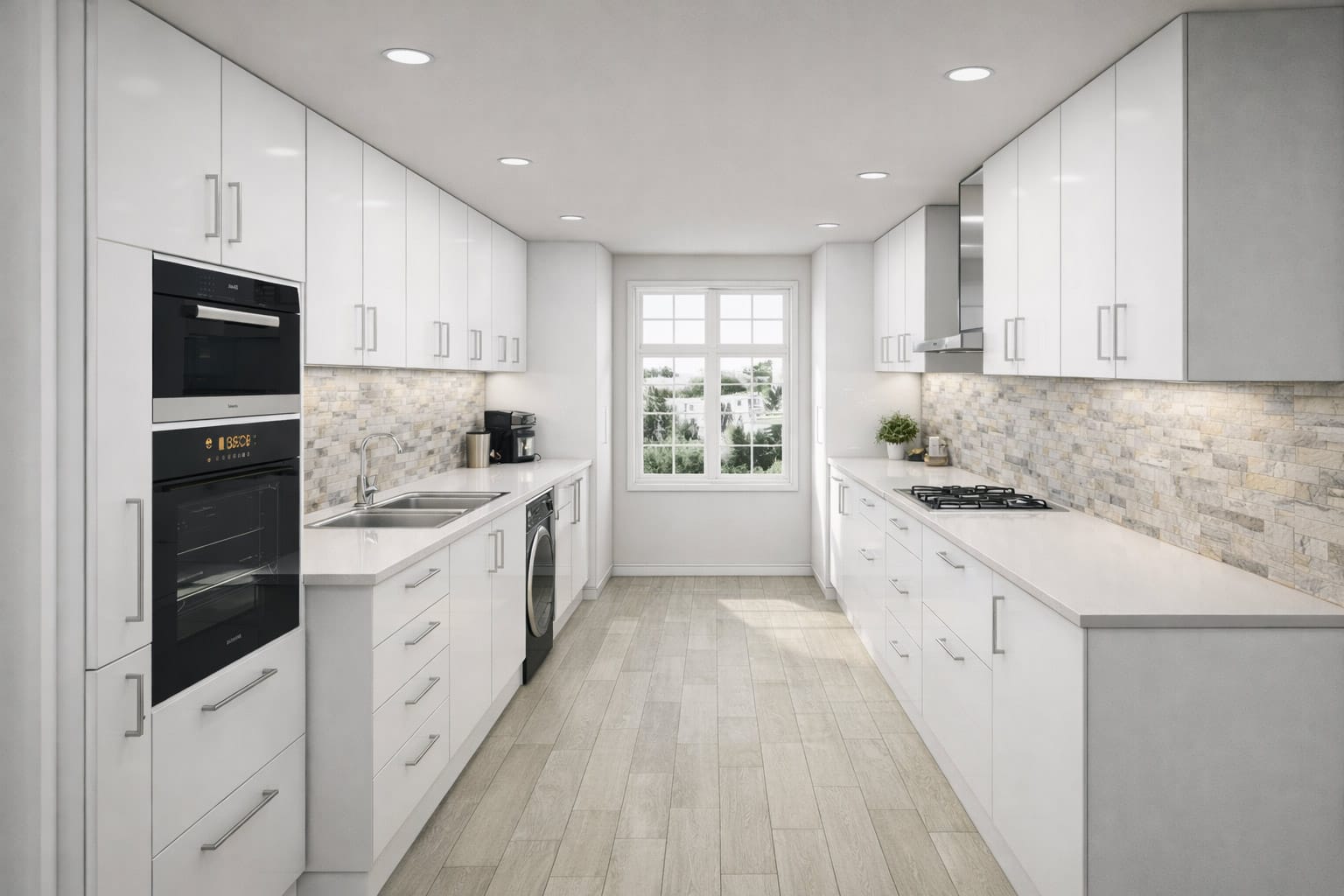
Galley kitchens have quietly stood the test of time — not because they’re trendy, but because they work. When space is long and narrow, few kitchen layout shapes are as efficient or practical as a well-planned galley kitchen.
Despite the reputation, galley kitchens aren’t outdated or restrictive. In fact, when designed properly, they’re one of the most functional kitchen layouts available. Two parallel runs of cabinetry create a natural workflow, generous storage, and clear work zones that make everyday cooking feel easier, not cramped.
This is where planning really matters. In a galley kitchen, small decisions have a big impact. Cabinet depth, appliance placement, and walkway spacing all need to be right because there’s no room to hide mistakes. Get the layout wrong, and the kitchen feels tight. Get it right, and it feels streamlined, organised, and effortless to use.
At Ross’s Discount Home Centre, we’ve planned and supplied cabinets for galley kitchens in Perth for decades. What we’ve seen time and again is that a thoughtfully designed galley kitchen isn’t a compromise — it’s simply a smart use of space that rewards good planning. That’s exactly why we’ve put this guide together.
What Is a Galley Style Kitchen?
A galley kitchen is a layout where cabinets, appliances, and benchtops are arranged along two parallel runs, facing each other. This creates a central walkway with all key work zones kept within easy reach, making it one of the most efficient kitchen layouts when space is limited.
There are two common variations of the galley kitchen layout. A single-ended galley is closed off at one end, often with a wall or window, while a through-galley is open at both ends, allowing movement between spaces. Both can work well — the right option depends on how the kitchen connects to the rest of the home.
Unlike one wall kitchens, which rely on a single run of cabinetry, galley kitchens use both sides of the room to increase storage and bench space without increasing the footprint. Compared to L-shaped layouts, galley kitchens are more linear and compact, making them particularly suited to narrow kitchen spaces where width is limited, but length is available.
Rather than prioritising visual openness, galley kitchens are designed around workflow. With everything positioned close together, the layout reduces unnecessary movement and keeps tasks efficient — provided the spacing and planning are done properly.
Is a Galley Kitchen Right for Your Space?
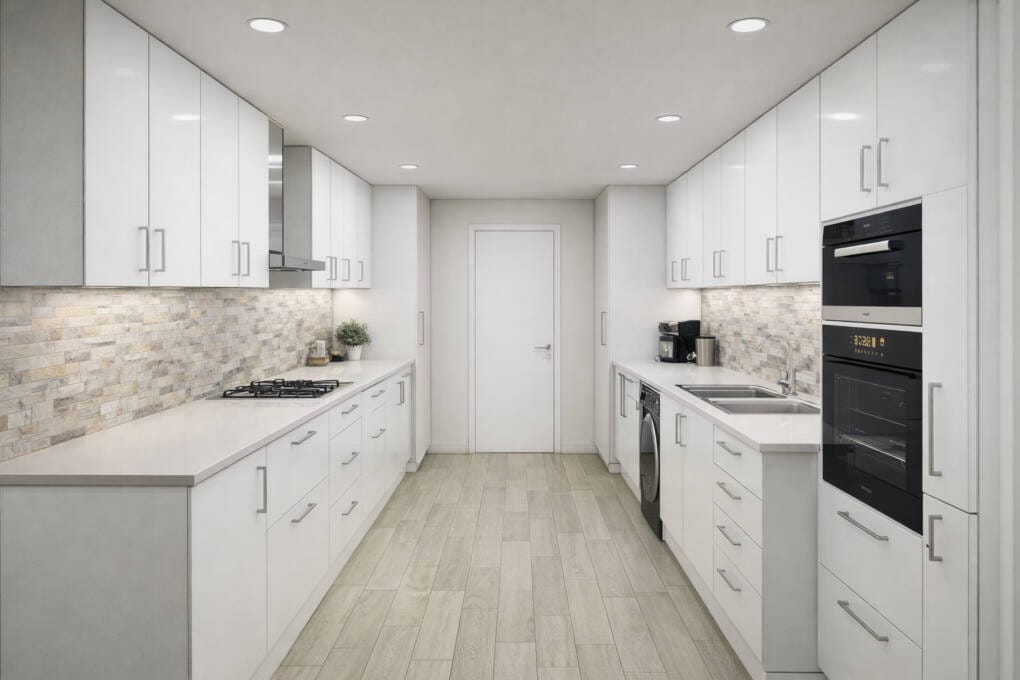
A galley kitchen can be an excellent solution — but it’s not a universal fit. Before committing to this layout, it’s worth stepping back to consider how the space is shaped, how the kitchen connects to the rest of the home, and how it will be used day to day.
Spaces Where Galley Kitchens Work Best
Galley kitchens work best when the space is shaped to support them, rather than when another layout is forced to fit. When width is limited, but wall length is available, a galley layout often makes better use of the room and delivers a more practical day-to-day kitchen.
They’re particularly well suited to:
- Long, narrow spaces: Where two parallel runs can be accommodated comfortably without crowding
- Homes with structural constraints: Fixed walls or services that limit layout flexibility
- Compact kitchens: Where efficient storage and workflow matter more than visual openness
- Separated kitchen areas: Spaces that aren’t required to double as a social hub
- Renovations within an existing footprint: Where making better use of the available space is the priority
When a Galley Kitchen Can Feel Restrictive
A galley kitchen can start to feel tight when proportions aren’t right or when the kitchen is expected to do too many things at once. In these situations, the layout itself isn’t the issue — it’s how the space is being asked to function.
A galley kitchen may feel restrictive when:
- Walkways are too narrow: Especially once appliance doors and drawers are open
- Foot traffic is high: Multiple people are using the space at the same time
- Natural light is limited: Fully enclosed kitchens without good artificial lighting
- Openness is the priority: Homes where the kitchen is meant to feel visually open and social
Planning the Layout — Why Galley Kitchens Live or Die by Spacing
In a galley kitchen, layout decisions matter more than finishes, appliances, or even cabinet style. Because everything runs in parallel, spacing determines whether the kitchen feels efficient and easy to use or tight and frustrating. Get the spacing right, and a galley kitchen flows naturally. Get it wrong, and no amount of good cabinetry will fix it.
The Ideal Galley Kitchen Workflow
Galley kitchens work so well because they naturally support an efficient work zone. With benches and appliances facing each other, movement is kept short and purposeful, which is why this layout is often described as one of the most practical for limited-space kitchens.
A common and effective approach is to split tasks across the two runs. One side typically handles preparation and cleaning, with the sink and main prep space, while the opposite run handles cooking, with the cooktop and oven. This separation keeps tasks organised and reduces crossover, especially in narrower kitchens.
Unlike larger kitchen layouts, such as L-shaped and U-shaped kitchens, galley kitchens don’t rely on a traditional work triangle. Instead, everything is kept within arm’s reach. When planned properly, this creates a compact, logical workflow that suits everyday cooking rather than occasional entertaining.
If you’re unsure how to sequence cabinets and appliances effectively, our guides on How to Design a Functional Kitchen and How to Arrange Kitchen Cabinets for Optimal Functionality explain these principles in more detail and show how good workflow translates into real layouts.
How Wide Should a Galley Kitchen Be?
Spacing is where most galley kitchens succeed or fail. Walkways that look fine on paper can quickly feel cramped when cabinets, appliances, and people are added to the equation.
As a general guide, the minimum clear walkway between opposing benchtops should be around 900mm. This can work in smaller kitchens, but it leaves little margin for error. A more comfortable and practical width is 1,000–1,200mm, which allows people to move past each other and gives appliance doors room to open without blocking the space.
Appliance clearances need to be considered carefully. Dishwashers, ovens, and fridge doors all swing into the walkway, so spacing needs to account for doors being open while someone else is working opposite. You also need to factor in appliance depth and access — not just how the appliance fits once installed, but whether it can actually be manoeuvred through hallways, doorways, and into the kitchen in the first place. Ignoring these details is one of the quickest ways to make a galley kitchen feel frustrating to use.
Where people get into trouble is guessing. Small differences in cabinet depth, appliance size, or clearance can have a big impact in a narrow kitchen. Once cabinets are installed, those mistakes are difficult — and expensive — to fix. That’s why accurate planning and visualising the layout using tools like a 3D kitchen planner before ordering anything is especially important in a galley kitchen.
Storage Advantages of Galley Kitchens (When Designed Properly)
One of the biggest misconceptions about galley kitchens is that they lack storage. In reality, a well-designed galley kitchen can be one of the most storage-efficient layouts available. By working with two parallel runs instead of a single wall, you gain usable cabinet space without increasing the footprint — provided both sides are planned properly.
Using Both Walls Effectively
Compared to one wall kitchens, galley layouts naturally offer more opportunities for storage. Having cabinetry on both sides allows you to balance storage and workflow rather than forcing everything into one run.
- A practical approach is to use kitchen drawers heavily on the main working side of the kitchen, where quick access to cookware, utensils, and everyday items matters most. Drawers are generally easier to use than cupboards in narrow spaces and reduce the need to bend or reach deep into cabinets.
- On the opposite run, base cupboards can work well for larger or less frequently used items, helping keep the main prep and cooking areas clear and uncluttered. This balance prevents the kitchen from feeling crowded while still maximising storage.
- Wall cabinets need more restraint in galley kitchens. Used thoughtfully, they add valuable storage. Overused, they can make the space feel tight and closed in. In many cases, fewer wall cabinets combined with better base and drawer storage create a more comfortable and visually balanced result.
Pantries and End-of-Run Storage
Tall pantry cabinets are often where galley kitchens really shine. Placing pantries at the end of a run, rather than mid-run, helps maximise storage without interrupting the workflow or blocking sightlines down the kitchen. This keeps the space feeling open while still delivering serious storage capacity.
End-of-run areas are often overlooked, but they’re ideal for turning what would otherwise be dead space into something useful. Tall cabinets, appliance housing, or additional storage can all work here, as long as they’re planned to suit the room proportions.
This is also where accurate planning becomes important. Knowing exact cabinet sizes and depths makes it much easier to place pantries and tall units without crowding walkways or creating visual bulk. Our pre-assembled kitchen cabinets, with fixed dimensions and consistent sizing, make this process simpler — especially in galley kitchens where precision matters and there’s little room for adjustment during installation.
Appliance Planning in a Galley Kitchen
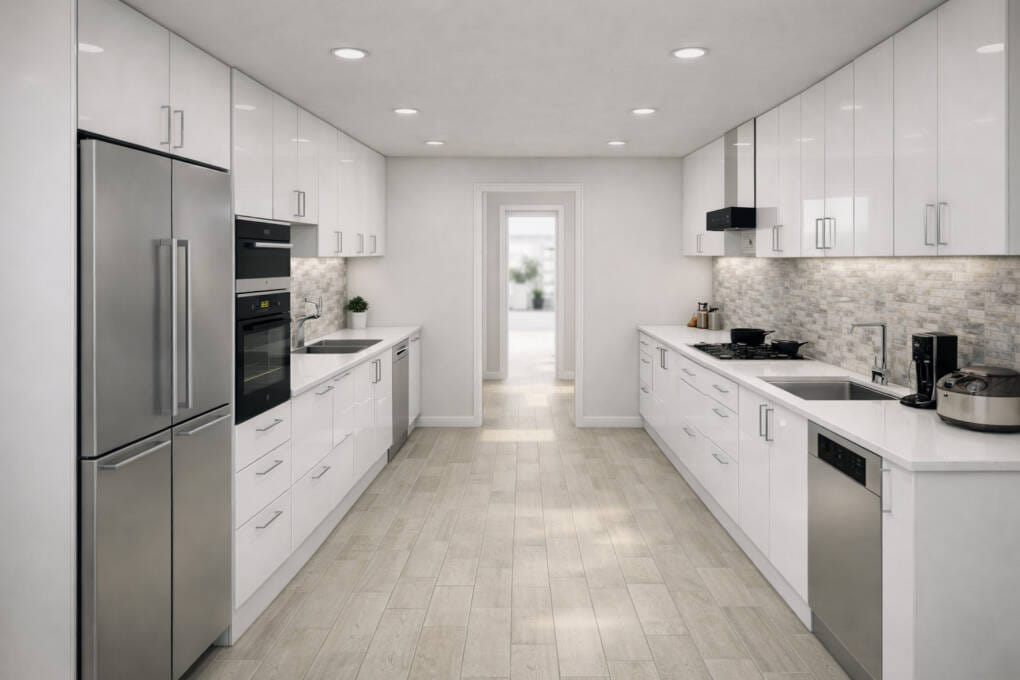
Appliance planning is where many galley kitchens run into trouble. Because appliances sit opposite each other, poor placement can quickly create bottlenecks and clearance issues that are hard to live with day to day. In this layout, appliances need to work together — not compete for the same space.
While the traditional kitchen triangle still matters, galley kitchens apply it differently. Instead of spreading the fridge, sink, and cooktop across a room, a galley layout keeps these zones close and aligned across opposing runs. This shortens movement and keeps tasks efficient, provided each zone has enough space to operate without conflict.
A common and effective approach is to place the sink and main prep area on one side, with the cooktop and oven opposite. This separates cleaning and cooking tasks while keeping everything within easy reach. What matters most here is not appliance brand or features, but appliance depth and door swing. In narrow kitchens, depth has a bigger impact on usability than width, especially when multiple doors are open at once.
Built-in appliances generally suit galley kitchens better than freestanding models. Integrated ovens, cooktops, and dishwashers sit flush with cabinetry, keeping the walkway clear and reducing visual bulk. Freestanding appliances can work, but they need to be chosen carefully to avoid encroaching on circulation space.
Dishwashers and ovens deserve particular attention. If both are placed directly opposite each other, opening doors at the same time can block the walkway entirely. Planning these appliances slightly offset, or positioning them at the ends of runs, helps avoid congestion and keeps the kitchen functional during busy times.
Bench Space and Prep Zones — Getting the Balance Right
One of the biggest misconceptions about galley kitchens is that they lack bench space. In practice, a well-designed galley kitchen often provides more usable prep space than larger layouts, simply because benches are continuous and positioned close to key work zones.
The key is prioritising uninterrupted prep zones. Long, clear benchtops between the sink, cooktop, and fridge make everyday tasks easier and reduce clutter. Broken benches, small gaps, or too many appliances interrupting the run quickly erode the space’s usability.
Seating is where galley kitchens often get overcomplicated. In most true galley layouts, there isn’t enough width to comfortably add seating without compromising bench space or walkways. Where seating is forced in, prep areas usually suffer.
Kitchen islands are rarely suited to galley kitchens unless the room is unusually wide. Adding an island often turns an efficient layout into a crowded one. If extra bench space is needed, extending existing benchtops or using a movable island is usually a better solution than trying to fix seating into the layout.
When planned properly, galley kitchens don’t feel short on workspace at all. By focusing on bench continuity and keeping the layout clear, the kitchen becomes easier to use, faster to work in, and more enjoyable day-to-day.
Design Choices That Stop Galley Kitchens Feeling Closed In
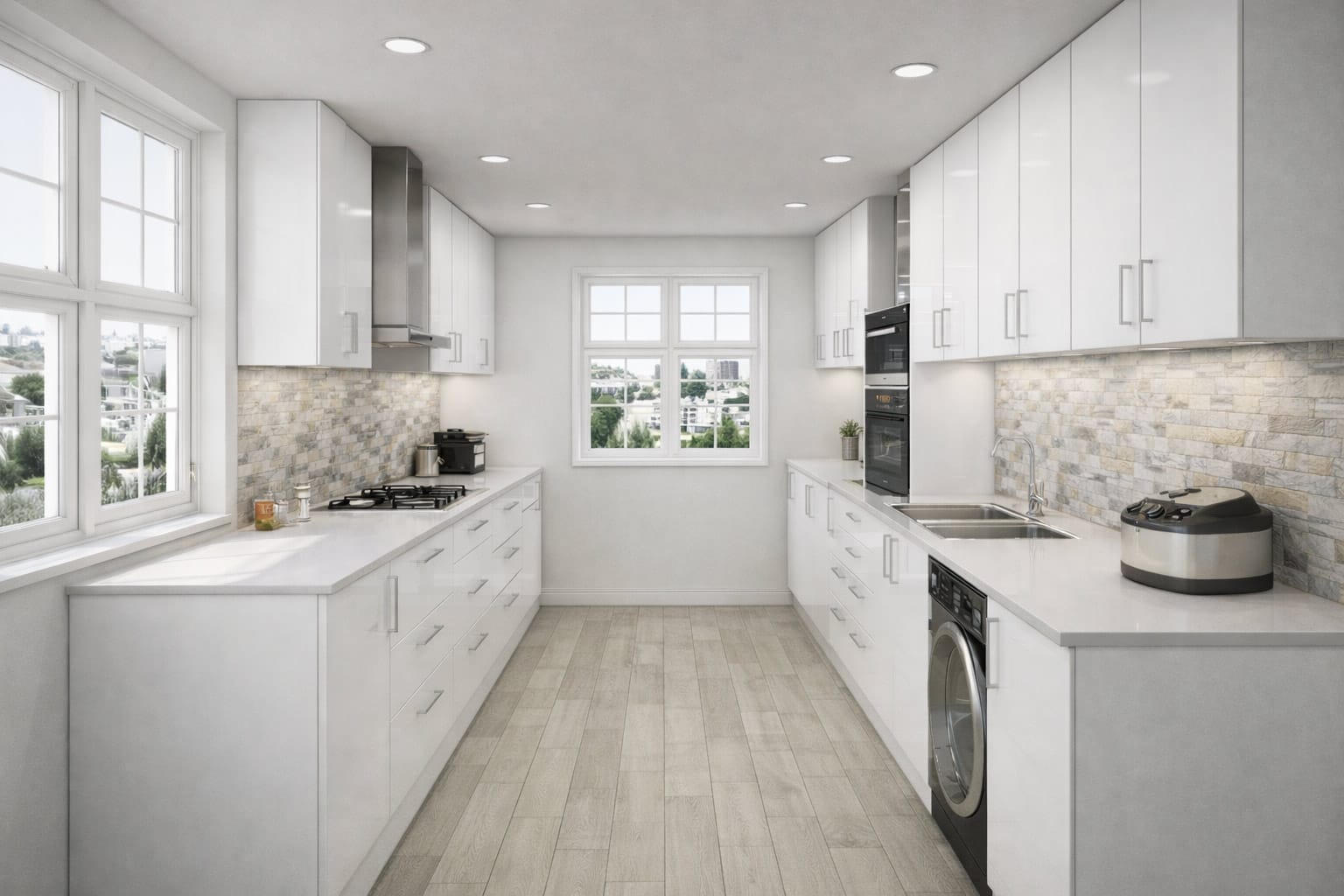
Because galley kitchens are naturally linear and enclosed, design choices play a big role in how the space feels day to day. The right finishes and details can make a narrow kitchen feel open and comfortable, while the wrong ones can exaggerate the sense of tightness — even when the layout itself is sound.
A few design decisions consistently make a difference:
- Light-reflective finishes: Light kitchen colours help bounce both natural and artificial light around the room, making the space feel wider and brighter. Gloss and semi-gloss finishes are particularly effective in narrower kitchens.
- Consistent cabinetry across both runs: Using the same cabinetry style and finish on both sides helps the kitchen read as one continuous space, rather than two competing walls. This visual consistency reduces clutter and keeps the layout feeling balanced.
- Handle styles and minimal detailing: Slimline bar handles or integrated handle options keep cabinet faces clean and uninterrupted. Heavy detailing or oversized handles can quickly make a galley kitchen feel busy.
- Splashback and lighting choices: Continuous splashbacks, lighter materials, and well-placed task lighting all help widen the space visually and prevent dark, enclosed corners.
This is why our white 2PAC kitchen cabinets work particularly well in galley kitchens. Their reflective surface helps maximise light, while the clean finish supports the streamlined look that narrow spaces benefit from.
Galley Kitchen Layout Ideas from Real Kitchen Designs
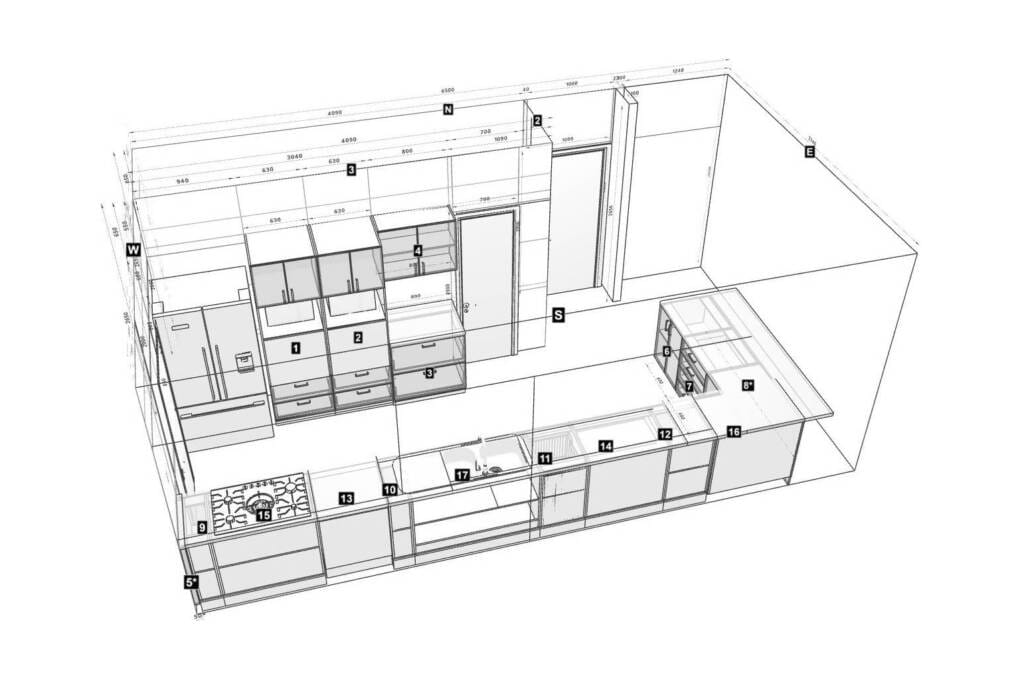
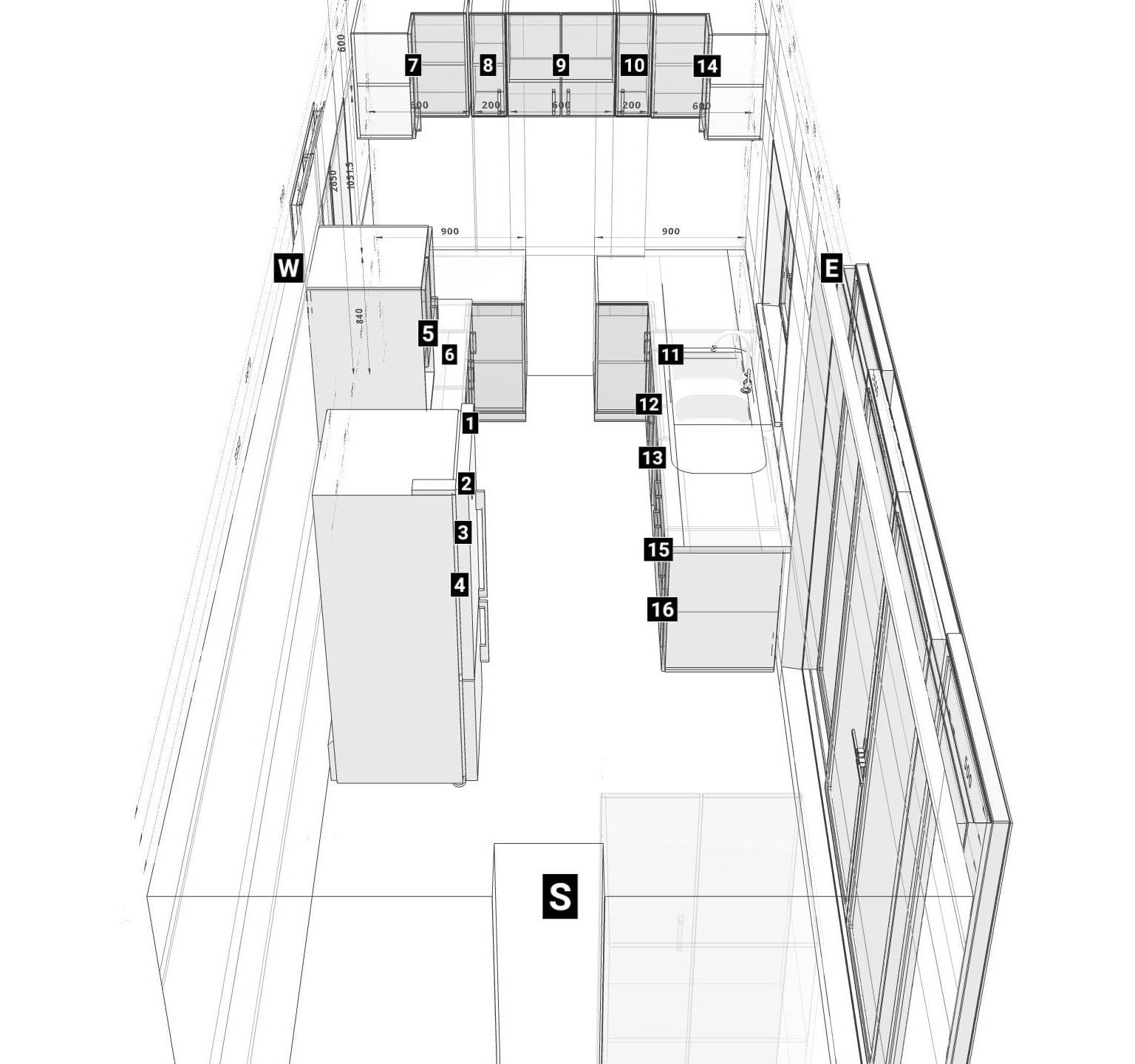
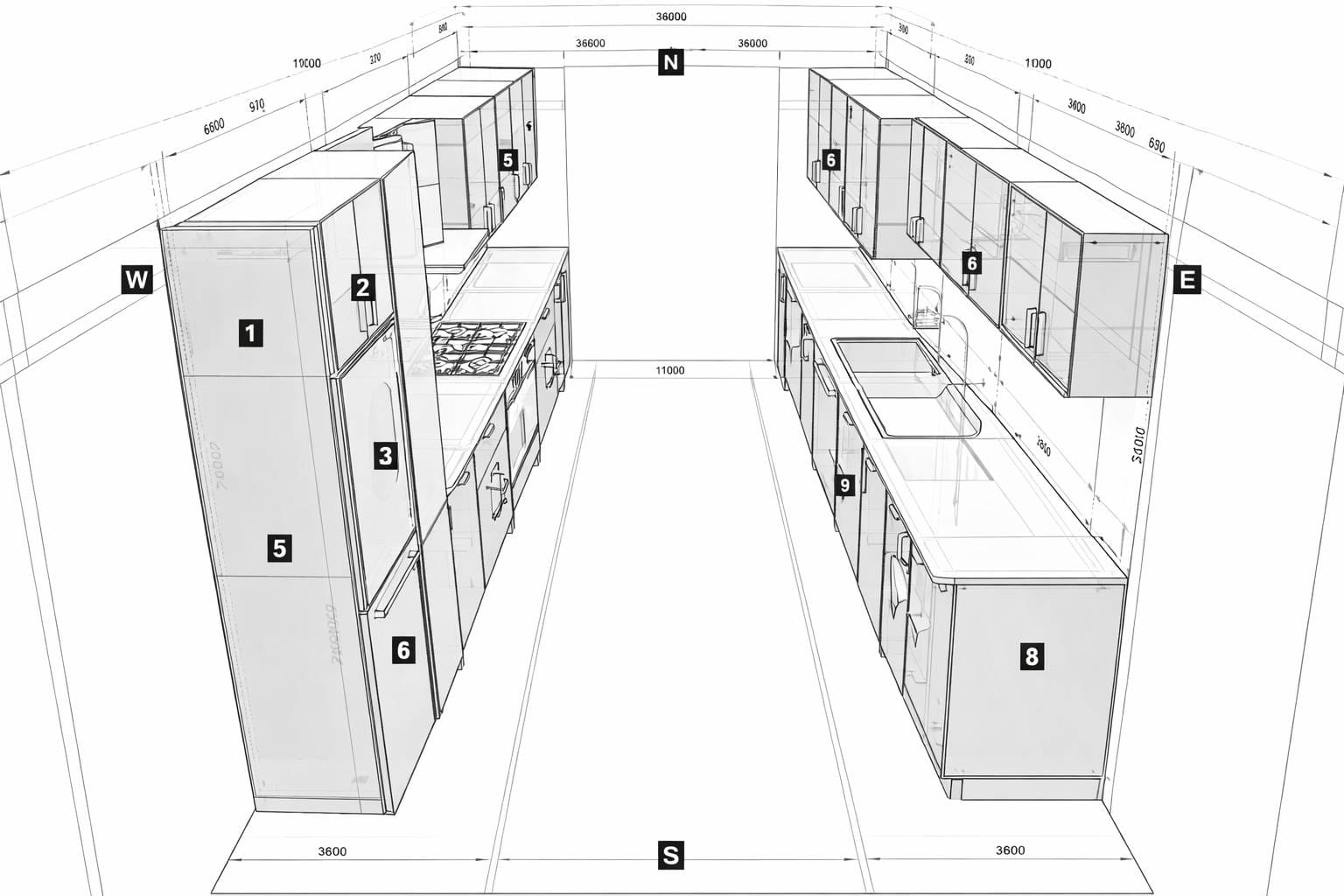
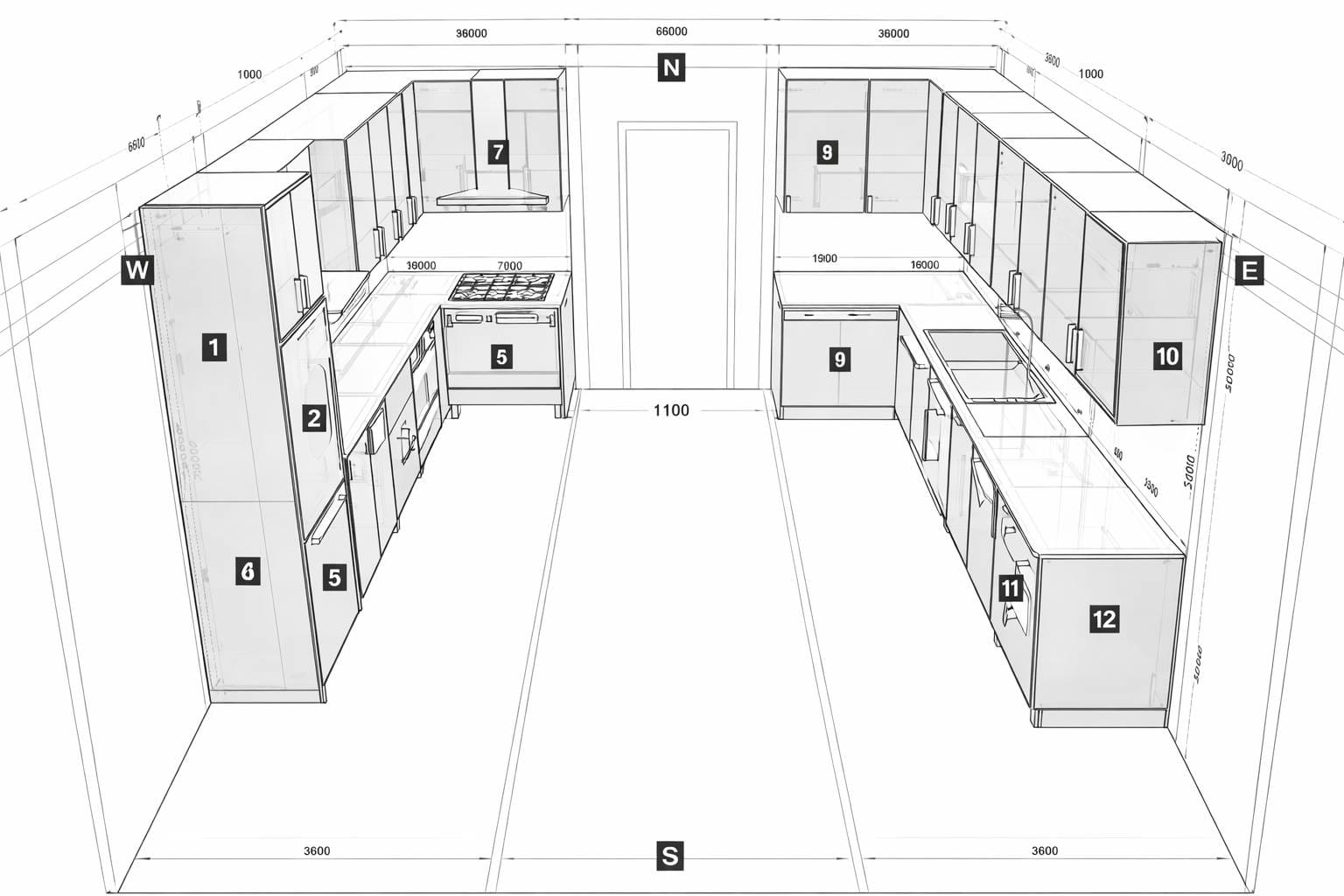
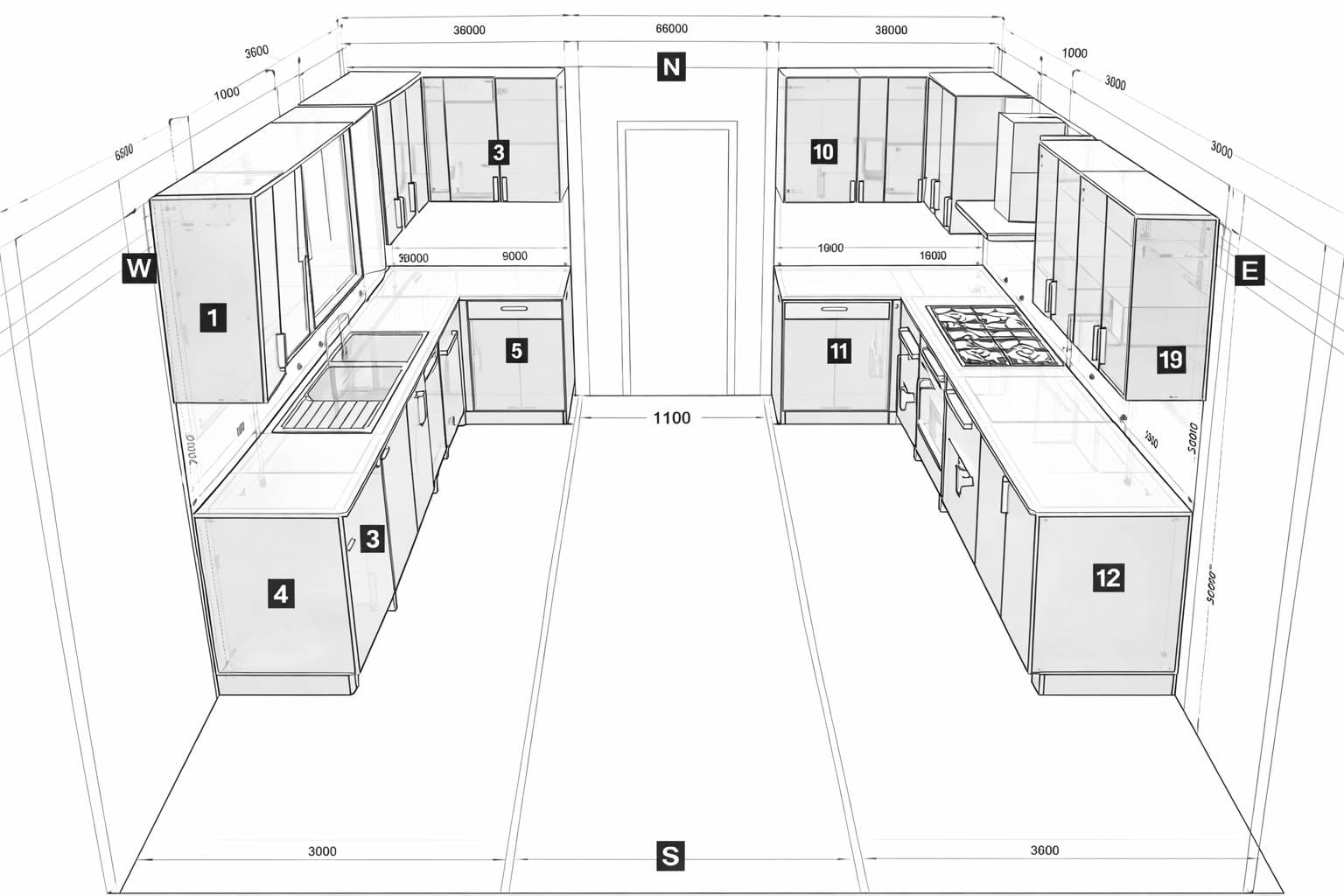
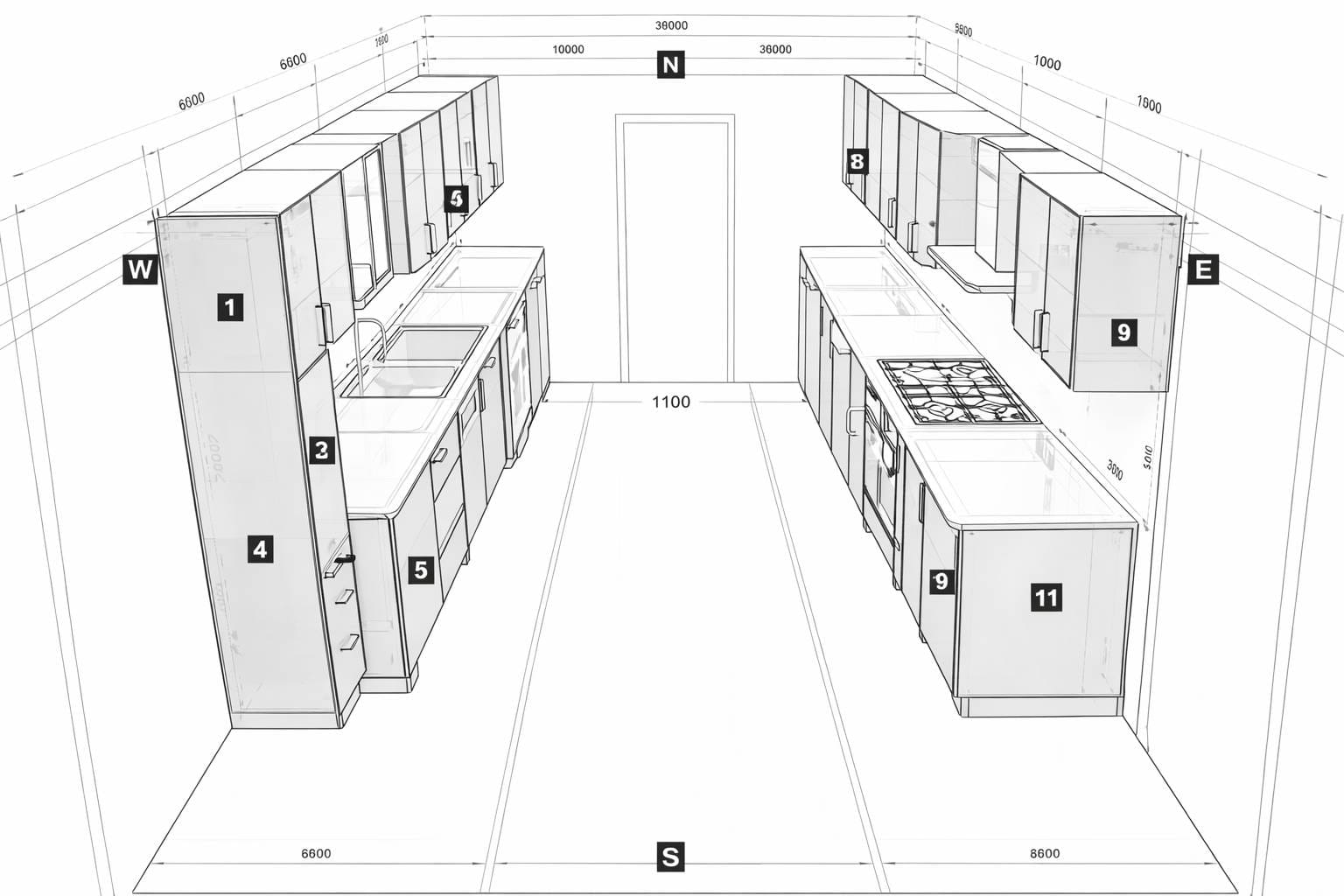
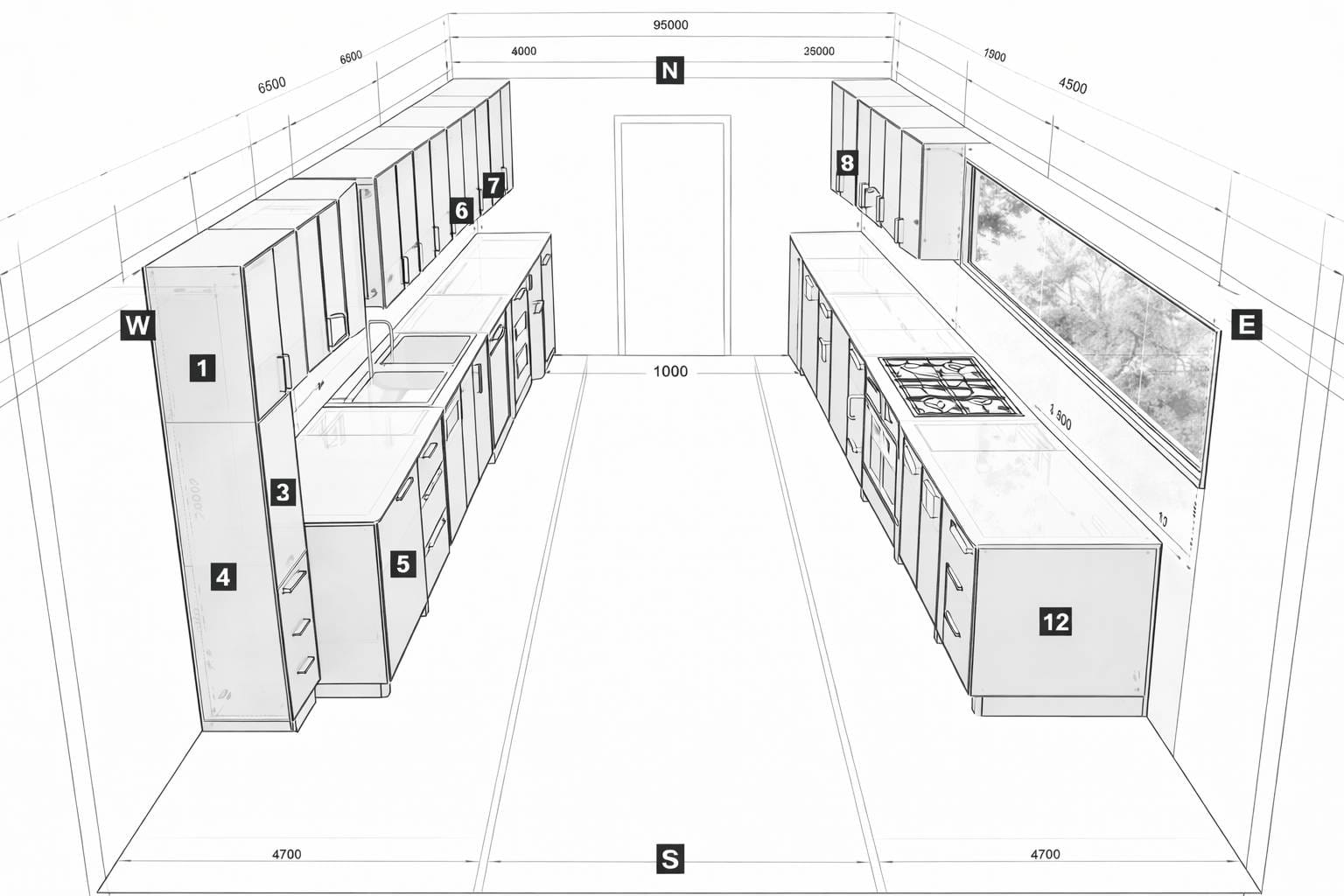
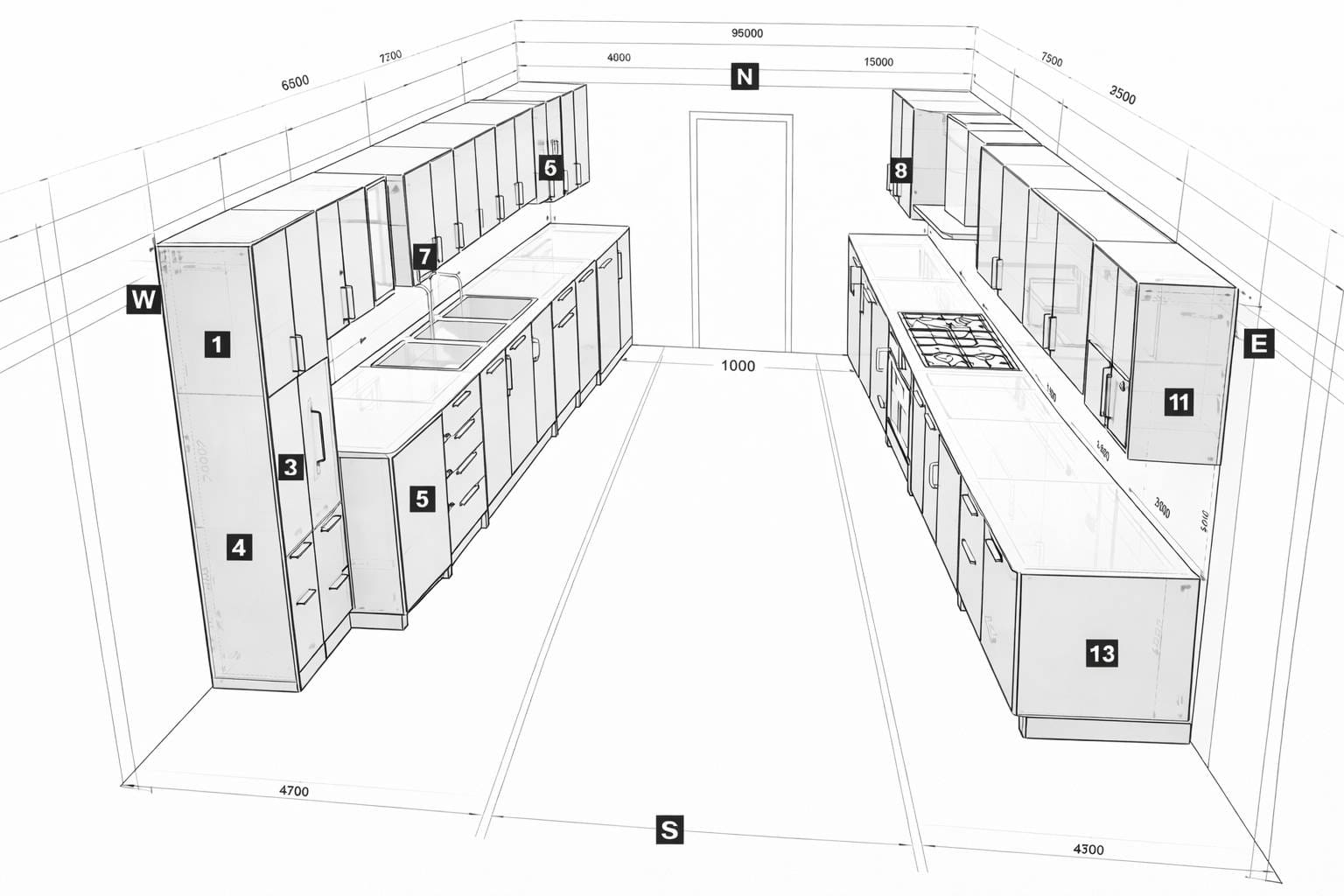
Need galley kitchen design inspiration? The galley kitchen layout ideas below are actual customer kitchens, created using our 3D planner. They show how different cabinet configurations work in narrow spaces, with examples suited to both compact and longer kitchen footprints.
You’ll see how layout decisions, such as appliance placement, pantry placement, and walkway spacing, affect a galley kitchen’s day-to-day performance. The aim is simple: provide practical inspiration you can adapt to your own space before locking in your final layout.
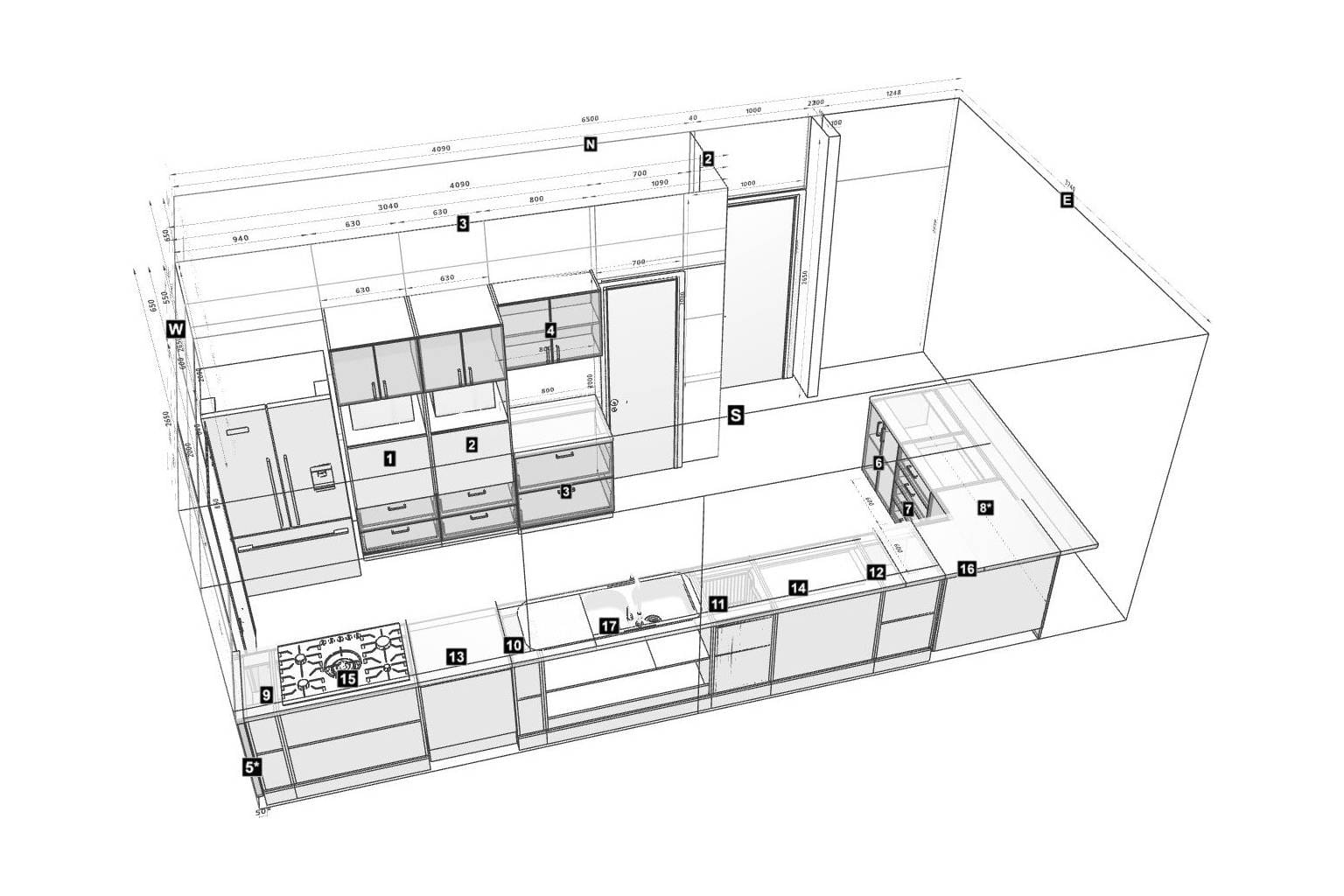
Plan Before You Buy — Why Galley Kitchens Demand Precision
Galley kitchens leave very little room for guesswork. With cabinets and appliances facing each other, small planning mistakes quickly become daily frustrations. Clearances, door swings, and cabinet depths all need to be right, because there’s nowhere else in the room to compensate.
Issues often arise when layouts aren’t visualised properly upfront. Appliance doors clash, walkways feel tighter than expected, or cabinets protrude just enough to disrupt the flow. Fixing these problems after installation can mean costly rework, replacement cabinetry, or compromised usability.
That’s why planning first is so important in a galley kitchen. Designing the layout using real cabinet sizes allows you to check clearances, test appliance placement, and confirm that everything works together before anything is ordered.
Using a galley kitchen planner or our 3D kitchen planner helps remove uncertainty. When you design with accurate cabinet dimensions and appliance allowances, you can see exactly how the kitchen will function and make informed adjustments early. In a layout where precision matters this much, designing first and ordering second isn’t optional — it’s what protects the end result.
Common Galley Kitchen Mistakes to Avoid
Most galley kitchen issues don’t come from the layout itself — they come from small planning decisions that compound once the kitchen is installed. These are the most common galley kitchen design mistakes we see, and they’re almost always preventable with proper planning upfront.
- Walkways that are too narrow: What looks acceptable on paper can feel cramped once cabinets, appliances, and people are added. Clearance matters more in galley kitchens than almost any other layout.
- Appliances placed directly opposite each other: Dishwashers, ovens, and fridges need room for doors to open. When appliances face each other, the walkway can become unusable.
- Overloading both walls with overhead cabinets: Too many wall cabinets can make the space feel boxed in and dark. Storage needs to be balanced with visual breathing room.
- Ignoring lighting and power placement: Poor lighting exaggerates narrow spaces, and badly placed power points quickly become impractical once the kitchen is in use.
- Choosing cabinets before confirming the layout: Selecting cabinets first often forces the layout to work around fixed sizes, rather than designing the space properly from the start.
Avoiding these kitchen planning errors is less about spending more and more about thinking through how the kitchen will actually function day to day.
Final Thoughts — A Galley Kitchen Can Be One of the Most Efficient Layouts
Galley kitchens aren’t outdated — they’re practical, efficient, and ideal for many Australian homes. When the proportions are right, they offer excellent storage, clear workflow, and a layout that makes everyday cooking easier rather than harder.
What makes the biggest difference isn’t the finish or the latest trend, but the planning behind the layout. Spacing, kitchen cabinet placement, appliance clearances, and lighting all play a bigger role here than in most other kitchen designs.
If you’re considering a galley kitchen for your Perth home, start by finalising the layout, then choose kitchen cabinets that suit the space—not the other way around. If you’d like help getting the details right, call 1300 133 186 to book a free kitchen design consultation with our kitchen specialist, Fiona. Together, we can help you plan a galley kitchen that fits your space, your appliances, and how you actually use it.
