
Wall-to-Wall Shower Screens: How to Choose the Right One for Your Alcove
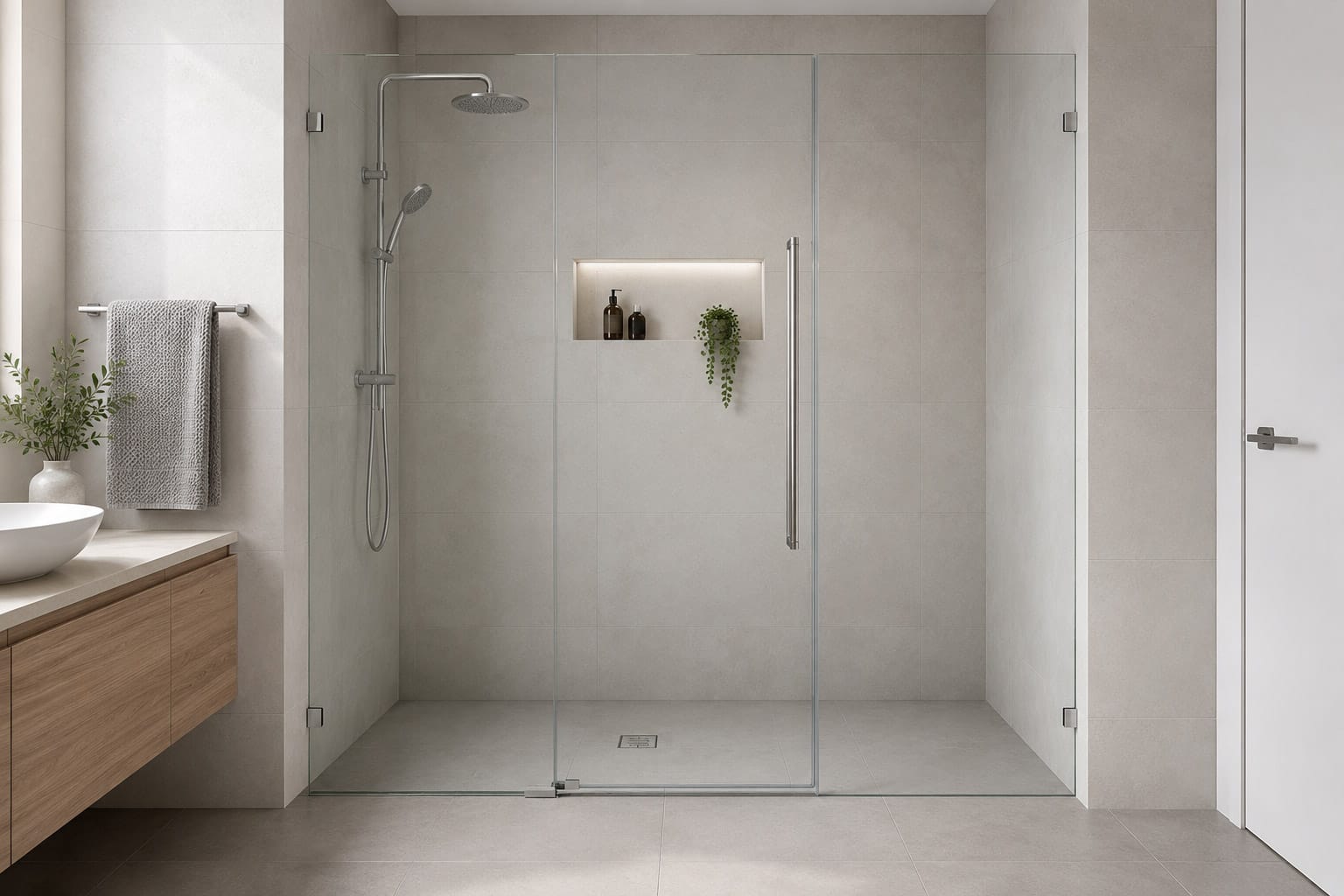
Two tiled walls, a tape measure, and no idea what to order. That’s where most Perth homeowners start. If that’s you right now, you’re in the right place. Choosing the right wall-to-wall shower screen for your alcove comes down to four decisions: your wall-to-wall span, your door type, your framing style, and your finish. Get those four things right, and the rest falls into place.
A few years back, I made an expensive mistake at home that I now use as a cautionary tale with customers. I ordered a standard pivot door for a wider-than-average bathroom-width opening, didn’t double-check the span before hitting confirm, and had to return it. The product wasn’t wrong. I’d just bought the wrong product for the span. Since then, I have always led with the measurement — and this guide will do the same.
We’ll work through each decision in order, so by the end you’ll know exactly which screen suits your space, how to measure for it, and what to look for before you buy.
What Is a Wall-to-Wall Shower Screen?
A wall-to-wall shower screen spans the full width between two parallel tiled walls in a shower recess or alcove, enclosing the shower with a door and one or more fixed glass panels. It is the most common shower enclosure configuration in Australian homes.
It’s different from a corner shower screen, where two glass panels meet at a 90-degree angle across adjacent walls. It’s also different from a walk-in shower panel, which is a single fixed glass panel with no door — typically used in open, doorless shower designs. If you have two walls facing each other with a gap between them that needs closing off, you have an alcove shower, and a wall-to-wall screen is what you need.
In my experience, this configuration turns up in the overwhelming majority of bathrooms I see — particularly in older Perth homes where the shower recess was built directly into the wall as part of the original layout. It’s practical, it’s space-efficient, and stock screens are designed around it.
Once you’ve confirmed the configuration, the next question determines which product you need: how wide is the gap between your walls?
Which Wall-to-Wall Screen Suits Your Span?
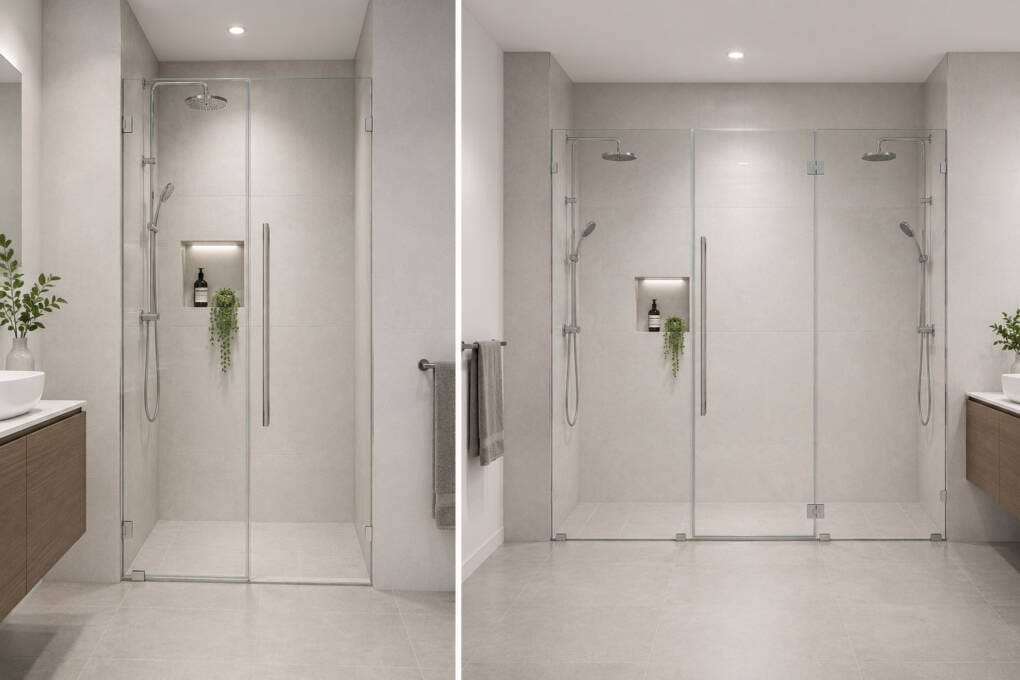
The first thing to nail down is the distance between your two walls — because that single measurement determines which product you need. Two span ranges cover the full width of alcove showers we see in Perth bathrooms, and knowing which one you’re in makes the decision easy.
Standard Shower Recesses: 750mm to 1,900mm
For most wall-to-wall shower recesses, a standalone shower door is all you need. Sliding, pivot, frameless, and semi-frameless configurations all work at standard alcove widths — the right choice comes down to door type and framing style, which we’ll cover in the next two sections. Browse the full range of shower doors to see the options.
Wider Openings: 950mm to 3,100mm
For wider spans, including full bathroom-width openings or larger ensuites, the Alpine Frameless Centre Pivot Door is the product designed for the job. This 3 panel wall to wall shower screen comprises a centre-pivoting door flanked by two fixed side panels, one on each side. Each side panel is available from 200mm to 1,200mm, and the door adjusts across the same 150mm range. It offers wall-to-wall frameless shower screen coverage of up to 3,100mm — enough for even a full bathroom-width opening. For panels 900mm and above, a horizontal bracing arm is required.
All Alpine screens use 10mm toughened PureViewHD glass, meeting AS/NZS 1288 and AS/NZS 2208 requirements for safety glazing in wet areas.
| Standard Recesses (up to 1,900mm) | Wider Openings (up to 3,100mm) | |
| Best for | Alcove showers with two parallel walls at standard bathroom widths | Wide ensuites, full bathroom-width openings |
| Wall-to-wall span | 750mm – 1,900mm | 950mm – 3,100mm |
| Door options | Sliding, pivot, frameless, semi-frameless | Alpine Frameless Centre Pivot Door |
| Door adjustment | Varies by product | 150mm (550–700mm) |
| Fixed panels | 1 fixed panel (size varies by product) | 2 fixed panels (200mm – 1,200mm each) |
| Glass | 6mm or 10mm toughened (varies by product) | 10mm toughened PureViewHD |
| Warranty | Varies by product | Lifetime (domestic) |
| Finishes | Varies by product | Chrome, matte black, white, brushed nickel, brushed gold, gunmetal |
For spans under 1,900mm, the full shower doors range has you covered. Browse by door type and framing style to find the right fit for your space. Over 1,900mm, the Alpine Frameless Centre Pivot Door is the right call. It carries a lifetime domestic warranty, comes in six finishes, and is the only stock screen that reaches up to 3,100mm wall-to-wall.
Sliding or Pivot Door — Which Is Right for Your Shower Recess?
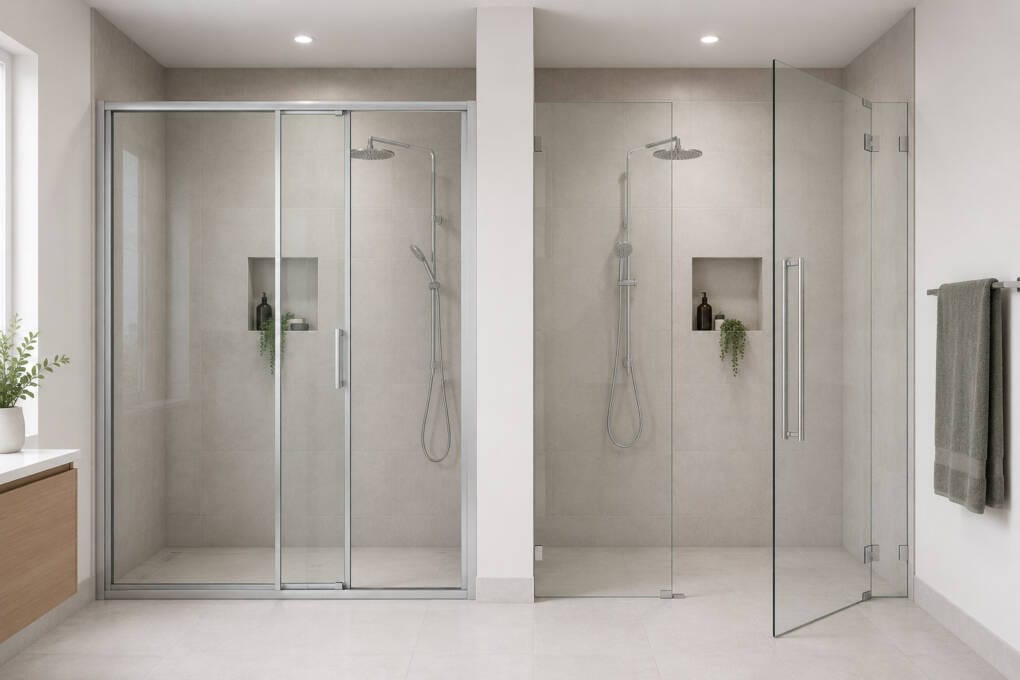
Most wall-to-wall shower screens come in two door configurations: sliding or pivot. For a wall-to-wall alcove, both work — but the right choice depends on how much bathroom space you have, whether outswing clearance is available, and how much maintenance you’re willing to do.
| Factor | Sliding Door | Pivot / Centre Pivot Door |
| Space needed | Minimal — no outswing required | Needs clearance for door swing (inward or outward) |
| Best for | Narrow bathrooms or where outswing is blocked | Medium to large bathrooms with clearance room |
| Water containment | Good — door overlaps fixed panel when closed | Excellent — magnetic seal, no track required |
| Maintenance | Track and rollers require regular cleaning | Low — minimal hardware, no track to clean |
| Glass thickness | Typically 6mm (semi-frameless) | 10mm (frameless) — more premium feel |
| Span range | Up to ~1,840mm | Up to 3,100mm with centre pivot configuration |
| Perth bore water | Track can accumulate mineral deposits | EasyClean nano-coating reduces buildup significantly |
Sliding doors are a practical choice for narrower bathrooms where there’s simply no room for a door to swing. But where space allows, a pivot door is the better long-term option — lower maintenance, better water sealing via the magnetic seal, and no track to worry about.
That last point matters more here in Perth than in most places. A customer came in a while back, frustrated — her sliding screen track had turned into a calcium graveyard thanks to bore water. She switched to a frameless pivot door with EasyClean nano-coating and hasn’t looked back. Hard bore water and sliding tracks are not a great combination, and it’s something I flag with anyone buying a wall-to-wall sliding shower screen in Perth.
For a full breakdown of door types across all bathroom configurations, see our full comparison of sliding, hinged, and pivot shower screens.
Frameless or Semi-Frameless — What Changes in a Wall-to-Wall Install?
The framing decision is simpler for wall-to-wall installs than it might seem. With two fixed walls and a floor doing the structural work, there’s no corner join to manage — you’re choosing between two clean, modern options that both suit the alcove configuration well.
Frameless screens use 10mm toughened glass fixed directly to the tile via wall channels or hinges. Minimal hardware, easy to clean, and a very open look. The trade-off is that plumb walls matter — the adjustment tolerance built into Alpine stock screens handles minor variation, but if your walls are significantly out of square, frameless can be harder to install cleanly. In practice, frameless works best in newer Perth homes where walls are built to standard.
Semi-frameless screens use 6mm toughened glass with a slimline aluminium frame at the edges. That frame adds adjustment tolerance, making semi-frameless the more forgiving choice for older Perth homes — pre-1990 construction especially — where walls can be out of square by more than 10mm. There’s slightly more hardware to clean around, but the look is still sharp and contemporary.
| Factor | Frameless (10mm glass) | Semi-Frameless (6mm glass) |
| Visual style | Maximum glass, minimal hardware | Clean — slimline frame visible at edges |
| Wall tolerance | Suits plumb, even walls | More forgiving of out-of-square walls |
| Glass thickness | 10mm toughened | 6mm toughened |
| Maintenance | Easy — less hardware to clean around | Slightly more — aluminium frame at edges |
| Best Perth context | Newer homes (post-2000 builds) | Older Perth homes (pre-1990) with less plumb walls |
| Price | Higher (premium glass, less hardware) | Lower — more affordable entry point |
For a wall-to-wall frameless shower screen, the key question is whether your walls are reasonably plumb. If they are, frameless is the better long-term choice — less to clean, better visual result. If you’re in an older home and not sure, semi-frameless gives you more room to move. Browse our frameless shower screens and semi-frameless shower screens to compare what’s available, or read our frameless shower screen buying guide for a deeper look at the differences.
How to Measure for a Wall-to-Wall Shower Screen
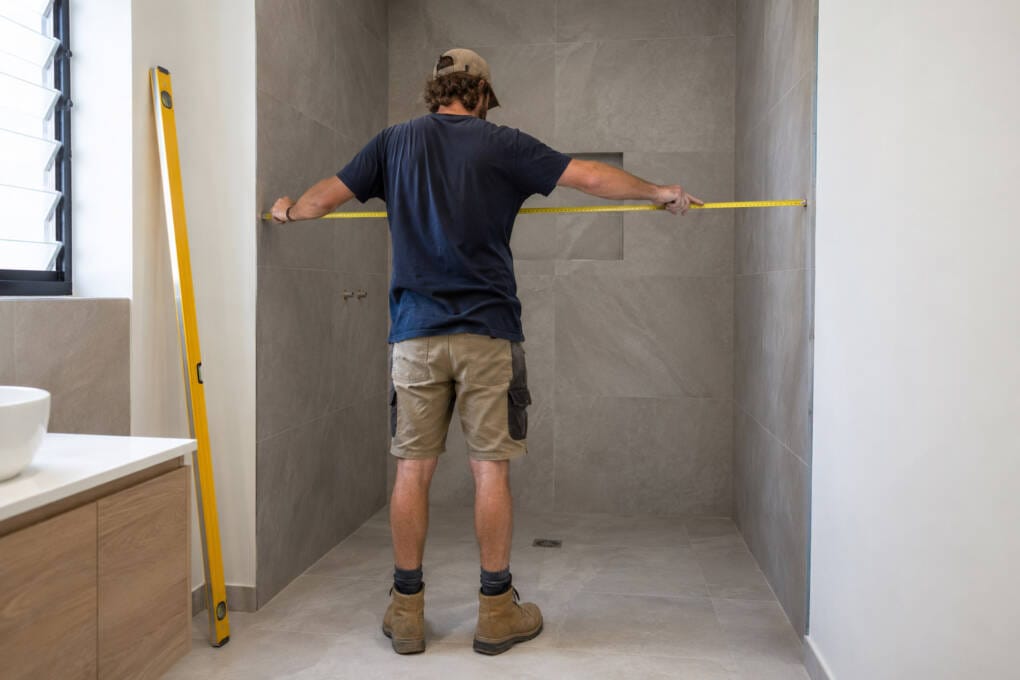
Measuring for a wall-to-wall shower screen is easier than most people expect. You’re working with two fixed walls and a floor — no corner joins, no custom enclosure to engineer. Three measurements are all you need before ordering.
1. Measure width at three heights
Take the wall-to-wall width at the top, middle, and bottom of the planned screen height. Use the smallest of the three measurements as your reference width. Most stock screens include 150mm of width adjustment built in, so a small deviation between measurements is fine — that’s what the adjustable wall-to-wall shower screen design accounts for.
2. Measure height
Standard stock screen height is 2,000mm. Measure from the floor or shower tray lip to where the top of the screen will sit and confirm ceiling height isn’t a constraint.
3. Check for out-of-square walls
Run a spirit level down both side walls. Minor deviations up to 10mm are handled by the wall channels and the adjustment range of stock screens. Greater deviations may need a wall channel extension or custom glass — flag this before ordering rather than after.
For step-by-step instructions with diagrams, see our guide: How to Measure a Shower Screen.
Choosing a Finish — and Why It Matters More Than You’d Think
Finish is usually the last decision, but in Perth, it deserves a bit more thought than elsewhere. Bore water is hard water, and some finishes show the effects more than others over time.
The Alpine frameless range — both the Centre Pivot Door and the standard Frameless Pivot Door — comes in six finishes: chrome, matte black, white, brushed nickel, brushed gold, and gunmetal.
Chrome is still the most popular. It’s easy to clean and suits almost any bathroom, but it shows water spots quickly in hard water areas. The EasyClean nano-coating on the PureViewHD glass helps significantly — it repels water and soap scum and cuts down how often the screen needs a proper clean.
Matte black is increasingly common in Perth renovations and hides water spots better than chrome. It works equally well in modern and Hamptons-style bathrooms. In matte black, this screen makes a strong visual statement without requiring much upkeep.
Brushed nickel and brushed gold are the finishes I’m seeing more of lately. Perth homeowners are choosing them for the same reason they’re choosing brushed tapware — the finish holds up better and doesn’t show every watermark. If you’re considering brushed gold hardware, it pairs particularly well with warm-toned tiles and brass fixtures.
Frequently Asked Questions
Conclusion
Choosing the right screen for a tiled alcove is one of the easier renovation decisions once you know what drives the choice. Start with your span — that single measurement tells you which product you need. From there, door type and framing style come down to your bathroom layout and your home’s age.
Most Perth shower recesses are covered by the standard door range. For wider openings up to 3,100mm, the centre pivot configuration handles it without custom glass. Either way, there’s a stock screen that fits.
When you’re ready to choose the right wall-to-wall shower screen for your alcove, browse our full range of shower doors online or come into our Guildford showroom. Perth Metro delivery is $100 flat rate, and every purchase comes with a 14-day money-back guarantee.
