
Travertine Look Tiles vs Natural Travertine: What’s the Difference and Which Is Right for Perth?
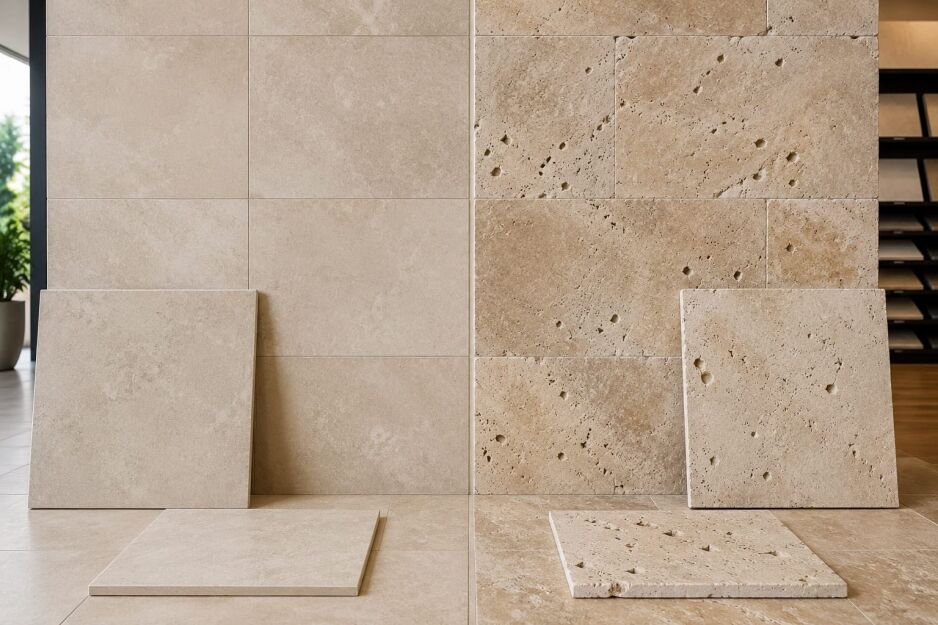
There’s a moment that happens regularly at Ross’s. A customer runs their hand over a tile, taken by the warm cream tones and the soft veining, and asks whether it’s real travertine. Sometimes it is. Sometimes it’s a porcelain travertine look tile. More often than not, they genuinely can’t tell, and that’s the point.
Travertine look tiles have come a long way. Modern porcelain manufacturing produces a surface convincing enough to fool experienced eyes at normal viewing distances. But the fact that both options can look similar doesn’t mean they perform similarly, and for Perth homeowners, that distinction matters a great deal.
Natural travertine tiles are a genuine sedimentary stone with structural characteristics that affect everything from sealing requirements to outdoor suitability. Travertine look tiles are engineered porcelain tiles designed to replicate the aesthetic while addressing many of the practical problems natural stone presents in Perth’s climate. The difference between the two matters more here than in most other Australian cities, and this guide works through exactly why.
What Is Natural Travertine?
Natural travertine is a sedimentary limestone formed around hot springs and geothermal vents. Over thousands of years, calcium carbonate dissolves in heated water and then deposits in layers as the water cools and reaches the surface. Those layers are what give natural travertine tiles their characteristic banding and variation.
The pitting and voids you see in the surface are a direct result of CO2 gas escaping during formation. That’s not a defect. It’s a structural feature of the stone, and it’s part of what makes travertine visually distinctive. It’s also what creates most of the practical maintenance challenges.
How the stone is cut significantly changes its appearance. Cross-cut travertine is sliced perpendicular to the layers, producing a more cloudy, irregular surface with a mottled pattern. Vein-cut travertine is sliced parallel to the layers, which reveals longer, more defined veins running across the tile face.
The stone also comes in two treatment states. Unfilled travertine retains its natural voids and holes. Filled travertine has those voids grouted or resin-filled for a smoother, more even surface. Each behaves differently underfoot and under maintenance.
Finishes vary further from there. Honed is a flat matte surface. Polished is reflective and smooth. Brushed gives a textured matte result. Tumbled produces a rustic, aged edge and surface that suits more informal applications.
What Are Travertine Look Tiles?
Travertine look tiles are porcelain tiles manufactured to replicate the surface character, veining, warm tones, and pitting of natural travertine stone. Fired at high temperature, they produce a tile that is essentially non-porous, with water absorption below 0.5%, requires no sealing, and is suitable for both indoor and outdoor use.
Digital inkjet printing is what makes modern travertine porcelain tiles so convincing. The technology lays down surface detail at a resolution that closely mimics the organic variation of natural stone, including the veining, colour shifts, and subtle surface texture. At normal viewing distances, the result is genuinely difficult to distinguish from the real thing. Get close enough to touch it, though, and the difference is there. Porcelain lacks the true depth and organic irregularity of natural stone, and no printing process fully replicates that. Being honest about that matters, because a buyer who understands the trade-off makes a better decision.
They sit within the broader stone look tiles vs natural stone category, alongside marble look, slate look, and limestone look options. Within the travertine range specifically, finishes include honed, polished, and textured brushed equivalents, giving you the same finish choices available in natural stone without the associated maintenance. For anyone new to porcelain as a material, our guide to choosing porcelain tiles covers the full picture.
Travertine Look Tiles vs Natural Travertine: Side-by-Side Comparison
Both materials can achieve the warm, earthy travertine aesthetic that works so well in Perth homes. Where they differ is in how they perform once they’re on the floor and what they ask of you over time. The comparison below covers the factors that matter most for a Perth renovation decision.
| Feature | Travertine Look Tiles (Porcelain) | Natural Travertine |
| Material | Fired porcelain clay body | Sedimentary limestone (natural stone) |
| Water absorption | Less than 0.5% (non-porous) | 3–8% (porous, varies by fill) |
| Requires sealing | No | Yes, every 1–3 years |
| Acid sensitivity | Not acid-sensitive | Sensitive: avoid vinegar, citrus, pool chemicals |
| Outdoor suitability | Yes (UV stable, frost resistant) | Limited: UV fading, sealer breakdown in Perth sun |
| Slip resistance | Rating specified by product | Varies by finish; unfilled can be slippery |
| Stain resistance | High (non-porous surface) | Low to moderate without sealing |
| Scratch resistance | High (7+ Mohs) | Moderate (3–4 Mohs for limestone) |
| Grout requirements | Standard porcelain tile grout | Requires careful grout selection around pitting |
| Maintenance | Low: sweep and damp mop | High: pH-neutral cleaner, regular resealing |
| Cost (approx.) | Lower: generally $20–$70/m² at Ross’s | Higher: generally $80–$200+/m² installed |
| Authentic character | Very convincing from distance; less depth on close inspection | Full natural variation, depth, and organic character |
| Best for | Most Perth residential applications, outdoors, wet areas | Premium interiors where natural stone presence is the priority |
The water absorption figure for porcelain is measured according to AS ISO 10545, which defines porcelain tile as achieving less than 0.5% water absorption under testing conditions.
On most performance measures, travertine look tiles are the stronger choice for Perth residential use, particularly for outdoor areas, wet zones, and any application where ongoing maintenance needs to stay low. Natural travertine holds its ground in one area: authentic character. For a protected indoor space where premium natural stone presence is the priority, and the homeowner is committed to proper care, natural travertine remains a legitimate option.
How Each Performs in Perth’s Climate

Perth’s climate creates tile performance conditions that are more demanding than most of southern or eastern Australia. A high UV index, hard bore water, outdoor temperature extremes, and the widespread use of tile across alfresco and pool surround areas all affect how travertine look tiles and natural travertine hold up. The differences that look minor on a spec sheet become real after a few Perth summers.
UV Intensity and Outdoor Sun Exposure
Natural travertine depends on a sealer to protect its surface, and in Perth that sealer breaks down faster than most homeowners expect. The UV intensity and sustained high daytime temperatures, particularly on north-facing outdoor areas, accelerate sealer degradation significantly. A sealer that holds for three years in a Melbourne alfresco may need reapplication every 12 to 18 months in Perth. Once the sealer goes, the stone is exposed.
The porcelain option is UV-stable, and the colour and surface finish do not degrade under UV exposure. There is no sealer to break down either. For anyone tiling an alfresco or north-facing outdoor area, that’s a meaningful advantage. Our guide to shopping for outdoor tiles in Perth covers what else to consider before committing.
Hard Bore Water
Perth’s water supply has high mineral content, and many properties also run bore water for irrigation. Hard bore water leaves calcium and mineral deposits that are difficult to remove from the pitted surface of natural travertine, and accelerates grout breakdown around the stone’s natural voids. The Water Corporation WA documents Perth’s water hardness across the metro area, and the figures are high enough to affect tile and grout maintenance materially.
The non-porous surface resists mineral buildup and cleans up with a damp mop.
Pool Surrounds and Acid Sensitivity
Natural travertine is a calcium carbonate stone and acid-sensitive. Pool chemicals, including chlorine and pH-adjustment products, will etch and damage natural travertine that isn’t perfectly sealed. Maintaining that seal around a pool is an ongoing challenge, and for most Perth pool surrounds, natural travertine is a poor material choice regardless of installation quality.
Porcelain is non-reactive to pool chemicals and is the recommended option for any pool surround, spa area, or outdoor wet zone.
Maintenance: What Each Option Actually Requires
Maintenance is one of the most underestimated differences between these two materials, and it’s where a lot of buyers get caught out after the fact.
Natural travertine requires a pH-neutral cleaner exclusively. Vinegar, citrus-based products, and anything acidic will etch the surface, which rules out a large portion of common household cleaners. Resealing is non-negotiable: depending on the finish, UV exposure, and whether the stone is filled or unfilled, natural travertine needs resealing every one to three years. Unfilled travertine compounds the issue further. The natural voids collect grout residue, dirt, and cleaning product buildup over time, and they’re genuinely difficult to keep clean. Polished finishes scratch more readily than honed or brushed, so high-traffic areas show wear faster than most buyers anticipate.
I had a customer come back into the showroom about fourteen months after laying natural travertine on his alfresco. He’d done everything right: professional installation, quality sealer, correct cleaning products. But Perth’s summer had pushed through two resealing cycles already, and he was finding the ongoing commitment more than he’d bargained for when he made the decision. He wasn’t unhappy with how the stone looked. He was unhappy with what it asked of him.
By comparison, the porcelain option is straightforward to maintain. Sweep regularly, damp mop with a mild cleaner, and the surface stays in good condition without specialist products. There’s no sealing required on the tile itself. The one maintenance point worth planning for is the grout: apply a penetrating grout sealer at installation and reapply every two to three years. That’s the extent of it.
For investors and busy households, that difference in ongoing upkeep is often the deciding factor.
Which Option Is Right for Your Perth Project?
The right choice comes down to three things: where the tiles are going, how much ongoing maintenance the homeowner is prepared to take on, and whether the authentic character of natural stone is essential to the outcome. For most Perth projects, those three questions point in the same direction.
Where Travertine Look Tiles Are the Better Choice
The case for porcelain is strongest wherever the conditions are demanding. Outdoor areas, alfresco paving, pool surrounds, and pool decks all expose tile to the UV intensity, temperature cycling, and chemical contact that natural travertine handles poorly. Bathrooms and wet areas present the same argument: ongoing water contact and humidity in an enclosed space make a non-porous, low-maintenance tile the more sensible choice.
Rental properties and investment properties are another clear fit. Tenants won’t follow a pH-neutral cleaner protocol, and a landlord who installs natural travertine outdoors is committing to a resealing schedule that simply won’t happen between tenancies. Kitchens and laundry areas also favour porcelain, where acid spills from citrus, cleaning products, or detergents are a routine reality.
For Perth homeowners in any of these categories, our travertine look tiles range is the practical starting point.
Where Natural Travertine Still Makes Sense
Natural travertine deserves an honest answer here, not a dismissal. In protected indoor applications where the presence of authentic natural stone is the priority, it remains a legitimate choice. Entry halls, feature walls, and formal living areas in well-maintained homes are applications where the depth and organic variation of real stone genuinely add something that porcelain cannot fully replicate.
The condition is commitment. Natural travertine in these settings rewards homeowners who are prepared to use the right cleaning products, reseal on schedule, and treat the material as the premium product it is. For that buyer, in that application, it can absolutely be the right decision.
For most Perth applications, particularly those that are outdoors, wet, or in a rental setting, the practical choice is porcelain.
Frequently Asked Questions
These questions come up regularly when Perth homeowners are working through the travertine decision. The answers below cover the practical details that matter most before you commit.
What Is the Difference Between Travertine Look Tiles and Natural Travertine?
The difference between travertine look tiles and natural travertine comes down to material and performance. Travertine look tiles are porcelain tiles engineered to replicate the warm tones, veining, and surface texture of natural travertine stone. Natural travertine is a porous limestone formed geologically. The key practical distinction is that travertine look tiles are non-porous, require no sealing, and handle outdoor use and moisture far better than natural travertine does.
Do Travertine Look Tiles Need Sealing?
Travertine look tiles do not need sealing. As porcelain tiles with a water absorption rate below 0.5%, they resist moisture, staining, and mineral buildup without any sealer treatment. The grout joints are a different matter: apply a penetrating grout sealer at installation and reapply every two to three years. But the tiles themselves require no ongoing sealing.
Are Travertine Look Tiles Good for Outdoor Areas in Perth?
Travertine look tiles are well suited to outdoor areas in Perth. Porcelain travertine tiles are UV-stable, non-reactive to pool chemicals, and unaffected by Perth’s hard bore water, making them a reliable choice for alfresco paving, pool surrounds, and outdoor entertaining areas. Natural travertine is a poor outdoor choice in Perth specifically because sealer breakdown under high UV intensity happens faster here than in other Australian climates.
How Much Do Travertine Look Tiles Cost Compared to Natural Travertine?
Travertine look tiles cost considerably less per square metre than natural travertine. Our travertine look tile range is generally priced from $20 to $70 per square metre, depending on the format and finish. Natural travertine supply and installation combined typically reaches $80 to $200 per square metre or more, depending on stone grade and finish. These figures are approximate and should be confirmed against current pricing before purchasing.
Can You Use Travertine Look Tiles in a Bathroom?
Travertine look tiles are a practical bathroom choice for Perth homes. As non-porous porcelain tiles, they handle the moisture, humidity, and cleaning products that bathroom use demands without the sealing requirements natural travertine would add. For bathroom floors, choose a finish with an appropriate slip resistance rating, and confirm the product’s R-rating if the floor area gets wet regularly. PEI rating is worth checking for floor applications too, particularly in higher-traffic bathrooms.
Conclusion
For most Perth applications, travertine look tiles are the more practical, lower-maintenance, and better-value choice. Outdoors, in wet areas, around pools, and in investment properties, the porcelain option simply performs better and requires less from you over time. Natural travertine remains a legitimate choice for protected indoor spaces where authentic natural stone character is the priority, and the homeowner is genuinely committed to its care.
If you’re working through a tile decision for a Perth renovation, browse our travertine look tiles online to see what’s available across formats and finishes. If you’d rather compare stone look tiles in person before committing, come into the showroom at 57 James Street, Guildford. We’re happy to walk you through the options and help you find the right tile for your project.
