Wet Wall Panels vs Tiles: The Honest Trade-Off for Perth Bathrooms
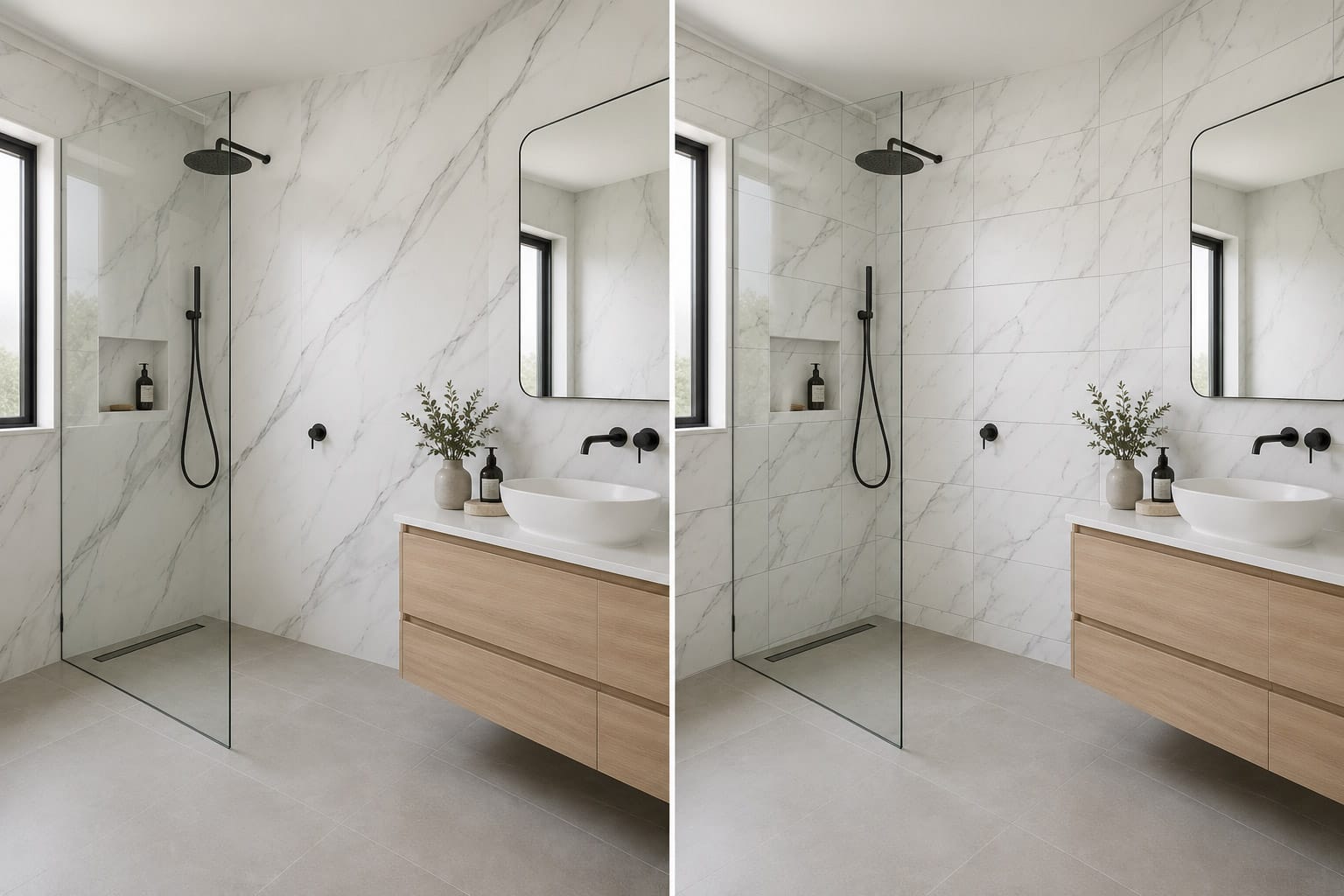
A few years ago I was standing in the bathroom of a Guildford investment property, staring at a shower recess that had seen better decades. The grout was black in the corners, crumbling in a few spots, and the tenant had mentioned it twice. I had a decision to make: re-tile it properly, or try something I’d been watching customers ask about more and more, wet wall panels.
That decision made me look properly at both options. Not from a supplier’s perspective, but as someone who actually had to live with the result.
I’m going to be straight with you in this article. We stock both products. I have no reason to push you toward either one. What I do have is a pretty clear view of where each performs, where each falls short, and what the real cost picture looks like for a Perth bathroom renovation. If you’re weighing up wet wall panels vs tiles, that’s exactly what this article is for.
We’ll cover cost, maintenance, waterproofing, installation, and design, and I’ll tell you where tiles are genuinely the better call, because sometimes they are.
Wet wall panels are generally the more cost-effective option for Perth bathrooms, particularly when labour and ongoing maintenance are factored in. They also outperform tiles on ease of cleaning and installation time. For design flexibility, durability, and resale value in premium properties, tiles remain the stronger choice.
If you want the fuller picture on renovation planning first, our Perth bathroom renovation guide is a good place to start.
What Are Wet Wall Panels?
Wet wall panels are large, waterproof sheets designed to cover bathroom and shower walls without grout. Most run around 2400mm x 1000mm, are cut to size on site, and adhere directly to the wall. PVC is the more common material, lighter, easier to work with, and well suited to DIY installation. Acrylic has a harder surface and a more premium feel underfoot and to the touch.
The finish range has moved well beyond the plain white sheets that gave bathroom wall panels a poor reputation in earlier years. Tile-look, marble-look, stone-look, and concrete finishes are now available in modern shower wall panels, and the better options are genuinely convincing in a finished bathroom. If you’ve dismissed panels on aesthetic grounds, it’s worth browsing our wet wall panels range before you decide.
One practical note worth raising early: installing wet wall panels over tiles is possible in many cases, provided the substrate is sound and level. It’s one of the reasons people choose them for a renovation over a full retile.
Wet Wall Panel Vs Tile Cost Comparison
Cost is usually the first question, and it’s worth breaking into two parts: materials and labour, because combining them into a single figure hides where the real difference lies.
On materials, basic ceramic wall tiles in Perth start from around $20–60/m² for standard options, rising to $40–70/m² for premium rectified porcelain. Panel pricing varies by product. Check our current range for up-to-date figures before you budget, as pricing can shift. Both options are competitive at the entry level. The gap opens up when you factor in what goes around the materials.
Labour is where the cost to tile a bathroom in Perth adds up quickly. Wall tiling currently runs approximately $90–160/m², and if existing tiles need to come out first, add another $40–60/m² for removal. For a medium shower area, around 12m² of wall coverage, you’re looking at $1,080–1,920 in tiling labour alone, before a single tile is purchased. Panels sidestep most of that. A competent DIYer can install them without trade qualifications, and even a paid installation is significantly faster than tiling. If you’re budgeting a full bathroom rather than just the shower, our
One important thing to note: installing panels over existing tiles avoids removal costs, but only if the substrate underneath is waterproof, sound, and level. In older Perth homes, that’s not always a given. It’s worth checking before you commit.
All figures above are indicative. Get current quotes for your specific job.
| Cost Factor | Wet Wall Panels | Bathroom Tiles |
| Material cost (indicative) | $149-$179 per panel ($74.58/m²) — verify against current stock | $20-$60/m² (ceramic) to $40-$70/m² (porcelain) |
| Labour cost | DIY-friendly; tradie install faster and cheaper than tiling | $90-$160/m² (Perth 2025); specialist required for waterproofing and tiling |
| Tile/substrate removal | Often avoidable over sound existing tiles | $40-$60/m² if existing tiles must come out |
| Installation time | Typically 1-2 days for a standard bathroom | 3-5 days including waterproofing cure time; more complex jobs longer |
| Ongoing maintenance | Minimal; no grout to replace or seal | Grout re-sealing, periodic re-grouting in high-use areas |
| Overall verdict | Usually lower total cost, especially with DIY | Higher upfront and ongoing cost; can add perceived value at resale |
When you’re choosing between wet wall panels or tiles for a Perth bathroom, budget is rarely the only factor, but it’s usually where the conversation starts. Panels generally come out ahead when you factor in labour and ongoing maintenance together. That said, cost alone shouldn’t make the decision. The sections below on maintenance, waterproofing, and design are worth reading before you decide.
Maintenance: Grout vs Wipe-Down
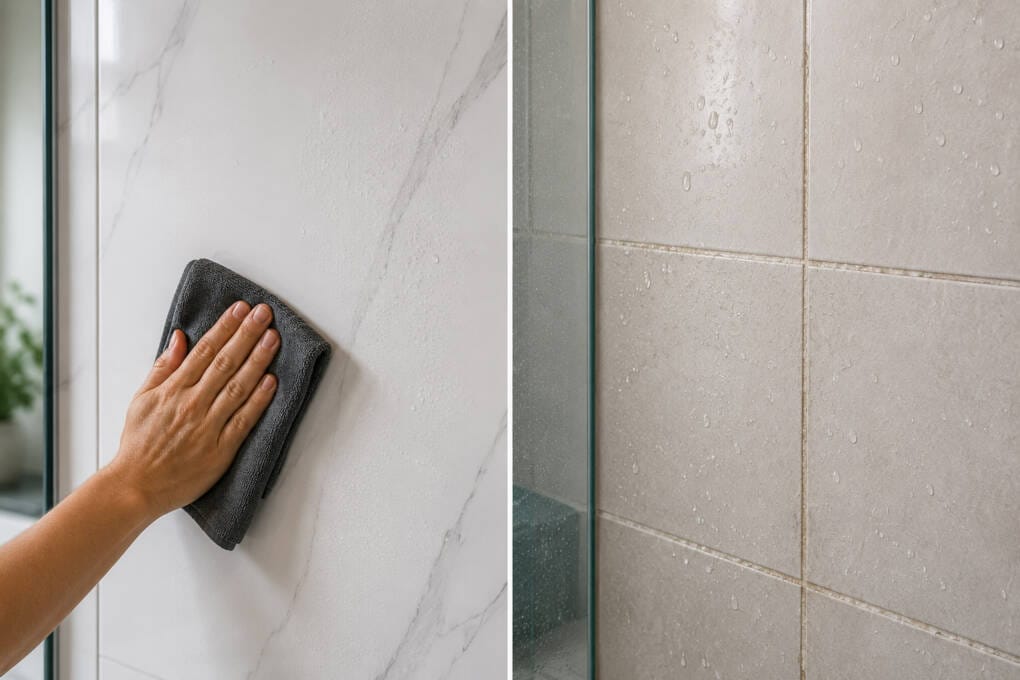
Maintenance is one of the clearest differences in the wet wall panels vs tiles comparison, and for Perth homeowners it carries extra weight. If you’re on bore water, you already know what it does to grout. The mineral content is high enough that buildup starts within months in a regularly used shower. White or light grout lines turn grey, then darker, and no amount of scrubbing fully reverses it. I’ve seen it in our own properties. One rental in the eastern suburbs had a shower that was only a few years old, but the grout looked a decade older. The tiles were fine. The grout was the problem. For anyone wanting a grout-free bathroom, Perth’s bore water makes that appeal easy to understand.
That’s the maintenance reality that drives most people toward panels in the first place, and it’s a fair reason. Panels have no grout lines, nothing for mineral deposits or mould to get into. The surface is non-porous and wipes down with a damp cloth. For a rental or a secondary bathroom, that’s a meaningful reduction in upkeep.
Panels aren’t completely hands-off, though. The silicone joins still need monitoring. It won’t fail quickly with a quality installation using neutral-cure silicone rated for wet areas, but it’s not a set-and-forget surface either. Check it periodically and reseal if it starts to lift or discolour.
On the tile side, it’s worth knowing that not all grout is equal. Epoxy grout is significantly more resistant to staining and mould than standard cement grout. A well-installed tiled shower with epoxy grout and good ventilation is a different maintenance proposition from the cheap grouted shower that gives tiles a bad name. If you’re going with tiles and want to minimise upkeep, choosing the right grout colour is part of that decision too.
Waterproofing: What You Actually Need to Know
One of the most common questions when comparing wet wall panels with tiles is whether panels remove the need for waterproofing. They don’t.
Panels are a surface finish product. The panel itself won’t absorb water, but that doesn’t mean the substrate behind it is protected. Any water that finds its way behind a panel through joins, edges, or fixings goes straight to whatever is underneath. Without a waterproofing membrane behind them, that’s a problem waiting to surface.
In practice, for any new build or renovation where the substrate is being opened up, a licensed waterproofer should apply a compliant membrane before panels go on. The requirements are governed by AS 3740:2021, Waterproofing of Domestic Wet Areas, and the National Construction Code. In WA, waterproofing must be carried out by a licensed waterproofer. Don’t skip it to save cost.
For over-tile installations, the same logic applies. If the original waterproofing behind those tiles was done correctly and is still sound, it may be adequate, but that needs to be assessed, not assumed. Going over existing tiles with panels doesn’t fix a waterproofing problem that already exists underneath.
It’s also worth understanding that tiles are subject to the same requirements. A waterproof membrane is required under tiles in wet areas, just as it is behind panels. The membrane isn’t a panel-specific complication. It’s a baseline requirement for any wet area wall finish, regardless of which surface product you choose.
Installation: DIY vs Professional
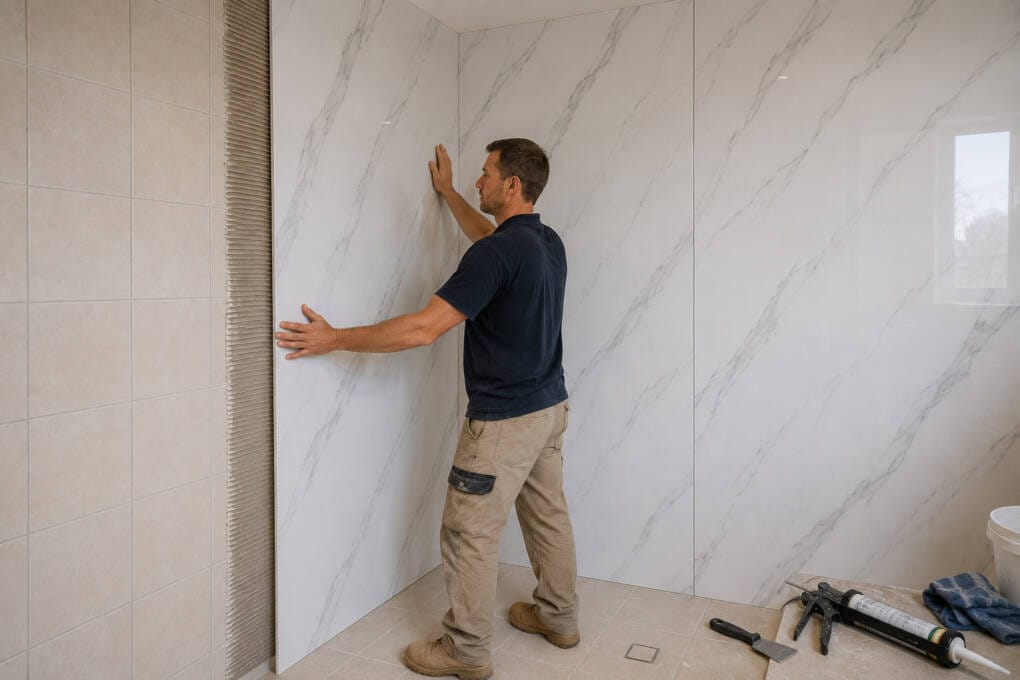
Panel installation doesn’t require trade qualifications. The process- measure, cut, adhere, silicone the joins- is within reach for a competent DIYer, and a standard bathroom can often be done in a day. Going over existing tiles removes the need for tile removal entirely, which saves both time and cost.
That said, installing panels over tiles only works if the existing tiles are sound, flat, and well-bonded, and the added wall thickness won’t create clearance issues for tapware or shower fittings. It’s also worth checking the wall build-up carefully in older Perth homes. In pre-1990 properties, and some pre-2000 brick veneer, wet area substrates can contain asbestos. If you’re not sure what’s behind the tiles, have it assessed before disturbing anything.
Tiling is a different proposition. In WA, the waterproofing membrane phase must be carried out by a licensed waterproofer, and the tiling itself takes skill and time. A medium shower area will typically run 2–3 days for an experienced tiler, including waterproofing cure time. DIY tiling is possible for capable renovators, but shower recess walls, where waterproofing compliance is non-negotiable, are not the place to learn on the job.
If you’re weighing up a DIY approach, our guide to planning a bathroom renovation is a practical starting point before you commit to either option.
Design and Aesthetics: Honest Assessment
Design is where the wet wall panels vs tiles debate gets most subjective, but there’s an honest answer. Tiles win on design flexibility, and there’s no point pretending otherwise. The range of colours, formats, textures, and patterns available in ceramic and porcelain is simply not matched by panels. Handmade-look, encaustic, mosaic, and feature tile formats don’t have panel equivalents, and in a design-led bathroom, that gap shows.
Where panels have genuinely closed the distance is in everyday finishes. Tile-look, marble-look, and stone-look options are convincing in a finished bathroom, particularly in contemporary or minimalist spaces. If the goal is a clean, functional bathroom with minimal upkeep rather than a design statement, modern panels deliver it without compromise.
Panels struggle aesthetically in premium bathrooms, heritage homes, and anywhere a buyer is likely to look closely for quality signals. A Hamptons-style renovation in Cottesloe, for instance, or a high-end ensuite in a property being prepared for sale. In those contexts, the material difference is noticeable, and it matters.
Where panels are a strong choice: budget bathroom renovations, investment properties, and contemporary renovations where function leads. The neutral tones available in modern bathroom wall panels- warm whites, stone tones, concrete greys- suit Perth’s current interior direction well and work as a practical bathroom wall covering without looking out of place.
If tiles are the direction you’re heading, our guide to choosing bathroom wall tiles covers format, finish, and colour selection in more detail.
Where Tiles Are Still the Better Call
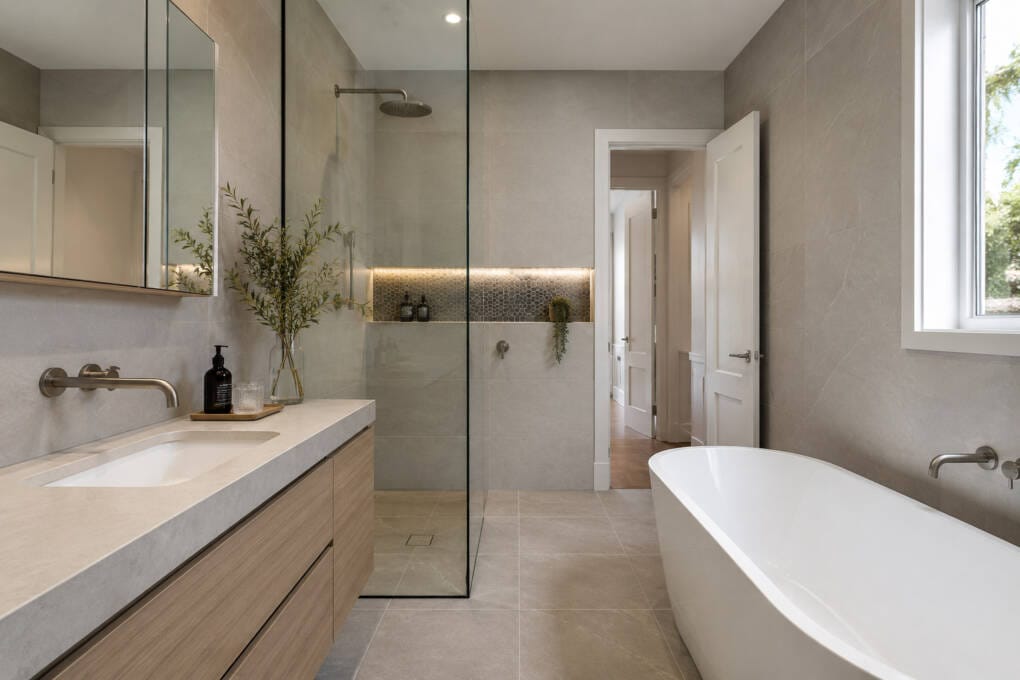
If you’re considering an alternative to tiles, panels are worth a serious look. But there are situations where tiles are simply the right call, and it’s worth being clear about them. Our article on bathroom renovation mistakes to avoid covers a few of these scenarios in more detail.
Floors, for a start. Wet wall panels are wall products. For wet area floors, you need a tile rated for appropriate slip resistance, P4 or P5 for shower floors under AS 4586. That’s not a role panels fill. That’s not a role panels fill.
Premium and high-resale properties are another. Buyers in the $700K+ Perth market expect tiled bathrooms. Professionally tiled bathrooms still carry stronger market perception at that level, and the resale value reflects it. Panels are a practical choice. They’re not a premium signal.
Design-led renovations are where the gap is most obvious. Custom formats, feature walls, mosaic niches, encaustic patterns. Tiles offer a level of design expression that panels can’t match. If the bathroom is meant to be a standout, bathroom tiles give you the range to make it one.
Durability is also worth considering for the long term. Quality porcelain tiles, correctly laid, are essentially impervious and will outlast any panel product. Panels are durable in normal use but can be damaged by sharp impact and are difficult to repair invisibly.
Finally, heritage and character homes. In a period property in Subiaco or Fremantle, panels look out of place. Tiles are the right material, full stop.
Frequently Asked Questions
Which Should You Choose?
What’s better, wet wall or tiles? Neither wins every situation. Panels are the stronger choice for budget-conscious renovators, low-maintenance priorities, and investment properties where practicality leads. Tiles are the better call for premium bathrooms, design-led renovations, high-resale properties, and anywhere long-term durability is the priority. Most Perth bathrooms fall somewhere in between, and the right answer depends on your budget, your timeline, and what you’re trying to achieve with the space.
If you’re leaning toward panels, we offer a range of wet wall panels in Perth that you can view in person in-store at 57 James Street, Guildford. If tiles are the right call for your bathroom, our bathroom tiles range covers everything from basic ceramic through to premium porcelain.
