
Kitchen Wall Tiles Perth: 2026 Trends and Buying Guide
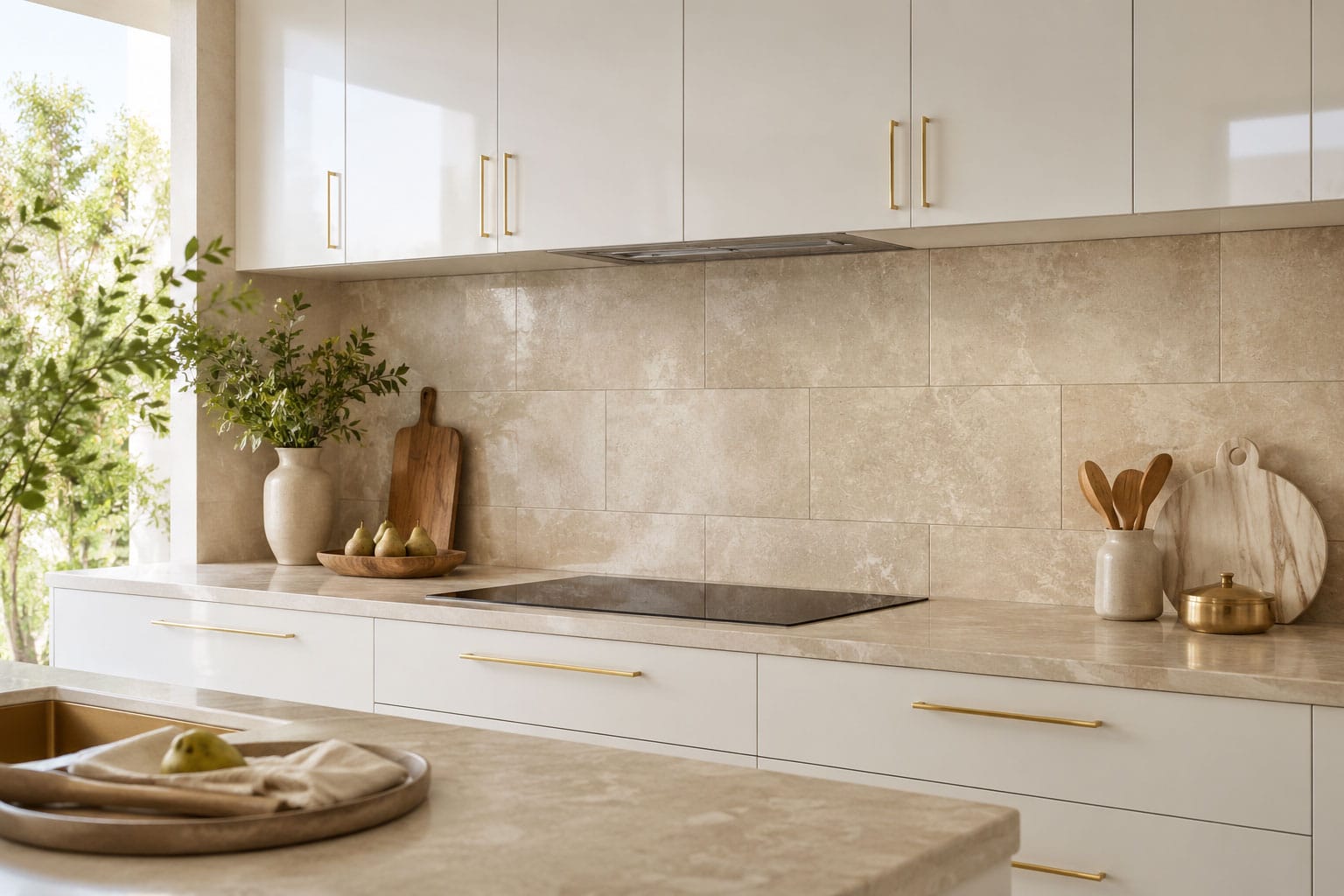
The question I get asked most often at Ross’s is some version of the same thing: “What should I put on the kitchen walls?” Not the floor, not the benchtop, but that 600mm strip of wall between the bench and the overhead cabinets, and occasionally the full wall behind the cooktop, they’re considering going all the way to the ceiling with. It seems simple until you’re standing in front of several hundred tile options with a renovation to get right.
The best kitchen wall tiles for 2026 are zellige, fluted ceramic, and handmade-look tiles for texture-led splashbacks; classic subway in a vertical stack layout for timeless kitchens; and large-format stone-look porcelain for seamless full-height feature walls. Warm neutral tones, think mushroom, sage, and warm white, lead the colour direction across all tile types this year.
This guide covers kitchen wall tile ideas across materials, sizing, layout, grout colour, and the 2026 trends worth committing to in a Perth kitchen. If it’s the floor you’re deciding on, our kitchen floor tile ideas guide covers that separately. And if you’re mid-kitchen renovation Perth-wide, the local conditions here add a few considerations no interstate article will mention. We’ll get to those, too.
Splashback Tiles vs Full Wall Tiles — Know the Difference Before You Buy
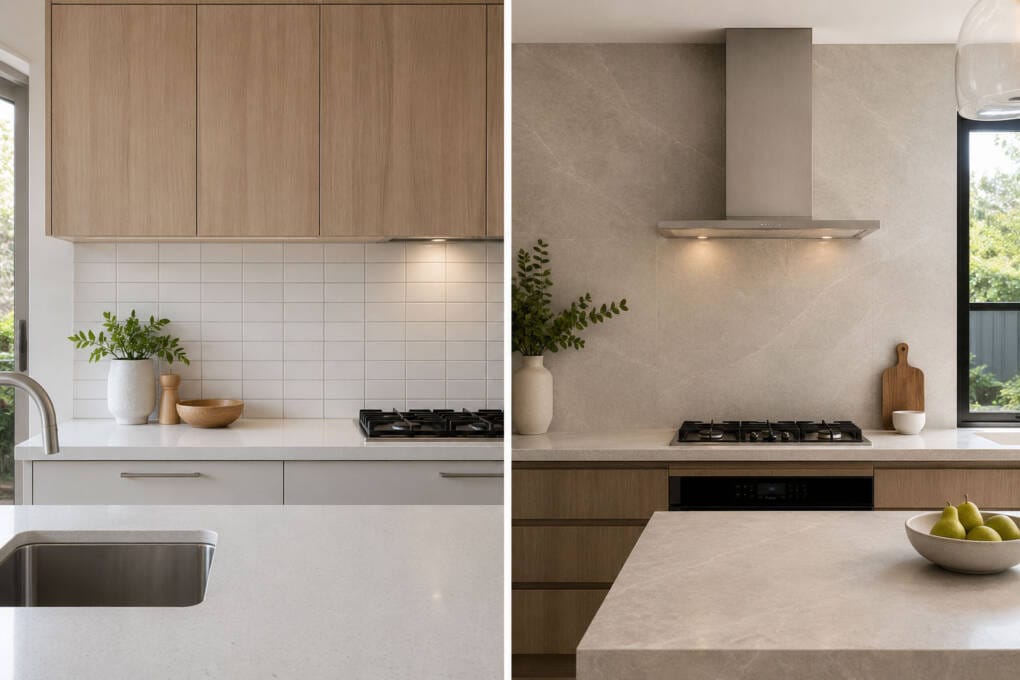
Most Perth homeowners tiling a kitchen are doing one of two things: covering the splashback zone between the benchtop and the underside of the overhead cabinets, or going further and tiling a full feature wall from floor to ceiling. Inspiration photos make these look interchangeable. They’re not. The tile format, the budget, the adhesive requirements, and the layout decision are all different depending on which one you’re tackling. Get clear on this before you choose a tile, not after.
The 600mm Splashback Zone — What That Means for Tile Choice
Most Australian kitchens have roughly 600mm between the benchtop and the underside of the overhead cabinets. That is your standard splashback zone. A 600x600mm large-format tile fills it in a single row, giving you minimal grout lines and a fast, clean installation. A 150x75mm subway tile gives you four or more rows, more grout joints, and more visual rhythm across the surface. Neither approach is wrong, but the choice affects both the look and the ongoing maintenance. If you’re tiling directly behind a gas cooktop, avoid mosaic tiles with heavy grout coverage in that zone — the grout sits close to the flame and is harder to keep clean at high temperatures. Full-height splashbacks running bench to ceiling are one of the stronger 2026 trends, but they need more tile volume and a clear layout decision before you buy. Bring your measurements. Our tile size guide walks through the format options in detail.
Full Kitchen Wall Tiles — When and Why to Go Further
A full feature wall, floor to ceiling or the entire wall behind the cooktop, makes a stronger visual statement but it is a different project. More tile, more adhesive, more grout, and more precision on layout from the start. Large-format tiles work best here because fewer grout lines give you stronger visual flow across a large surface. A small-format tile across a full wall reads as busy and requires considerably more cutting. If that wall connects into a living or dining area, the tile needs to work in both zones, which usually means keeping to a neutral or stone-look format rather than a bold pattern. For full-height walls, porcelain has a practical edge over ceramic. It holds adhesive more reliably on larger unsupported wall surfaces.
Kitchen Wall Tile Materials — Ceramic, Porcelain, and What to Choose
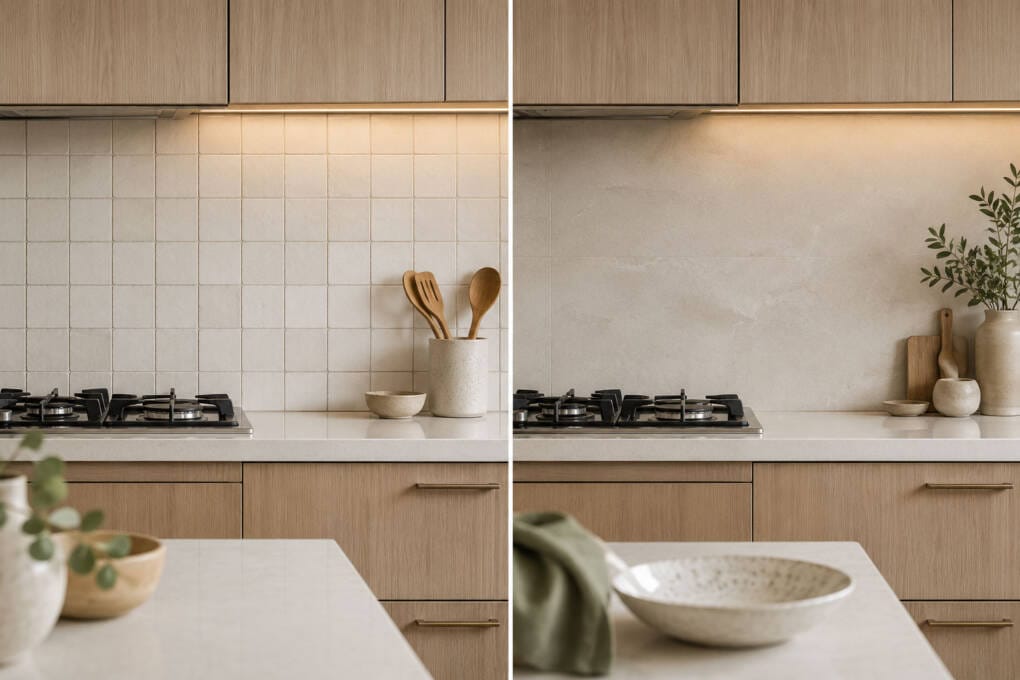
For the vast majority of Perth kitchen splashbacks and wall tiles, ceramic or porcelain covers the brief. Glass tiles exist, and natural stone has its place, but both come with specific limitations — glass magnifies every fingerprint and installation imperfection, and natural stone requires sealing and ongoing maintenance that most kitchen walls don’t need. If you’re choosing wall tiles for a standard splashback or feature wall, ceramic or porcelain is where to start.
A few practical points worth knowing before you choose between them.
- Heat resistance is not a meaningful differentiator for most kitchens — both ceramic and porcelain handle standard splashback temperatures without issue. Near a gas cooktop running at high heat for long periods, porcelain’s denser composition gives it a slight edge.
- Moisture resistance is where the gap opens up: porcelain has lower porosity than ceramic, which matters in a steam-heavy kitchen or a cooking zone that cops a lot of condensation.
- Cost is where ceramic earns its place — it is the more affordable material and entirely appropriate for walls where load-bearing is not a factor.
- Design range is a non-issue: both are available in subway, large-format, patterned, and textured finishes across every 2026 style direction.
One thing worth repeating clearly: wall tiles do not require a slip-resistance rating. R-ratings apply to floors only. Do not pay for an R-specification on a kitchen wall tile. Stone-look porcelain in warm neutral tones is the material doing the heaviest lifting across Perth kitchens this year, and it is available in both ceramic and porcelain formats depending on the application.
Ceramic Wall Tiles — Best for Splashbacks on a Practical Budget
Ceramic is fired at lower temperatures than porcelain, which makes it slightly more porous but entirely fit for purpose on kitchen walls. It is lighter, easier to cut, and available across a broader price range, which makes it the practical default for splashbacks and decorative wall applications. Our Gloss White Subway and Gloss White Ripple 75x300mm are both ceramic and both well suited to the standard 600mm splashback zone. One firm rule: ceramic wall tiles are not suitable for kitchen floors. That is the application where porcelain’s density earns its cost premium. On a wall, ceramic does the job cleanly.
Porcelain Wall Tiles — Denser, Less Porous, Better for Steam-Heavy Kitchens
Porcelain is fired at higher temperatures, producing a denser tile with lower porosity and better performance in high-moisture or high-heat kitchen zones. For a full-height wall that connects the kitchen through to a living or dining area, porcelain is also the right call — material consistency across a large surface matters. Our Borgogna White Matte and Magic Stone Sand are both porcelain, and both backed by a 10-year manufacturer’s warranty. For a deeper comparison of both materials across all applications, our porcelain vs ceramic tiles guide covers the full picture.
2026 Kitchen Wall Tile Trends — What Perth Homeowners Are Choosing
The shift happening in 2026 is clear from where I stand in the showroom every week. Texture has replaced flat uniformity as the primary wall tile story, warm neutrals have replaced cool whites and greys, and the vertical stack has replaced the horizontal brick-offset as the default subway layout. The kitchen wall tile ideas customers are bringing in on their phones are almost all in the same family: surface variation, warmth, and depth over the clean flat backgrounds that defined the last decade. Here is what is actually moving and what is worth committing to.
Zellige, Fluted Ceramic, and Handmade-Look Tiles — The 2026 Texture Trio
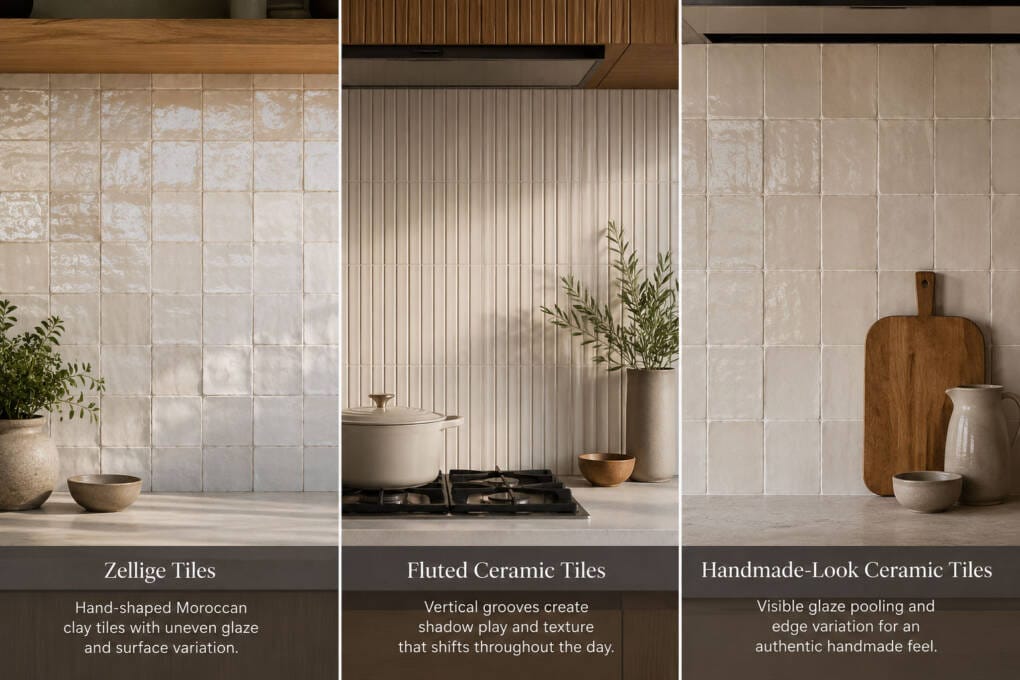
These three tile types share the same design logic: deliberate surface variation over flat uniformity. Zellige tiles are hand-shaped Moroccan clay tiles with uneven glaze and surface, no two pieces are identical. They work best as a feature splashback, not a whole-wall treatment. Fluted ceramic tiles feature vertical grooves across their faces, creating shadow play that shifts throughout the day. It earns its place as a feature panel behind the cooktop or as an island surround. Handmade-look ceramic delivers visible glaze pooling and edge variation at a more accessible price point. All three pair well with matte or honed benchtop surfaces.
One Perth-specific note: under our intense natural light, the shadow detail in fluted and zellige tiles reads best on walls receiving indirect light. On a strong north-facing wall in direct afternoon sun, that shadow detail flattens, and the effect is lost.
Subway Tiles in 2026 — The Vertical Stack Update
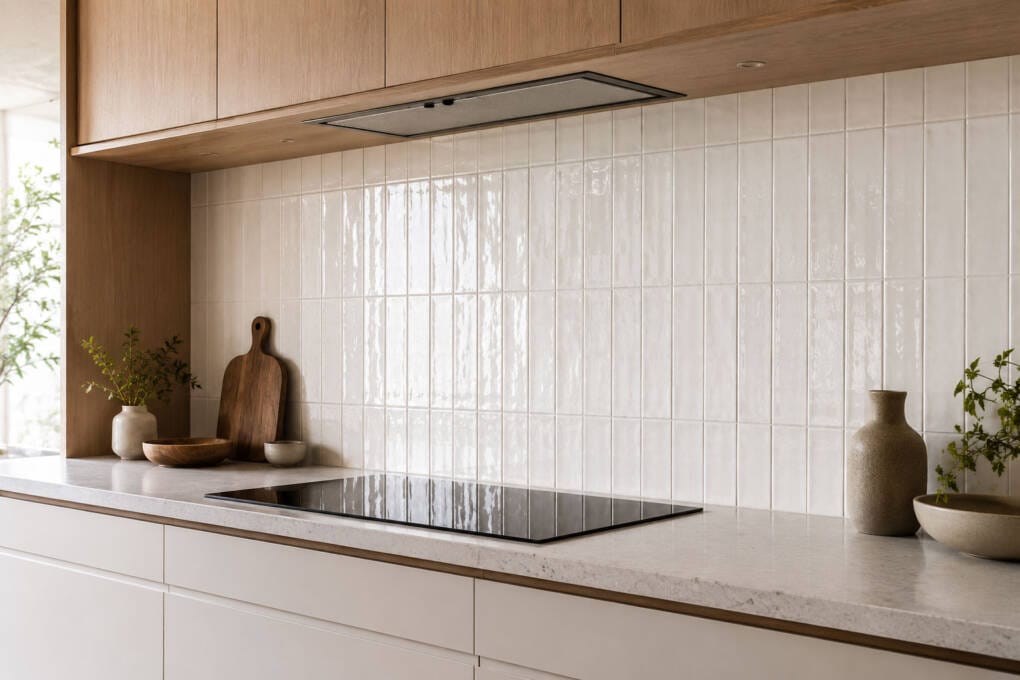
Subway tiles are not out. The horizontal brick-offset layout is. The 2026 standard is vertical stack, tiles laid portrait in a straight stacked bond, in longer formats: 75x300mm, 100x400mm, and 75x450mm. The result reads as architectural and contemporary without abandoning the familiarity of subway. Grout direction matters here as much as layout direction: tonal grout matching, or a grout colour that nearly matches the tile, is the 2026 default. Contrasting grout, white tile with dark grout, dates the kitchen to 2015 faster than anything else. Our Gloss White Ripple 75x300mm is the product I most often point customers to for a vertical stack application. For the full breakdown of layout options, our best subway tile patterns guide covers every configuration.
Warm Neutral Tiles — The 2026 Colour Direction

The colour direction for kitchen wall tiles in 2026 is warm white, mushroom, soft sage, terracotta accent, and creamy off-white. Cool grey and stark white are the palettes fading fastest, confirmed by the HIA 2026/27 Design Trends Report, which calls out warm, comforting tones as the dominant direction across Australian renovation projects this year. The warm neutral palette suits Perth particularly well, but it comes with a practical warning. Our intense natural light emphasises warmth in warm-toned tiles and hardens the coldness in cool ones. A tile that reads creamy and welcoming in the showroom at midday may read blush-pink on a west-facing wall at 4pm. Always bring a sample home and view it in your actual kitchen light at different times of day before committing.
Large-Format Stone-Look Porcelain — For Full-Height Feature Walls
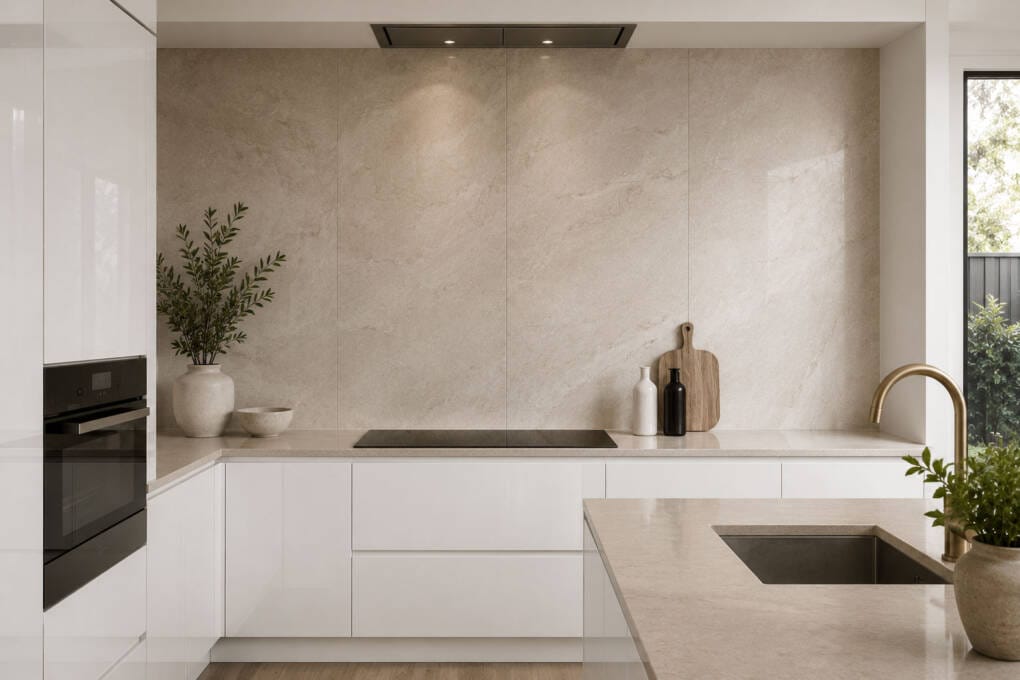
For full-height kitchen walls, large-format stone-look porcelain is the 2026 workhorse. Fewer grout lines mean stronger visual continuity across the surface, and the warm vein detailing of travertine or marble comes without natural stone’s sealing requirements. The 600x600mm and 600x1200mm formats are the standard range for this application. Our Magic Stone Sand and Matang tiles are the two products I see working hardest in Perth kitchens this year across full-height and feature wall applications. One firm Perth note: large-format tiles on a north-facing full-height wall will receive direct sun for a significant part of the day. Choose a matte or honed finish. Polished large-format tiles on a sun-facing wall reflect heat and light directly back at the person cooking. For the wider splashback picture, our hottest kitchen splashback trends guide covers the full 2026 direction.
Matching Kitchen Wall Tiles to Your Kitchen Style
Most people walk in knowing the look they’re after long before they know the tile. Here is how I match wall tiles to the six kitchen styles we see most often in Perth homes.
Hamptons. Light, coastal, and relaxed. White or soft-toned subway tiles in a vertical stack carry this look without trying too hard, and a honed marble-look tile behind the cooktop lifts it for anyone wanting a bit more polish. Keep the grout tonal so the wall reads calm rather than busy.
French Provincial. Warm, rustic, a little bit country. Cream, beige, and soft sage tiles in a handmade or lightly textured finish suit it best. A travertine or limestone-look porcelain gives you that aged feel without the sealing real stone demands.
Modern Farmhouse. Clean lines with a bit of warmth. Off-white subway in a straight stack is the timeless base, and a single panel of patterned feature tiles behind the cooktop gives it the focal point the style is known for. One feature surface only. The rest stays simple.
Shaker. Simple and functional, all about restraint. Neutral ceramic in white, grey, or beige with a matte finish fits the look. Brick-shaped tiles in a horizontal or herringbone layout add quiet texture without breaking the pared-back feel.
Mediterranean Coastal. Earthy, warm, and a touch playful. This is the one kitchen style where I’ll happily steer someone to colour: glazed tiles in terracotta or deep blue, or a patterned splashback that does the talking. Use it as an accent rather than wall to wall, or it tips into too much.
Japandi. Japanese calm meets Scandinavian simplicity. Stone-look tiles in soft neutrals keep it grounded, and slim Kit Kat tiles in a muted tone add the bit of detail the style relies on. Everything stays low contrast and quiet.
Pick the style first, then let it narrow the tile down. It is a far easier way to choose than standing in front of every option at once.
What Is Out in 2026 — Tile Choices to Move On From
A few choices worth considering before you commit.
The horizontal brick-offset subway layout has had its decade and now reads as default rather than considered. Cool grey and stark white backgrounds are the palettes most likely to feel dated soonest. Contrast grout, particularly white tile against dark grout, carries more baggage than most people realise at the time of choosing. Polished high-gloss finishes on sun-facing Perth walls create glare problems that no amount of style justifies. And heavy patterned tiles across the entire splashback zone tend to exhaust quickly. One feature surface is the rule. The rest of the kitchen earns its character from texture and tone, not pattern coverage.
Grout Colour — The Decision That Makes or Breaks the Whole Wall
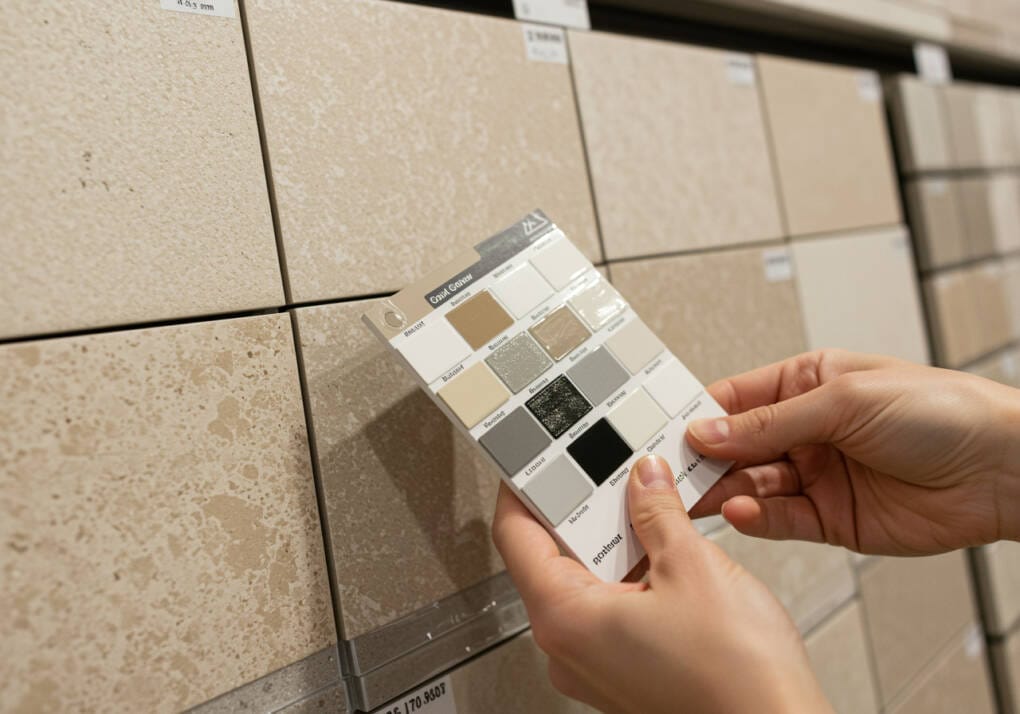
The grout colour is as important as the tile colour. Most people choose it last, spend the least time on it, and treat it as an afterthought. In 2026, that approach produces a kitchen that reads dated within three years, because the grout choice is visible in every joint across every surface you just tiled.
The 2026 default is tonal grout: a colour that matches or sits very close to the tile. When the grout recedes, the tile appears as a continuous surface rather than a grid. That is the look driving Perth kitchens this year. Contrast grout, white tile against dark grout, being the classic version, was the standard from roughly 2010 to 2020. It now carries enough baggage that most designers are actively steering clients away from it in a kitchen context.
I had this conversation on my own kitchen renovation a few years back. I had chosen a warm white handmade-look ceramic and was leaning toward a light grey grout to add some definition. The tiler talked me out of it and suggested an off-white tonal grout instead. The finished wall reads as one warm surface. The grey would have gridded the whole thing and drawn the eye to the joints rather than the tile.
Perth adds a practical reason to think carefully about grout colour beyond aesthetics. Our bore water is high in minerals, and light-coloured grout shows mineral staining more quickly than a tonal or mid-grey option. If you are using hard-bore water for cleaning, a near-white grout joint will show residue within months. For high-moisture zones or kitchens running heavy steam, epoxy grout is worth the extra cost — it is non-porous and will not absorb staining. For any natural-stone or handmade-look tile, sealing the grout after installation is a non-negotiable step, not optional maintenance.
Before you decide, read our guide on how to choose a grout colour, then bring your actual tile sample to the showroom and hold physical grout samples against it. A colour card will not tell you what you need to know.
Choosing Kitchen Wall Tiles for a Perth Kitchen — What to Know Before You Buy
Buying kitchen wall tiles in Perth is not the same decision as buying them in Melbourne or London. Four local conditions consistently shape what works and what does not in a Perth kitchen, and none of them appear in international tile trend guides or eastern-states renovation articles.
- UV intensity and finish choice. Perth’s UV intensity is among the highest of any capital city in Australia. Polished or high-gloss wall tiles on north- or west-facing kitchen walls reflect significant glare back into the room and directly at the person cooking. Matte and honed finishes absorb rather than bounce that light, which is why they are the practical default for sun-exposed Perth kitchens, not just a style preference.
- Hard bore water and grout. Perth’s bore water is high in minerals, and that shows up fastest on light-coloured grout. A near-white grout joint in a Perth kitchen renovation will show mineral residue noticeably faster than the same grout would in Melbourne or Sydney. Tonal mid-tone grout or epoxy grout reduces this considerably and is worth specifying from the start rather than managing after the fact.
- Indoor-outdoor kitchens. Perth’s indoor-outdoor living culture means a large proportion of kitchens here open directly to an alfresco zone through bifold or stacking doors. The tile choice needs to work across that visual transition. Warm neutral stone-look porcelain reads consistently inside and out, handles the light shift between zones, and is the safest aesthetic call for an indoor-outdoor kitchen Perth layout.
- Temperature cycling. Perth summers regularly reach 40-plus degrees, and kitchens with large north-facing glass openings experience significant temperature cycling between the air-conditioned interior and the heat radiating through the glass. Porcelain handles that cycling better than natural stone because of its lower porosity and denser composition. Natural stone is more vulnerable to surface stress from repeated expansion and contraction over successive Perth summers.
I had a customer in the showroom last year who had fallen in love with a polished marble-look tile for a full-height wall behind her cooktop. North-facing kitchen, large bifold doors, strong afternoon light. We pulled a sample out and held it at the right angle under the showroom lights, and the glare was immediately obvious. She left with a honed version of the same tile in the same warm vein pattern. Same look, without the glare.
Frequently Asked Questions
Conclusion
The framework for choosing kitchen wall tiles comes down to a few decisions made in the right order. Choose ceramic or porcelain based on your zone and moisture levels. Pick a finish that suits your kitchen’s light exposure, matte for sun-facing walls, glossy only where the light is controlled. Commit to tonal grout from the start rather than retrofitting the decision later. Then choose a 2026 tile style with enough staying power to feel right in ten years, not just this season.
For kitchen wall tiles Perth-wide, our range of kitchen tiles and splashback tiles covers every format and finish covered in this guide. If you want to compare tiles in person before committing, come and see us at 57 James Street, Guildford. Perth Metro delivery runs at a flat rate of $100, and every purchase is backed by our 14-day money-back guarantee. A kitchen renovation Perth homeowners feel confident about starts with getting the tile choice right before anything else goes in.
