
Matte vs Gloss Kitchen Cabinets: Which Finish Is Right for Your Kitchen?
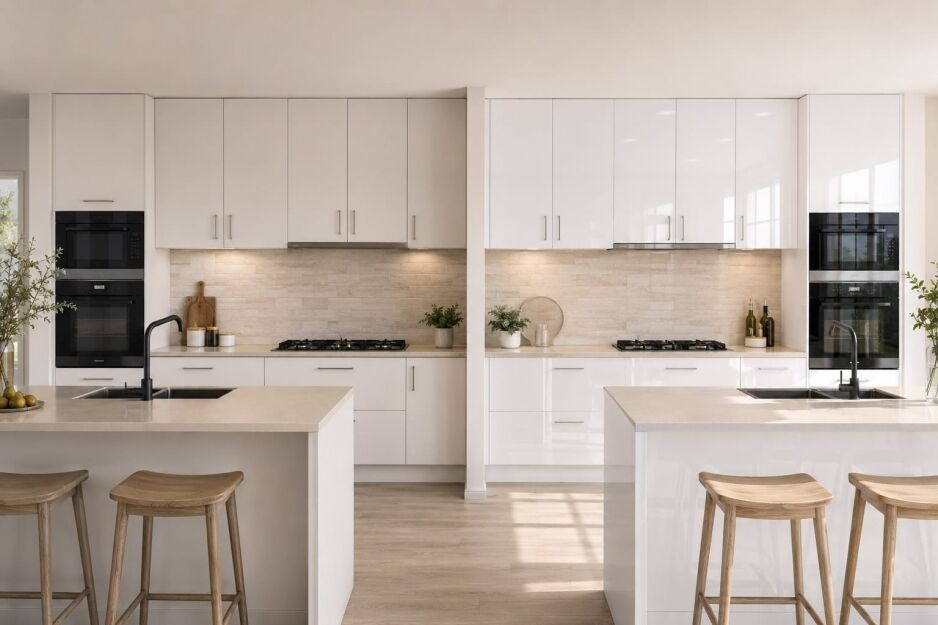
You’ve got the layout sorted. You’ve picked white. Then the question arises that stops almost every Perth renovator at exactly the same point: matte or gloss? It sounds like a small call. It isn’t. The kitchen cabinet finish you choose affects how light moves through the room, how the kitchen looks on a Tuesday morning after school lunches, and whether the whole thing still reads well in ten years.
Gloss reflects light, works harder in smaller or darker kitchens, and wipes clean in one pass. Matte absorbs light, conceals fingerprints, and suits larger well-lit spaces. Neither finish is universally better. The right call depends on kitchen size, aspect, and lifestyle. We stock gloss because it performs in Perth conditions.
This article covers both finishes honestly, so you can make the right call for your kitchen. For the broader finish picture beyond matte and gloss, our kitchen cabinet finish guide is worth reading alongside this one.
What’s the Difference Between Matte and Gloss Kitchen Cabinets?
The difference between matte and gloss kitchen cabinets comes down to one thing: how each finish behaves with light. Everything else follows from that: fingerprint visibility, cleaning, how the kitchen feels day to day.
A gloss finish reflects light off the cabinet surface. In a 2PAC polyurethane kitchen like ours, that surface is sprayed and cured directly onto the door. No surface layer sitting on top, no edge joins. The result is a seamless, bright surface that bounces light around the room.
A matte finish absorbs rather than reflects light. The surface appears flat and consistent, with no sheen. This is why fingerprints and minor marks are less obvious, there’s no reflected light to make them visible.
Here is how the two finishes compare across the factors that matter in a real kitchen.
| Factor | Gloss | Matte |
| Light behaviour | Reflects light, makes spaces feel brighter and larger | Absorbs light, flat, consistent colour across all door faces |
| Fingerprint visibility | More visible, easy to remove with a microfibre cloth | Less visible, light does not reflect to reveal them |
| Cleaning | One wipe with a damp microfibre cloth | Slightly more deliberate wipe needed; same cloth, no special products |
| Best kitchen size | Smaller, darker, or south-facing kitchens benefit most | Larger, well-lit kitchens where light bounce isn’t needed |
| Kitchen style | Flat-front, contemporary, modern | Traditional, Hamptons, shaker, routed cabinet fronts |
| Durability (2PAC) | Sprayed and cured, sealed surface, no edge joins to lift | Depends on material; laminate matte can fail at edges over time |
| Colour consistency | Light variation possible under direct or shifting light | Uniform, no reflected light variation across door faces |
| Dated risk | White gloss remains Australia’s most-specified finish in 2026 | Matte trending up but newer to Australian kitchens |
| Perth suitability | Strong, bounces Perth’s intense natural light through room | Works in larger well-lit Perth kitchens with good north exposure |
When you look at our matte vs gloss kitchen comparison, most differences trace back to light. In a Perth kitchen, how your finish handles light is the most consequential call you’ll make.
Gloss Kitchen Cabinets: Where They Work Best

Gloss earns its place in most Perth kitchens. Here is where it does its best work and what you can expect from it day to day.
Smaller and Darker Kitchens
Gloss kitchen cabinets reflect light, which makes a compact or south-facing kitchen feel larger and brighter than it actually is. Perth gets over 3,200 sunshine hours a year, and a white gloss cabinet puts that light to work, bouncing it further into the room rather than stopping it at the door face. In a kitchen with limited natural light, this difference is visible and practical. It’s not just an aesthetic preference.
Busy Family Kitchens
The sealed polyurethane surface wipes clean with a single pass of a damp microfibre cloth. Fingerprints show more clearly on gloss, that’s worth saying plainly, but they come off just as easily. In a kitchen used twice a day by a household with children, the ability to clean fast matters more than fingerprint concealment between cleans. No special products, no scrubbing.
Kitchens Built for the Long Term
White gloss kitchen cabinets work across virtually every benchtop material, tapware finish, and splashback direction. The Houzz AU 2023 Kitchen Trends Report found that 52% of Australian homeowners chose white cabinetry, more than any other colour by a significant margin. That dominance reflects a practical reality: white gloss is the easiest finish to refresh over a 10 to 15 year kitchen lifespan. New handles, new tapware, a different splashback, and the kitchen reads differently without touching the cabinetry. For more on why white remains Perth’s most confident kitchen choice, our white kitchen article covers it in full.
A customer came into the Guildford showroom a couple of years back, renovating a south-facing kitchen in a Subiaco home, not a big space, maybe 10 square metres, and genuinely dark for most of the day. She’d been considering a matte finish because she liked the look in a magazine. We pulled out a high gloss kitchen cabinet door sample and held it next to the matte option under the showroom lights. The difference in how each surface handled the light was immediate. She went gloss without hesitation. The kitchen finished up looking considerably larger than the footprint suggested, and the light off the cabinet faces carried through to the benchtop and splashback in a way the matte sample simply didn’t.
Matte Kitchen Cabinets: Where They Work Best
Matte is not the inferior option. It is the right option in specific situations. Here is where matte kitchen cabinets perform best, and where they don’t.
Larger, Well-Lit Kitchens
In a kitchen with strong north-facing natural light and plenty of floor space, matte delivers a calmer, more considered look. The flat, consistent surface doesn’t compete with other materials in the room. Stone benchtops, timber accents, and textured splashbacks all read more clearly against a matte cabinet than a reflective surface. Colour consistency is also more uniform, there’s no light variation across door faces as the sun moves through the day.
Kitchens Where Fingerprints Are a Priority
Matte genuinely hides fingerprints better. Light doesn’t bounce off the surface to reveal them. For households with young children where visual tidiness between cleans matters, this is a real practical benefit, not a talking point.
Traditional and Hamptons-Style Kitchens
Matte suits routed cabinet fronts, shaker and Hamptons-style doors, more naturally than gloss. High gloss on a traditional profile can look at odds with the style. The sheen draws attention to the routing in a way that rarely flatters it. We only supply flat-front cabinetry, so this isn’t a factor in our range, but it’s worth knowing if you’re comparing options across suppliers.
Are Gloss Kitchens Dated?
This is the question that stops a lot of people from committing to gloss. The short answer is no, and the longer answer is worth understanding, because the confusion comes from a specific era, not from gloss as a finish.
The look that dated was a particular moment in kitchen design: ultra-high gloss, dark-coloured, handleless European kitchens that dominated the mid-2000s to early 2010s. That combination has aged. White gloss kitchen cabinets paired with warm stone benchtops and brushed metal hardware have not. They’re not the same thing, and conflating them is what causes the hesitation.
White gloss is still Australia’s most-specified kitchen finish in 2026. The Houzz AU 2023 data, 52% of Australian homeowners choosing white cabinetry, hasn’t shifted. Warm neutrals and white remain the dominant direction for Australian kitchens, and gloss white falls squarely within that. Our 2026 kitchen design trends guide confirms it: white is not a finish the Australian market is moving away from.
The question of whether high gloss kitchens are old-fashioned applies to a colour and hardware combination, not to sheen. A gloss white kitchen with brushed gold handles reads as current. The same gloss finish with chrome bar handles from 2008 reads as dated. The hardware is doing that work, not the finish.
Matte is also worth putting in context. It’s the newer finish in the Australian market, it’s had its moment in European design for longer, but its rise here is more recent. Being newer doesn’t make it more timeless. Resale appeal follows execution, not trend cycles, and a well-specified white gloss kitchen holds its value across a 10 to 15 year lifespan as reliably as any finish available.
Which Finish Looks More Luxurious and Professional?
Whether matte or gloss looks more luxurious and professional is one of the most common questions in the finish decision, and the honest answer is that neither finish is inherently either of those things. The quality of the material and the execution determine how a kitchen reads. The sheen level is a secondary signal at best.
A high-quality polyurethane finish on an 18mm HMR MDF substrate reads as premium. A low-quality vinyl-wrap gloss finish on a thin, poorly constructed door does not. The same logic applies to matte. High-end European cabinetry systems use matte finishes and read as luxurious, because of the material quality and the precision of the application, not because the surface is flat.
In Australia, and in Perth specifically, gloss white is the finish most consistently associated with a well-executed kitchen. That’s partly because it dominates well-specified renovations here, and partly because it reads as considered rather than clinical when the rest of the kitchen is doing its job, warm stone benchtop, brushed metal hardware, a splashback with some texture or depth.
Which finish looks more professional comes down to the whole kitchen working together. Benchtop, tapware, handles, splashback. Sheen is one input into that. Surface durability and repairability matter just as much for long-term value, and on both counts a sprayed and cured polyurethane finish holds up better than most alternatives at this price point. A kitchen that still looks sharp at year ten reads as a better investment than one that looked premium on day one.
Which Finish Is Right for Your Kitchen?
If you’re still deciding, these are the questions that resolve it. The answers aren’t always gloss, if matte genuinely suits your situation, that’s the right call.
- Kitchen size. A compact or south-facing Perth kitchen benefits from gloss. Matte absorbs light, which can make a smaller kitchen feel heavier than it is. If your kitchen is large and north-facing with strong natural light through most of the day, either finish works without compromise.
- Natural light. South and west-facing kitchens in Perth get the most from a gloss finish, it bounces ambient light further into the room and compensates for what the aspect doesn’t provide. A kitchen with strong north-facing light performs well in either finish, so the decision shifts to style and lifestyle preference rather than practicality.
- Young children. Fingerprints show more on gloss, but a microfibre cloth removes them in seconds. Matte conceals them better between cleans, which matters if visual tidiness is a priority in a busy household. Neither finish is meaningfully harder to maintain day to day, the difference is visibility, not effort.
- Cabinet style. Flat-front modern cabinetry suits gloss. Routed or shaker fronts suit matte better, the flat sheen reads more naturally against a traditional profile than a reflective surface does. We only supply flat-front kitchen cabinets Perth homeowners can pre-assemble and install, so gloss is the natural pairing with our range.
- Long-term value. White gloss is easier to refresh across a 10 to 15 year kitchen lifespan. New kitchen cabinet handles, new tapware, a different splashback, and the kitchen reads as a different space without touching the cabinetry. For a finish that supports indoor-outdoor living and holds its resale appeal across a decade of Perth summers, that flexibility is worth factoring in from the start.
Why We Only Offer Gloss Kitchen Cabinets
We don’t offer matte kitchen cabinets. That is a deliberate decision, not a gap in the range. Here is the reasoning and what it means for you choosing from our range.
Our kitchen cabinets are 2PAC kitchen cabinets finished in a sprayed and cured polyurethane gloss. That process produces the most durable, repairable finish available at this price point. There are no edge joins to lift, no surface layer to peel, no vulnerable seams around the door perimeter. The finish ages consistently across the whole door face. If a door takes minor damage, a knock or a scuff. It can be repaired without replacing the entire door. That’s not something most finish types can offer. The doors are built on 18mm HMR MDF, which handles the moisture and humidity of a kitchen environment without swelling or warping. The gloss surface works with the substrate rather than sitting on top of it as a separate layer.
White gloss is also simply the most versatile finish in the Australian kitchen market. It works with every benchtop material, every tapware finish, and every splashback direction we’ve seen come and go over the years. It’s not a trend position, it’s a baseline that everything else builds from. For a deeper look at how 2PAC compares to laminate and other finish types, our laminate vs 2PAC kitchen cabinets guide covers the full picture. Our cabinets also arrive fully preassembled, square, rigid, and ready to install without flatpack risks or edge damage during assembly.
The finish decision for our range came from watching other finish types perform over time across a few of our own properties. I had a laminate kitchen in a Balga rental that started lifting at the door edges within four years, not from misuse, just from the combination of steam, cleaning, and Perth’s summer heat cycling through the space. The corners went first, then the edges along the base cabinets nearest the sink. Repairing it meant replacing full doors because the laminate surface couldn’t be spot-fixed. A gloss polyurethane finish on HMR MDF doesn’t behave that way. That experience made the case for gloss more clearly than any product specification ever did.
Frequently Asked Questions
What Are the Disadvantages of Gloss Kitchen Cabinets?
The main disadvantage of gloss kitchen cabinets is fingerprint visibility, the reflective surface picks up marks and reveals them clearly, which a matte finish won’t. Surface imperfections are also more visible on dark gloss than on white or light gloss, so colour choice matters. That said, visibility and maintenance effort are two different things. Fingerprints wipe off with a single pass of a damp microfibre cloth. They show more, but they don’t stay longer.
What Are the Disadvantages of a Matte Kitchen Finish?
The primary disadvantage of a matte kitchen finish is light absorption. Matte surfaces absorb rather than reflect light, which makes smaller or darker kitchens feel heavier and more enclosed than they are. Beyond that, the quality of matte finishes varies significantly by material. Laminate matte can fail at door edges over time in high-moisture kitchen environments. A painted matte finish performs better, but it’s less widely available in pre-assembled cabinetry at this price point.
Are High Gloss Kitchen Cabinets Going Out of Style?
High gloss kitchen cabinets are not going out of style, white gloss remains Australia’s most-specified kitchen finish in 2026. The look that dated was a specific moment: ultra-high gloss, dark colours, handleless European profiles from the mid-2000s to early 2010s. That combination has aged. White gloss paired with warm stone benchtops and brushed metal hardware is the dominant direction for Australian kitchens right now. The Houzz AU 2023 data puts it plainly, 52% of Australian homeowners chose white cabinetry.
Does Matte or Gloss Look More Natural?
Matte looks more natural than gloss because the flat, light-absorbing surface reads closer to how raw materials like timber and stone actually behave. Whether matte or gloss looks more natural comes down to what the finish does with light, matte absorbs it, which is what unprocessed surfaces do. Gloss is inherently a reflective, processed finish. It reads as contemporary and considered, but not natural. If a natural aesthetic is the goal, matte pairs better with timber accents and organic materials.
Should Kitchen Cabinets Be Matte or Shiny?
For most Perth kitchens, matte or shiny kitchen cabinets is a question best resolved by aspect and size. A gloss finish is the stronger choice for compact or south-facing kitchens, it reflects light and makes the most of Perth’s natural light conditions in spaces where every bit of brightness counts. In a larger, well-lit kitchen with strong north-facing light, either finish works. Flat-front modern cabinetry suits gloss. Routed traditional fronts suit matte.
Conclusion
The matte vs gloss kitchen cabinets decision is simpler than it first appears. For most Perth kitchens, compact, south-facing, or built around indoor-outdoor living, gloss is the more practical finish. It handles Perth’s natural light intensity better, cleans faster, and holds its resale appeal across a decade of use. Matte is the right call where space and light genuinely allow for it, and if that’s your situation, it’s worth pursuing.
We stock gloss because it performs in real Perth kitchens. That’s the only reason. It’s not a range limitation, it’s a position we’ve arrived at through experience, and the 2PAC polyurethane finish on 18mm HMR MDF is the most durable option we could put in front of kitchen cabinets Perth homeowners will use every day for the next fifteen years.
If you’re ready to move forward, browse our kitchen cabinet colours ideas for help narrowing down your direction, or map out your layout using the 3D Kitchen Planner before you commit to anything. You’re also welcome to come into the showroom at 57 James Street, Guildford, and see the finish in person, because no screen replicates what gloss actually does with light in a real room.
